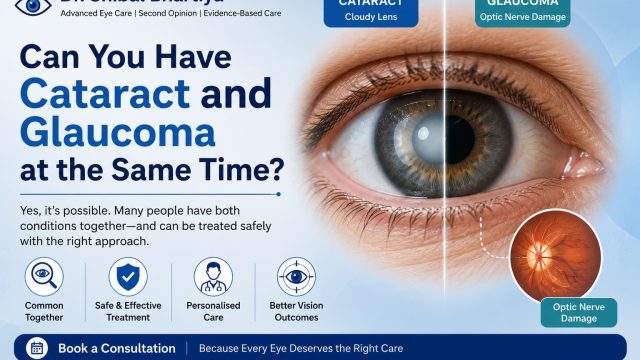
Quick Answer: Yes, you can have cataract and glaucoma in the same eye, and this happens often after age 60. Cataract surgery clears the cloudy lens but cannot reverse optic nerve damage from glaucoma.
Both conditions become more common with age. In my clinic, I often see both in the same eye in patients in their sixties and seventies.
Having both changes how I test, treat and time surgery. A cataract blurs vision and makes glaucoma tests less reliable. It can also crowd a narrow drainage angle. So my first job is to work out which condition is causing which problem.
Are Cataract and Glaucoma Related?
Mostly, no. Cataract clouds the lens. Glaucoma damages the optic nerve. They overlap because both follow age, not because one causes the other. A few links do exist:
- Narrow drainage angles. A thick, swollen lens can crowd the angle and raise eye pressure. Removing the cataract can then help.
- Pseudoexfoliation. This flaky deposit can block drainage and cause glaucoma. It can also weaken the fibres that hold the lens, which changes how I plan surgery.
- Steroids. Long-term steroid use, in drops, tablets or injections, can cause cataract and raise eye pressure.
How Do I Know Whether Cataract or Glaucoma Is Blurring My Vision?
Symptoms overlap, so an examination decides. These patterns show what to ask your doctor.
| Symptom | What It Means | What To Do About It |
|---|---|---|
| Hazy, foggy vision with glare, and stable eye pressure and visual fields | Most likely the cataract | Plan cataract surgery once it limits daily life. Keep glaucoma checks on schedule. |
| Missing patches at the side, with fairly clear central vision | Typically glaucoma, not cataract | Book a visual field test and OCT. Do not wait for blur to appear. |
| Blur plus a worsening visual field test | Glaucoma progression, cataract, or both | Repeat the field test. A dense cataract can exaggerate field loss, so compare it with your OCT. |
| Eye pressure rising despite regular drops | Drops falling short, or the lens crowding a narrow angle | Ask for gonioscopy to check the drainage angle. Ask whether the lens is contributing. |
| Poor quality OCT or visual field printouts | A dense cataract is degrading the tests | Your surgeon may advise cataract surgery to get reliable baseline tests. |
| Frequent glasses changes, colours looking faded or yellow | Usually the cataract progressing | Ask for a glaucoma stability check at the same visit. |
How Does Glaucoma Change Cataract Surgery?
Glaucoma does not rule out cataract surgery. It changes the plan in five ways:
- Pressure checks. Cataract surgery can cause a short rise in eye pressure. In a glaucoma eye, I watch this closely in the first days.
- Drops. I may adjust or pause some glaucoma drops around surgery. Never stop them on your own.
- Incision planning. If you may need glaucoma surgery later, I plan the incision to keep those options open.
- Lens choice. Multifocal lenses can reduce contrast sensitivity. I advise caution with them in glaucoma, especially advanced disease.
- Test timing. A freshly operated eye can give unreliable fields and OCT readings. I repeat them a few weeks later to set a new baseline.
I explain the steps before and after surgery in Cataract in Glaucoma Patients. Lens options are in Premium Lenses for Cataract Surgery in Gurgaon.
Will Cataract Surgery Cure My Glaucoma?
No. Cataract surgery cannot reverse optic nerve damage. Damage that already exists stays. It can still help in two ways:
- Eye pressure often falls a little after surgery. Some patients then need fewer drops.
- In narrow-angle eyes, removing the lens deepens the drainage angle. In the EAGLE trial, clear lens extraction gave better results than laser iridotomy in many people with angle-closure glaucoma (Azuara-Blanco A et al, Lancet 2016;388:1389-1397).
You may want to know more about Dr Bhartiya’s published article on Cataract Surgery in Eyes with Previous Glaucoma Surgery: Pearls and Pitfalls, available on Pubmed.
When Does Combined Cataract and Glaucoma Surgery Make Sense?
Sometimes I treat both in one operation. I consider it when:
- Glaucoma stays uncontrolled on the drops you tolerate, and the cataract also limits your vision.
- Angle-closure risk is present, since lens removal helps open the angle.
- A MIGS device can go in through the same incision as the cataract lens.
- You prefer one recovery period, and your glaucoma stage allows it.
Many patients need only cataract surgery and continue their drops. Combined surgery also lowers pressure less than a stand-alone glaucoma operation. I reserve it for patients whose glaucoma needs only a modest pressure drop. Read more about MIGS and glaucoma surgery.
Please read Dr Bhartiya’s review article on Evaluating glaucoma surgeries in the MIGS context on Pubmed.
When Should I See a Doctor?
See a Doctor Urgently
- Sudden severe eye pain with headache, nausea or vomiting
- Sudden halos around lights with a red, hazy eye
- Sudden, large loss of vision over hours or days
- Worsening pain, redness or vision after any eye procedure
See a Doctor
- Slow blur, glare or trouble driving at night
- Bumping into objects on one side, or family noticing missed side vision
- Frequent glasses changes
- Eye pressure above your target at recent visits
- Side effects that make you skip your drops
- Cataract surgery planned, but your glaucoma tests are not recent
What Can I Do Before My Visit?
- Use your glaucoma drops on schedule, even while cataract surgery is being planned.
- Bring every old visual field, OCT report and drop name. I compare old and new tests directly.
- Tell your surgeon about all medicines, including steroids and prostate medicines such as tamsulosin. These change how the pupil behaves in surgery.
- Ask at each visit whether your vision loss comes from cataract, glaucoma, or both.
Home Measures That Help
- Take glaucoma drops exactly on schedule, even if cataract surgery is being planned — don’t self-pause them
- Keep a simple log of your eye pressure readings if you’re being monitored closely around the time of cataract evaluation
- Bring your current visual field and OCT reports to every consultation, so old and new tests can be compared properly
- Ask specifically whether your vision changes are being attributed to cataract, glaucoma, or both, at each visit
Frequently Asked Questions
Is cataract surgery safe if I have glaucoma?
Yes, in most patients. The operation carries a similar low risk with or without glaucoma. The difference is closer follow-up, because a pressure rise matters more in an eye with optic nerve damage. Advanced glaucoma needs extra planning, so tell your surgeon your glaucoma type, your drops and any earlier glaucoma surgery.
Will my vision be 100% after cataract surgery if I have glaucoma?
Not always. Surgery restores the clarity the cataract took away. It cannot restore vision lost to glaucoma. If your glaucoma is advanced, I tell you before surgery what improvement to expect. Most patients still notice clearer, sharper vision.
Do glaucoma eye drops cause cataract?
Standard glaucoma drops, including prostaglandins and beta-blockers, are not major causes of cataract. Steroids are a well-known cause. Earlier trabeculectomy can also speed cataract growth in some patients. Your surgeon usually discusses this trade-off before that operation.
Should I stop my glaucoma drops before cataract surgery?
Not on your own. Your surgeon may adjust or pause specific drops around surgery day. Stopping drops without advice can let eye pressure rise. Ask for a written drop plan before the operation.
What is combined cataract and glaucoma surgery?
It is one operation that removes the cataract and lowers eye pressure, often with a MIGS device. Both steps use the same incision, so you recover once. It suits selected patients, not everyone with both conditions.
Key Takeaways
- Cataract and glaucoma often coexist after age 60, but they usually arise independently.
- A cataract can make glaucoma tests less accurate, so separating the two matters.
- Cataract surgery cannot reverse glaucoma damage, though it can lower pressure a little.
- Combined surgery with a MIGS device suits selected patients, not everyone with both.
- Never pause glaucoma drops around surgery without your surgeon’s advice.
Discuss Your Cataract and Glaucoma With Dr Shibal Bhartiya
Told you have a cataract, and you also have glaucoma, or, you’re managing glaucoma and have also been told you have a cataract? I can help you understand how the two are interacting in your specific eyes — and whether medical management, cataract surgery alone, or a combined approach is the right path for you.
If you have both cataract and glaucoma, a detailed assessment can help determine the right treatment approach for each condition. Book a consultation at my clinic in Gurgaon for personalised, evidence-based eye care and a clear plan for protecting your vision.
Book an Appointment →
📍 Gurgaon 📞 +91 88826 38735 | 🌐 Contact Us | Second Opinion Form for teleconsults
This page is a part of the Glaucoma Hub. you may want to read about Glaucoma Progression, and Risk Stratification in Glaucoma. You may want to read more about OCT and Visual Field, Glaucoma Tests Explained, Normal OCT but Vision Symptoms and How to Understand Your OCT Better. Also of help could be Why Do I Need a Visual Field Test? Glaucoma Diagnosis in Gurgaon, Get a Glaucoma Second Opinion in Gurgaon and Get an Online Glaucoma Consult.
This article is part of the Cataract Hub. Read more Cause of cataract, Cataract Surgery, Cataract Surgery Does Not Protect You From Glaucoma, Femtosecond Laser Cataract Surgery: Contraindications, Femtosecond Laser-Assisted Cataract Surgery, Cataract Surgery , Cataract in Glaucoma Patients, Is Cataract Surgery Painful?, Vision Not Clear After Cataract Surgery? What It Really Means, Second opinion Before Cataract Surgery, Which Lens is Best for Cataract Surgery, and Premium Lenses for Cataract Surgery in Gurgaon.
You can also watch these videos to understand more, here and here
About the Author
This article was written by Dr Shibal Bhartiya, fellowship-trained glaucoma specialist and Mayo Clinic Research Collaborator, Clinical Director at Marengo Asia Hospitals, Gurugram, known for ethical, patient-centred glaucoma care and independent glaucoma second opinions. She is also the Program Director for Community Outreach & Wellness; and for the Marengo Asia International Institute of Neuro and Spine.
She has published peer-reviewed research on glaucoma management, examining how treatment decisions should balance medical evidence, patient preferences, and long-term vision outcomes.
As Editor-in-Chief of Clinical and Experimental Vision and Eye Research and Executive Editor of the Journal of Current Glaucoma Practice (Pubmed Indexed, official journal of the International Society of Glaucoma Surgery), Dr Shibal Bhartiya brings editorial and research depth to every clinical decision. Her 200+ publications, including 90+ PubMed-indexed publications and 28 edited textbooks span glaucoma biology, surgical outcomes, health equity, and emerging diagnostics.
1700+ Five Star Patient Reviews Google Business Profile
If you are unable to come to Dr Bhartiya’s clinic: Read more about teleconsultation
Read her research on PubMed | Google Scholar | ResearchGate | ORCID | Github
📋Upload your reports for a structured review.| 🌐 Contact Us| 📞 +91 88826 38735
⭐ Helped by this article? Leave a Google review — it helps other patients find reliable eye care.
Last Reviewed: November 2026