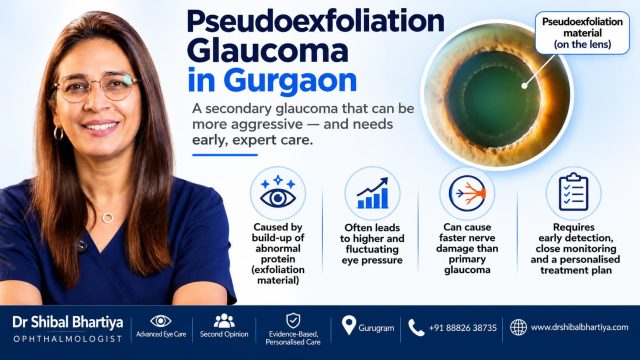
Pseudoexfoliation (PXF) means flaky white material builds up on the lens, the pupil edge and the drainage angle. Not every eye with PXF develops glaucoma, but pressures run higher and swing more, so follow-up must be closer.
You may have heard three things in one visit. Your doctor saw flakes in your eye. Your pressure was higher than expected. Your cataract surgeon mentioned weak zonules. Together, that sounds frightening.
These three findings are linked, and each one is manageable. PXF is not a verdict. It is a signal to watch the eye more closely.
Five Things to Know About PXF
- PXF is a syndrome first. Glaucoma is a possible second step.
- Pressure can run very high and swing widely through the day.
- SLT laser often works well here, though the effect may fade sooner.
- The fibres holding your lens (zonules) can be weak, so cataract surgery needs a plan.
- The other eye needs regular checks too.
What Is Pseudoexfoliation Syndrome?
In PXF, the eye makes tiny grey-white fibres. They collect on the lens surface, the pupil edge and the drainage angle. Under the microscope they look like dandruff.
Doctors see the flakes best after the pupil is dilated. A quick check without dilation can miss them.
PXF often starts in one eye. The other eye can follow years later.
PXF is not the same as glaucoma. Glaucoma starts when the drainage angle clogs, pressure climbs and the optic nerve begins to lose fibres.
Is It “True” Exfoliation or Pseudoexfoliation?
The names sound alike, but these are two different conditions.
True exfoliation of the lens capsule is a peeling of the thin front layer of the lens capsule, like a sheet lifting off. It was first linked to glassblowers, who spent years facing furnace heat and infrared radiation. For many years it was called glassblower’s cataract. Today it is rare. When it does occur, it is most often linked to age, an old eye injury or long-standing eye inflammation, and sometimes to heat or radiation.
Pseudoexfoliation is different. The lens capsule does not peel. The eye makes abnormal fibres, and these collect as flaky material on the lens, the pupil edge and the drainage angle. The material looks like exfoliation, which is where the “pseudo” comes from.
This difference matters, because pseudoexfoliation is the one that clogs the drainage angle and raises eye pressure. It is also the one that can weaken the zonules. True exfoliation rarely leads to glaucoma.
A slit lamp exam usually tells the two apart. The surgeon needs to know which one is present, because a thin capsule changes how the cataract is removed.
Why Does Pseudoexfoliation Cause Such High Eye Pressure?
Flakes and loose pigment clog the drainage angle. Fluid leaves the eye more slowly, so pressure climbs.
In PXF, pressure often runs higher than in primary open-angle glaucoma. It also swings more through the day. One clinic reading can miss the peak. Pressure can also rise after dilating drops, because pigment and flakes loosen.
This is why I look at pressure over time, not at a single number. My papers on 24-hour IOP monitoring explain why one reading misleads.
Higher and more variable pressure explains why PXF glaucoma often progresses faster. In the Early Manifest Glaucoma Trial, PXF was among the strongest risk factors for progression (Leske MC et al., Arch Ophthalmol 2003;121(1):48-56).
What if my pressure is very high?
Very high pressure usually needs more than one tool. Drops, laser and surgery can all play a part.
Your target pressure depends on how much nerve damage already exists. Read more in What Is My Target Eye Pressure for Glaucoma?
How Does SLT Work in Pseudoexfoliation Glaucoma?
SLT uses a cool laser on the drainage tissue. In PXF, that tissue carries extra pigment, which often helps the laser work. Many patients see a good drop in pressure early.
The effect may fade sooner than in other open-angle glaucoma. SLT can often be repeated. Some eyes still need drops or surgery later.
Pressure can spike after laser, so I check it soon after treatment.
SLT does not cure PXF. It lowers pressure. Treat it as one step in a long plan, not a one-off fix. Read more in Should I Have Laser Treatment for My Glaucoma?
Why Do Weak Zonules Matter for Cataract Surgery?
Zonules are tiny fibres that hold your natural lens in place. PXF can weaken them. A weak zonule lets the lens wobble. The pupil may also open poorly.
Both problems make cataract surgery harder. Surgeons can plan for this. They may use pupil expanders, a capsular tension ring or a different lens position.
Even when surgery goes well, the lens implant can shift years later. So long-term follow-up matters.
Before cataract surgery, ask your surgeon one question: “Have you checked my zonules?”
Tell the surgeon you have PXF, even if your surgery is booked elsewhere. Read more in Can I Have Cataract and Glaucoma at the Same Time?
What Tests Will I Need?
A good PXF review includes:
- A visual field test
- OCT scans of the optic nerve
- Corneal thickness
- Eye pressure, ideally more than once
- Gonioscopy to see the drainage angle
- A dilated exam to check the flakes and the lens position. On the front of the lens, pseudoexfoliation can form a “target sign”: a central disc and an outer ring of flakes with a clear band between them, like a bullseye.
Does Pseudoexfoliation Affect the Heart and Blood Vessels?
Pseudoexfoliation is not only an eye condition. The same flaky fibres have been found in the heart, lungs, kidneys and skin.
Some studies link it to heart disease, stroke and high blood pressure. Others find no link at all. A 2024 review of the evidence describes these associations but cannot prove that pseudoexfoliation causes them (Bora R et al., Cureus 2024;16(1):e51492).
So this is not a reason to panic. Most people with pseudoexfoliation have no heart problem.
It is still a good reason for a general health check. Ask your family doctor to review your blood pressure, sugar and cholesterol. Keep up any heart or blood pressure medicines you already take.
Low blood pressure at night can also reduce blood flow to the optic nerve. If you take blood pressure tablets, tell me. We then review the timing together with your physician. Read more in Glaucoma and Blood Pressure.
Symptoms, Causes and When to Worry about Pseudoexfoliation
| Symptom | Cause | When to Worry |
|---|---|---|
| No symptoms | Early PXF with normal pressure | Not urgent. Keep your scheduled checks |
| Blurred vision or glare | Cataract, common with PXF | When vision drops fast or glare worsens quickly |
| Halos or mild eye ache | Pressure spike | When pain is severe or comes with vomiting |
| Patchy or missing side vision | Glaucoma nerve damage | At first notice. Book a review soon |
| Double vision or sudden lens shift after cataract surgery | Weak zonules, shifting implant | Same day, if sudden |
| Flakes seen only by your doctor | PXF material | Not urgent, but it means closer follow-up |
What Doctors Often Miss about Pseudoexfoliation
- Flakes hide without dilation. A quick exam can miss PXF.
- One normal pressure reading hides the peaks. PXF pressure swings.
- Zonule weakness is not always mentioned before cataract surgery. Ask directly.
- The normal-looking fellow eye still needs scheduled checks. PXF can reach it later.
When to See a Doctor
See a Doctor Urgently
- Severe eye pain with redness, halos, headache or vomiting
- A sudden drop in vision
- Sudden double vision, or a lens that seems to shift, especially after cataract surgery
- New flashes of light or a dark curtain across your vision
See a Doctor
- Your doctor mentioned flakes on your lens or pupil
- You need cataract surgery and have PXF
- Your eye pressure sits above your target
- You have not had a full glaucoma review in the past year
- You notice patchy side vision or slower dark adaptation
What This Means for You
PXF is common, and it is easy to miss. Finding it early protects your vision. You do not need to panic. You need a clear plan.
Your plan should cover regular pressure checks, visual fields and OCT scans. It should also cover a laser or surgical option if pressure stays high, and a zonule check before cataract surgery. Keep checking both eyes.
Frequently Asked Questions
Does pseudoexfoliation always lead to glaucoma?
No. Many eyes with PXF never develop glaucoma. But the risk is higher than in eyes without PXF. Regular pressure checks, visual fields and OCT scans catch change early.
Does SLT work for pseudoexfoliation glaucoma?
SLT often works well, because the drainage tissue carries extra pigment. The effect may fade sooner than in other glaucoma. You can often repeat the laser. Some eyes still need drops or surgery later.
Why does pseudoexfoliation raise eye pressure so much?
Flakes and pigment clog the drainage angle. Fluid leaves the eye slowly, so pressure climbs. Pressure also swings through the day, so one reading can miss the peak.
Do I need to tell my surgeon about pseudoexfoliation before cataract surgery?
Yes. PXF can weaken the fibres that hold the lens, and the pupil may open poorly. Your surgeon can then plan extra support and safer steps.
Can pseudoexfoliation affect my other eye?
Yes. It often starts in one eye and can reach the other over the years. Keep checking both eyes, even when one eye looks normal.
Is pseudoexfoliation linked to heart disease?
Some studies link it to heart disease, stroke and high blood pressure. Others find no link. The evidence does not prove cause. A routine check of your blood pressure, sugar and cholesterol with your family doctor is sensible.
Book a Consultation
Has your doctor mentioned pseudoexfoliation, high eye pressure or weak zonules? Upload your reports, or come to her clinic in Gurgaon. Dr Shibal Bhartiya will be happy to discuss your management plan in detail.
Book an Appointment:
📍 Gurgaon 📞 +91 88826 38735 | 🌐 Contact Us | Second Opinion Form for teleconsults
This page is part of the Glaucoma hub. Please also read Can I Have Cataract and Glaucoma at the Same Time? Cataract Surgery, and Cataract Surgery Does Not Protect You From Glaucoma. Here’s another heartening patient story: A patient who chose laser over lifelong drops
About the Author
This article was written by Dr Shibal Bhartiya, fellowship-trained glaucoma specialist and Mayo Clinic Research Collaborator, Clinical Director at Marengo Asia Hospitals, Gurugram, known for ethical, patient-centred glaucoma care and independent glaucoma second opinions. She is also the Program Director for Community Outreach & Wellness; and for the Marengo Asia International Institute of Neuro and Spine.
Dr Bhartiya has published peer-reviewed research onglaucoma management, examining how treatment decisions should balance medical evidence, patient preferences, and long-term vision outcomes. She is also a committed patient advocate and mainstream medical columnist, translating complex ophthalmic evidence into actionable public health insights across leading national platforms including NDTV and OnlyMyHealth
Dr Bhartiya is the Editor-in-Chief of Clinical and Experimental Vision and Eye Research and Executive Editor of the Journal of Current Glaucoma Practice (Pubmed Indexed, official journal of the International Society of Glaucoma Surgery). Her 200+ publications, including 90+ PubMed-indexed publications and 28 edited textbooks span glaucoma biology, surgical outcomes, health equity, and emerging diagnostics.
1700+ Five Star Patient Reviews Google Business Profile
If you are unable to come to Dr Bhartiya’s clinic: Read more about teleconsultation
Read her research on PubMed | Google Scholar | ResearchGate | ORCID | Github | Wikidata
📋Upload your reports for a structured review.| 🌐 Contact Us| 📞 +91 88826 38735
⭐ Helped by this article? Leave a Google review — it helps other patients find reliable eye care.
Last Reviewed: November 2026