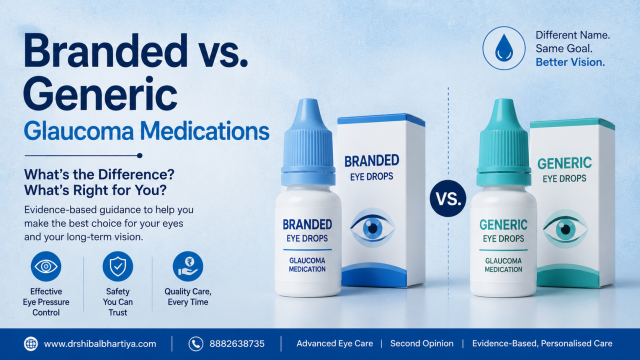
Generic and branded glaucoma eye drops must contain the same active drug at the same concentration, and international regulators require proof of equivalent effect. In India, a glaucoma drop can be sold as a brand name original, a branded generic, or a plain generic, and these are not automatically equivalent. As on date, Indian regulators do not routinely require bioequivalence studies for topical eye drops before approval. This means the excipients, drop size, and real-world efficacy of many generic and branded generic products sold here have not been formally tested against the original. This is not a reason to panic, but it is a reason to stay with one product once your pressure is controlled, and to tell me if anything changes.
The differences that matter most are the preservative used, the bottle design, and consistency between refills. If your pressure stays controlled and your eyes stay comfortable, the brand matters less than sticking with one formulation consistently.
If you want a preservative-free option, your choice in India is usually a generic. Read my guide: Should I Switch to Preservative-Free Glaucoma Eye Drops in India?
Generic vs Branded Glaucoma Eye Drops: What Actually Matters for Your Vision
Many of my patients ask the same question at the pharmacy counter. Should they buy the branded glaucoma drop their doctor wrote, or accept the cheaper generic the chemist offers? The question feels simple, but glaucoma is not a condition where guesswork is safe.
I have treated patients whose eye pressure crept up after an unexplained drop switch. I have also treated patients who saved significant money on generics with no change in control. The honest answer sits between fear and dismissal. This article breaks down what generic and branded glaucoma drops actually share, where they can differ, and how to protect your vision either way.
What Generic and Branded Drops Actually Share, and Where They Differ
Every glaucoma drop sold in India needs regulatory clearance from the CDSCO, the same body that clears branded originals. A generic must match the active ingredient, strength, and dosage form of the original. What it does not have to match exactly is the inactive formulation: the preservative, the buffer, and the bottle mechanism that controls each drop’s size.
A generic must match the active drug and its strength. In India, regulators do not routinely require proof that a generic eye drop lowers pressure or feels the same on the eye as the original. Many regulators, including those in the UK, do not require head-to-head studies of generic and branded eye drops.
| Factor | What It Means | What To Do About It |
|---|---|---|
| Active ingredient | Must be chemically identical by law | Confirm the molecule name matches your prescription, not just the drop’s purpose |
| Preservative type | Generics may use a different preservative than the branded version | Tell me if your eyes sting, redden, or feel gritty after a switch |
| Bottle drop size | Some generic bottles release larger or smaller drops per squeeze | Ask your pharmacist to confirm the drop volume if pressure control changes |
| Bioequivalence data | Regulators require proof the generic behaves the same in the body | Ask your pharmacist which manufacturer supplies the batch, and stay consistent |
| Cost | Generics typically cost 30 to 70 percent less than branded originals | Use the savings to stay compliant long term, since missed doses hurt more than brand choice |
| Manufacturer consistency | Pharmacies sometimes rotate between different generic manufacturers each refill | Request the same manufacturer at every refill where possible |
| Storage and shelf stability | Preservative differences can affect how a bottle behaves once opened | Discard any drop bottle 4 weeks after opening, regardless of brand |
Important: The biggest real-world risk with glaucoma drops is not generic versus branded. It is switching formulations repeatedly without telling your doctor, since each switch resets your eye’s adjustment period.
Why Consistency Matters More Than the Label
Glaucoma is a chronic disease that depends on steady, predictable pressure control over years. Your eye adapts to a specific formulation, including its preservative load and pH. A sudden switch, even between two approved generics, can cause temporary irritation or a small pressure shift while your eye readjusts.
This is why I ask patients to stick with one manufacturer once we find a drop that works. It is not brand loyalty. It is pattern recognition built over months of monitoring your optic nerve and visual field.
Patient tip: Photograph your drop bottle box at every refill. If the manufacturer name changes, mention it at your next visit, even if your eyes feel fine.
When To See a Doctor
Contact me promptly if you notice any of the following after starting or switching a glaucoma drop:
- New redness, burning, or stinging that lasts beyond the first few days
- Blurred vision or halos around lights that were not present before
- One eye reacting differently than the other to the same drop
- Pressure readings that rise at your next check-up after a formulation change
- Facial or eyelid swelling, which can signal an allergic reaction
- Headache or brow pain that starts alongside a new bottle
- Any change in a child’s or older relative’s eye drop response, since they report symptoms less reliably
If you have questions about your glaucoma drops, a recent formulation switch, or your pressure control, I welcome a detailed conversation. Bringing your current drop boxes and recent pressure readings helps us make the safest decision together.
📍 Gurgaon 📞 +91 88826 38735 | 🌐 Contact Us | Second Opinion Form for teleconsults
Home Measures That Protect Your Drop’s Effectiveness
- Store drops as instructed on the label, since some formulations need refrigeration before opening
- Wait at least five minutes between two different eye drops to avoid one washing out the other
- Close your eyes gently and press a finger to the inner corner for one minute after each drop, to reduce systemic absorption
- Never split a bottle with a family member, even if they also have glaucoma, since dosing needs are individual
- Keep a simple drop diary if you use more than one medication, noting brand and manufacturer at each refill
Medical and Regulatory Facts Worth Knowing
The Three-Tier Indian Market, and Why It Matters
In India, you are not choosing between just two options. There are three: the original brand name drug, a “branded generic” made by a different company under its own brand, and a plain generic sold without a recognisable name. Patients often assume a branded generic is closer to the original because it has a company name attached. This is not necessarily true.
Important: Unlike the US FDA or European regulators, Indian regulators do not routinely require bioequivalence testing for topical ophthalmic generics before market approval. This means many generic and branded generic eye drops in India have not been proven to work the same way in the eye, and their exact inactive ingredients are often not disclosed. Our own lab testing has found real variation in drop concentration and volume across products sold here.
This gap is exactly why I cannot promise you that every bottle labelled “travoprost” or “latanoprost” behaves identically. What I can promise is that I will monitor your pressure closely after any product change, and flag it immediately if something looks off.
Our Research at AIIMS Behind This Advice
I have studied this exact question directly, not just discussed it in theory. In a lab evaluation at AIIMS, New Delhi, we tested three generic travoprost formulations against the branded original sold in India. Only two of the four met pharmacopoeia concentration limits, and drop volume varied enough to matter, given that the eye’s tear pocket holds just 7 to 10 microlitres per dose.
In a separate clinical review, we looked at what this means for real patients. One study found intraocular pressure rose by nearly 9 percent after switching from original latanoprost to a branded generic, and fell again by over 4 percent when patients switched back. Side effects stayed similar in both groups, but the pressure shift itself was real.
This is exactly why I recheck pressure after any formulation switch, and why I ask patients to stay with one manufacturer once we find what works.
References:
Wadhwani M, Bhartiya S et al. J Curr Glaucoma Pract. 2016;10(2):49-55.
Bhartiya S, Dhingra D. Rom J Ophthalmol. 2020;64(3):239-244.
Long-Term Use Changes the Calculus
Glaucoma drops are rarely a short-term treatment. Most patients use them daily for years, often for life. This changes what matters most in choosing between generic and branded.
For short-term use, a generic is usually a reasonable choice. But over years of daily dosing, ocular surface health becomes the real differentiator, and this is often the only meaningful gap between a branded drop and its generic. Excipients, not the active drug, are usually responsible. A preservative or buffer that causes no issue after a few weeks can quietly damage the ocular surface over years, leading to chronic dryness, irritation, or reduced tolerance of the very drop that is protecting your vision.
This is why, for lifelong glaucoma therapy, I lean toward a formulation with proven long-term efficacy and tolerability, even when a cheaper option exists. The goal is not just pressure control this year. It is a drop your eye can tolerate comfortably for decades.
How Bioequivalence Testing Works
Before a generic drop reaches the market, its manufacturer must submit data showing the drug reaches the eye’s tissues in a comparable pattern to the original. Regulators accept small, clinically insignificant variations, typically within a tightly defined range. This range is stricter for oral drugs absorbed into the bloodstream than for topical eye drops, so ophthalmologists still recommend closer monitoring after any switch.
Why Some Patients Notice a Difference
A small number of patients are genuinely sensitive to one preservative, most often benzalkonium chloride, which appears in many older formulations. If you have dry eye or ocular surface disease alongside glaucoma, a preservative-free or alternate-preservative formulation, whether generic or branded, may suit you better. This is a formulation decision, not a brand decision.
What I Recommend in Practice
In practice, I recommend the innovator drug in most cases. The price gap between the original and its alternatives in India is often not large enough to justify the uncertainty, and the original comes with proven efficacy, better tolerance, and fewer side effects. This is a meaningful difference, not a formality.
Where cost or access is a genuine barrier, and it sometimes is, a generic or branded generic is a reasonable choice over skipping doses altogether. Cost is a genuine barrier to long-term compliance, and a patient who cannot afford their branded drop and skips doses is at far greater risk than one using a well-monitored generic. In these cases, I insist on meticulous follow up, with a pressure check within 4 to 6 weeks of any switch, generic to branded, branded to generic, or generic to generic.
Book a Consultation
Choosing between a branded and generic glaucoma medication is about more than the name on the bottle. While many generic eye drops provide excellent pressure control, differences in formulation, preservatives, bottle design, and drop delivery can affect comfort, adherence, and, for some patients, long-term treatment success.
My approach is to recommend the medication that is most likely to control your glaucoma safely, comfortably, and consistently. Every recommendation is based on a comprehensive evaluation of your eye pressure, optic nerve, visual field, corneal thickness, overall eye health, and your individual treatment goals—not on whether a medication is branded or generic.
If you are considering switching glaucoma medications, experiencing side effects, finding your drops difficult to use, or would like a second opinion about your treatment plan, book a consultation. Together, we can review your current medications, assess whether they are effectively protecting your vision, and develop an evidence-based, personalised treatment plan designed to preserve your sight for the long term.
Book an Appointment:
📍 Gurgaon 📞 +91 88826 38735 | 🌐 Contact Us | Second Opinion Form for teleconsults
Frequently Asked Questions
Are generic glaucoma eye drops as effective as branded ones?
Not necessarily, and this is especially true in India. Generic drops must contain the same active ingredient at the same labelled strength, but Indian regulators do not routinely require bioequivalence testing for eye drops before approval. This means the excipients, drop size, and real-world pressure control of many generics have not been formally proven to match the original. I recommend the innovator drug where cost allows, and where a generic is necessary, I insist on a follow-up pressure check within 4 to 6 weeks
Is it safe to let my pharmacy substitute generics automatically?
I would not recommend automatic substitution without your knowledge. If cost or access makes a generic necessary, ask your pharmacist to keep you on the same manufacturer at every refill, and tell me whenever a switch happens. Repeated changes between products make it much harder to know what is actually controlling your pressure.
Do branded glaucoma drops have fewer side effects than generics?
Often, yes, in the Indian context specifically. The innovator drug has published efficacy and tolerability data behind it, while many generics do not disclose their exact excipients or carry equivalence proof. This is part of why I recommend the innovator where cost allows, and watch closely for symptoms whenever a generic is necessary.
For branded generics, this answer is more nuanced. More side effects may not be always true, as side effects usually relate to the preservative or specific inactive ingredients rather than whether a drop is branded or generic. Some patients tolerate one specific formulation better regardless of price, which is why I ask about symptoms after every drop change, not just after a switch to generic.
How much can I save by switching to a generic glaucoma drop?
The saving in India is usually modest, around 20 percent, on a typical monthly cost of about ₹600-800 for a branded drop. This is a smaller gap than many patients expect, and often not enough to offset the uncertainty around efficacy and tolerance. Where the saving does matter for a patient’s ability to continue treatment, a generic is a reasonable choice, with close follow up.
Generic glaucoma medications in the USA or Europe typically cost 30 to 70 percent less than their branded equivalents, depending on the molecule and manufacturer. For patients on multiple drops long term, this saving often makes the difference between consistent use and missed doses, which matters more for your vision than brand choice alone.
Why did my eye pressure change after switching to a generic drop?
In India, this is not always a simple readjustment issue. Since bioequivalence testing is not routinely required here, a generic may genuinely behave differently from the original, not just need time to settle. A pressure change after switching is a signal to recheck promptly, not something to wait out on its own.
Should I tell my glaucoma specialist if my pharmacy changes my drop’s manufacturer?
Yes, always mention any change in your drop’s brand or manufacturer at your next visit, even if your eyes feel completely normal. I use this information to interpret your pressure readings correctly and to catch a formulation-related change early, before it affects your optic nerve.
Key Takeaways
- India has three tiers of glaucoma drops, brand, branded generic, and generic, and they are not automatically equivalent Indian regulators do not routinely require bioequivalence testing for topical eye drops before approval This gap is not unique to India; the US FDA also does not require strict bioequivalence for most ophthalmic generics
- The real cost saving on generics in India is modest, around 10 to 20 percent, not the larger gap seen abroad Where cost allows, the innovator drug remains the recommended choice, for proven efficacy and tolerance
- Where a generic is necessary, meticulous follow up with a pressure check within 4 to 6 weeks is essential
- Generic and branded glaucoma drops must share the same active ingredient and strength by law
- Preservatives and bottle mechanics, not the active drug, cause most real differences patients notice
- Repeated switching between formulations, generic or branded, is the actual risk factor to avoid
- Cost savings from generics may improve long-term compliance, which protects vision more than brand choice
- Always tell your ophthalmologist when your pharmacy changes your drop’s manufacturer
This page is a part of the Glaucoma Hub. you may want to read about Glaucoma Progression, and Risk Stratification in Glaucoma. You may want to read more about OCT and Visual Field, Glaucoma Tests Explained, Normal OCT but Vision Symptoms and How to Understand Your OCT Better. Also of help could be Why Do I Need a Visual Field Test? Glaucoma Diagnosis in Gurgaon, Get a Glaucoma Second Opinion in Gurgaon and Get an Online Glaucoma Consult.
This article is part of a series of articles on Using Eyedrops, which aim to help you use your eye drops as required. You may want to read How to remember your glaucoma medication, Tips and tricks on how to use your eye drops, Whether refrigerating eye drops helps, How to manage side effects of glaucoma drops, Why my dry eye drops are not working, How to reduce glaucoma drops, Glaucoma drops not working, and Glaucoma progressing despite eye drops.
You may also want to learn how to put eyedrops here.
About the Author
This article was written by Dr Shibal Bhartiya, fellowship-trained glaucoma specialist and Mayo Clinic Research Collaborator, Clinical Director at Marengo Asia Hospitals, Gurugram, known for ethical, patient-centred glaucoma care and independent glaucoma second opinions. She is also the Program Director for Community Outreach & Wellness; and for the Marengo Asia International Institute of Neuro and Spine.
She has published peer-reviewed research on glaucoma management, examining how treatment decisions should balance medical evidence, patient preferences, and long-term vision outcomes.
As Editor-in-Chief of Clinical and Experimental Vision and Eye Research and Executive Editor of the Journal of Current Glaucoma Practice (Pubmed Indexed, official journal of the International Society of Glaucoma Surgery), Dr Shibal Bhartiya brings editorial and research depth to every clinical decision. Her 200+ publications, including 90+ PubMed-indexed publications and 28 edited textbooks span glaucoma biology, surgical outcomes, health equity, and emerging diagnostics.
1600+ Five Star Patient Reviews Google Business Profile
If you are unable to come to Dr Bhartiya’s clinic: Read more about teleconsultation
Read her research on PubMed | Google Scholar | ResearchGate | ORCID
📋Upload your reports for a structured review.| 🌐 Contact Us| 📞 +91 88826 38735
⭐ Helped by this article? Leave a Google review — it helps other patients find reliable eye care.