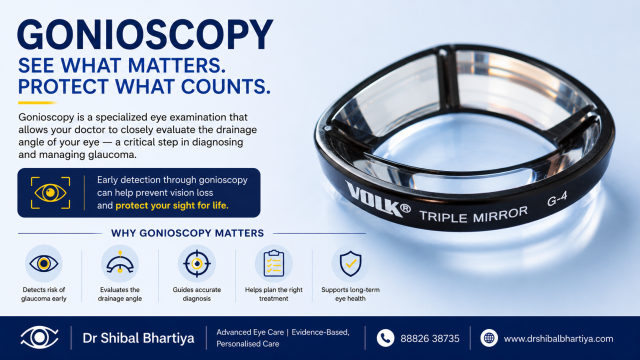
Gonioscopy is an eye test that uses a special mirrored lens placed on the eye’s surface to directly view the drainage angle. The drainage angle is the structure that determines whether glaucoma is open-angle or angle-closure. Dr Shibal Bhartiya performs gonioscopy in Gurgaon with the room lights dimmed rather than under bright slit-lamp illumination. This is because bright light constricts the pupil and can make a narrow angle falsely appear open.
Gonioscopy is the gold-standard test for classifying glaucoma. The test determines which kind of glaucoma you have. That decision determines whether your treatment is drops, laser, or urgent intervention. Which is why it is extremely important.
If you’ve been told you need a gonioscopy in Gurgaon, it’s worth knowing that not all gonioscopy is done the same way, and the difference affects whether a narrow or closing angle gets caught at all.
Dr Shibal Bhartiya is a fellowship-trained glaucoma specialist and Mayo Clinic Research Collaborator with over 25 years of experience. Her approach focuses on identifying risk before damage is irreversible, simplifying treatment decisions, and protecting vision long-term. Emphasis on early detection, risk assessment, and continuity of care. She is rated 5 stars across 1,600+ patient reviews on Google. Her PubMed-indexed research on angle-closure diagnosis speaks to her extensive work and experience in gonioscopy.
How Gonioscopy Is Done, and What It Tells Us
What you’ll experience
Your eye is numbed with anaesthetic drops, so the test itself doesn’t hurt. You may feel mild pressure but not pain. A small amount of gel is placed on a contact lens. the lens is then gently rested on the surface of your eye. You’ll be asked to look in a few different directions while I view your drainage angle through the microscope. The whole test takes about five minutes. Your vision may stay slightly blurry for 15–20 minutes afterward as the gel clears.
What the results mean for you:
- Open angle: Your drainage channel is unobstructed. If you have glaucoma, it’s open-angle glaucoma — typically managed with drops, laser, or surgery aimed at lowering pressure over time.
- Narrow or occludable angle: Your drainage channel is at risk of closing, even if it hasn’t yet. This changes the conversation from “treat glaucoma” to “prevent an acute attack” — often with a same-visit or near-term laser iridotomy.
- Closed angle: The drainage channel is blocked. This is urgent. Untreated angle closure can cause a sudden, painful pressure spike and permanent vision loss within hours to days.
- Other findings — pigment deposits, scarring (synechiae), or abnormal blood vessels. These can point to pigment dispersion syndrome, past trauma, or diabetic eye changes. Each redirects your treatment plan differently.
In short: Gonioscopy doesn’t just confirm glaucoma. It decides which kind you have, and that decision determines whether your treatment is drops, laser, or urgent intervention.
Why is Gonioscopy Important?
Gonioscopy is an eye test that visualises the drainage angle of the eye. This drainage angle is responsible for maintaining the eye pressure. Gonioscopy determines if the glaucoma is open angle, or angle closure. It’s findings depend heavily on room lighting and examiner technique. A gonioscopy done under bright slit-lamp illumination can make a narrow angle look falsely open. This is because light constricts the pupil and pulls the iris away from the drainage angle. In Gurgaon, I perform gonioscopy in a dimmed room specifically to avoid this artifact. This way, the angle is graded at its true, physiologic width, not an artificially widened one.
Why Room Lighting Changes the Result
This is one of the most under-discussed variables in glaucoma diagnosis.
When light hits the eye, the pupil constricts. A smaller pupil pulls the peripheral iris away from the trabecular meshwork, which can open up an angle that is, in normal daily conditions, narrow or intermittently closing. If your gonioscopy is done in a bright room, an angle-closure risk can be missed — graded as open when it isn’t reliably open at all.
I do gonioscopy with the room lights dimmed, so the pupil stays closer to its natural size. This is closer to how your eye actually behaves when you walk out of a bright clinic into dim evening light, or sit in a dark cinema. These are the exact conditions in which angle closure is most likely to be triggered. Where indicated, I also use dynamic (indentation) gonioscopy. This involves gently pressing the lens to distinguish a truly closed angle from one that only appears closed (appositional closure). This distinction changes management directly. It decides whether you need a laser iridotomy, monitoring, or nothing at all.
Why Experience in This Specific Test Matters
Gonioscopy is a skill-dependent test — the same eye can be graded differently by two examiners. It takes practiced technique to hold the lens steady, avoid corneal compression that distorts the view, and read subtle angle structures consistently.
Gonioscopy is a routine part of my daily glaucoma practice, not an occasional add-on test. As a fellowship-trained glaucoma and neuro-ophthalmology specialist with over 25 years in the field, and as a research collaborator with Mayo Clinic, Jacksonville, my clinical work is built around glaucoma diagnosis and long-term angle monitoring. This means I perform gonioscopy, not delegate, on nearly every glaucoma or glaucoma-suspect patient I see.
Published Research on Angle Closure
My angle-closure glaucoma work has been published in peer-reviewed journals and is indexed on PubMed, including:
- Diurnal Variation of IOP in Angle Closure Disease: Are We Doing Enough? — Romanian Journal of Ophthalmology, 2019
- Diurnal Intraocular Pressure Fluctuation in Eyes with Angle-Closure — Journal of Current Glaucoma Practice, 2015
- Evaluation of the Van Herick Technique for Screening for Occludable Angles in an African Population — Journal of Current Glaucoma Practice, 2013
- Ultrasound Biomicroscopic Assessment of Angle Parameters in Patients with Primary Angle Closure Glaucoma Undergoing Phacoemulsification — European Journal of Ophthalmology, 2011
You can view these and my other publications on PubMed and Google Scholar.
Frequently Asked Questions
Does room lighting really change my gonioscopy result?
Yes. Bright light constricts the pupil and can pull the iris away from the drainage angle, making a narrow angle look artificially open. Gonioscopy done in dim lighting reflects your angle’s true, physiologic width.
What is dynamic (indentation) gonioscopy, and do I need it?
It’s a technique where gentle pressure is applied through the lens to see whether a closed-looking angle is truly closed or only appositionally closed. It’s used selectively, when the initial view suggests possible closure. This is because it changes whether you need a laser iridotomy or just monitoring.
Is gonioscopy available in Gurgaon?
Yes. I perform gonioscopy routinely in Gurgaon as part of every comprehensive glaucoma evaluation. I specifically do it in a dark room, and do the dynamic indentation where indicated.
How is this different from gonioscopy done elsewhere?
The test itself is standardised, but technique varies. Room lighting, indentation technique, and examiner experience all affect the reading. These are the specific variables I control for in every gonioscopy I perform.
Book a Gonioscopy or Glaucoma Evaluation in Gurgaon
If you have a shallow anterior chamber, a family history of angle closure, or have simply never had your drainage angle formally assessed. A gonioscopy — done correctly — is a five-minute test that can prevent an acute angle-closure attack.
If you have been diagnosed with glaucoma, but have never had a gonioscopy, Request a Glaucoma Second Opinion →
📞 Call: +91 88826 38735 | +91 98187 00269
[Book an Appointment → contact us]
This article is part of the Glaucoma Diagnosis Hub. You may also want to read Eye Pressure Measurement, Why Do I Need a Visual Field Test? Understanding Your OCT Report in Glaucoma, Visual Field and OCT: Structure & Function Correlation, Gonioscopy, Glaucoma Progression: What It Means and How to Slow It, Do I Really Need All These Tests and Get a Glaucoma Second Opinion in Gurgaon
About the Author
This article was written by Dr Shibal Bhartiya, fellowship-trained glaucoma specialist and Mayo Clinic Research Collaborator, Clinical Director at Marengo Asia Hospitals, Gurugram, known for ethical, patient-centred glaucoma care and independent glaucoma second opinions. She is also the Program Director for Community Outreach & Wellness; and for the Marengo Asia International Institute of Neuro and Spine.
She has published peer-reviewed research on glaucoma management, examining how treatment decisions should balance medical evidence, patient preferences, and long-term vision outcomes.
As Editor-in-Chief of Clinical and Experimental Vision and Eye Research and Executive Editor of the Journal of Current Glaucoma Practice (Pubmed Indexed, official journal of the International Society of Glaucoma Surgery), Dr Shibal Bhartiya brings editorial and research depth to every clinical decision. Her 200+ publications, including 90+ PubMed-indexed publications and 28 edited textbooks span glaucoma biology, surgical outcomes, health equity, and emerging diagnostics.
1600+ Five Star Patient Reviews Google Business Profile
If you are unable to come to Dr Bhartiya’s clinic: Read more about teleconsultation
Read her research on PubMed | Google Scholar | ResearchGate | ORCID
Upload your reports for a structured review.| www.drshibalbhartiya.com | +91 88826 38735
Leave a review on Google