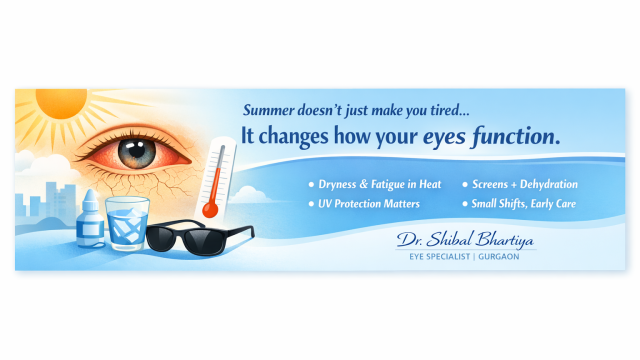
The cumulative effect of heat, dehydration, air conditioning, and screen use, acting together on the surface of the eye determines the effect of summer on your eyes. Heat does not just make you uncomfortable. It stresses every system in your body, and your eyes show that stress early, quietly, and in ways most people dismiss.
As temperatures in North India climb past 40°C each year, I see a predictable pattern in clinic. Patients arrive not with dramatic disease, but with a consistent cluster of functional complaints. Their vision checks out on the chart. Their pressure is fine. But something feels wrong.
The Economic Times recently featured Dr Bhartiya’s take on how to navigate rising temperatures and their effect on health, including what she sees playing out specifically in the eyes.
Dr Shibal Bhartiya is a fellowship-trained glaucoma specialist and Mayo Clinic Research Collaborator with over 25 years of experience. Her approach focuses on identifying risk before damage is irreversible, simplifying treatment decisions, and protecting vision long-term. Emphasis on early detection, risk assessment, and continuity of care. She is rated 5 stars across 1,500+ patient reviews on Google.
What Patients Notice in Summer
These are the symptoms I hear most often between April and July:
Eyes tiring earlier in the day. Reading or screen work that felt easy in winter now creates effort by mid-morning.
Burning or dryness that worsens indoors. Counterintuitively, air-conditioned environments accelerate tear evaporation. The cooler the room, the drier the air.
Vision that fluctuates through the day. Clear in the morning. Slightly blurred after two hours at a screen. Clear again after blinking. This is almost never a power change. It is tear film instability.
Increased light sensitivity outdoors. The corneal surface under stress scatters light differently.
A sense of effort in focusing. Not pain. Not blurred vision. Just effort, which patients often describe as eye strain or fatigue.
Most patients assume their glasses prescription has changed. A few assume it is just the season and wait. Both responses delay the simple interventions that work.
Why Heat Affects the Eyes Differently Than We Expect
The mechanism is a cascade, not a single cause.
Dehydration reduces the aqueous component of the tear film. The tear film thins, becomes unstable, and breaks up faster between blinks. Air conditioning removes humidity from indoor air, accelerating evaporation of whatever tears remain. Screen use, which increases significantly when people stay indoors to avoid heat, reduces blink rate from a normal 15 blinks per minute to as few as 5 or 6. And UV exposure outdoors adds direct surface stress to the cornea and conjunctiva.
None of these factors alone is severe. Together, in sustained summer conditions, they create functional visual discomfort that routine eye tests may not capture.
The Distinction That Matters: Seeing Clearly Versus Seeing Comfortably
A standard eye examination confirms one thing: whether you can see clearly at a given distance.
Summer often creates a different problem: the inability to sustain that clarity comfortably over time. Patients can read the chart. They cannot read a screen for four hours without discomfort. These are not the same question, and a prescription check alone does not answer the second one.
This is where surface health and tear film assessment become relevant, especially for patients who already use long-term eye drops, including glaucoma treatment, where preservative load on the surface may compound seasonal dryness.
What Actually Helps
The interventions are not dramatic. They are consistent.
Hydrate ahead of thirst. By the time you feel thirsty in Indian summer heat, you are already mildly dehydrated. Tear film instability follows quickly.
Wear UV-protective sunglasses outdoors. Not tinted lenses, proper UV-400 certified eyewear. The cornea accumulates UV damage over years, and summer amplifies acute surface stress.
Take deliberate screen breaks. Every 20 minutes, look at a distant object for 20 seconds. This is not a productivity rule, it is a blink-rate reset.
Redirect air conditioning and fan airflow. Direct airflow to the face, sustained for hours, is one of the most consistent triggers for dry eye I see in clinic. Redirect the vent. Use a humidifier if working long hours in AC.
Do not cycle through new glasses prescriptions in summer. Fluctuating vision in May is rarely a new refractive error. It is often surface instability. Confirm the surface is stable before changing a prescription.
When to See Your Doctor
If any of the following persist for more than two weeks:
- Burning or dryness that does not resolve with rest
- Vision that fluctuates consistently through the day
- Increased dependence on lubricating drops to function
- Visual fatigue that is affecting work or reading
…the right evaluation looks beyond the chart. Surface health, tear film quality, and, where relevant, whether existing treatment is contributing to surface stress, all deserve assessment.
Summer eye symptoms caught early are almost always reversible. Left to accumulate, they become chronic dry eye, and chronic dry eye is a meaningfully harder problem to manage than the conditions that created it.
Frequently Asked Questions
Why do my eyes feel dry only in summer?
Summer combines dehydration, low-humidity AC environments, higher UV exposure, and more indoor screen time. Each factor independently reduces tear film stability. Together, they create surface dryness that most people do not experience in cooler or more humid months. The eye is not structurally different, the environment it is working in is.
Can heat actually change my vision prescription?
Heat itself does not change your refractive error. Fluctuating vision in summer is almost always tear film instability. The tear layer breaks up unevenly, creating transient blur that resolves with a deliberate blink. If a prescription change is being considered in April or May, I always recommend waiting until the surface is stable and reassessing.
I use glaucoma drops. Does summer make them more irritating?
Yes, this is a common pattern. Preserved eye drops carry a chemical load on the corneal surface. When the surface is already stressed by summer dryness, even well-tolerated drops can cause increased burning or redness. This is worth reviewing with your glaucoma specialist preservative-free formulations or adjusted timing can make a significant difference.
What kind of sunglasses actually protect the eyes?
UV-400 certification means the lens blocks all ultraviolet light up to 400 nanometres. Tinted lenses without UV certification can actually worsen UV exposure. The tint causes the pupil to dilate, admitting more UV than it would in bright light without glasses. Wraparound frames offer better peripheral protection in outdoor conditions.
How much water should I drink to protect my eyes in summer?
There is no single number, but the principle is consistent: hydrate before you feel thirsty. In peak summer in Gurugram, most adults need 3–4 litres of water daily when indoors and more with outdoor activity. Coffee and alcohol are diuretics and compound dehydration. The tear film reflects systemic hydration status more quickly than most people realise.
When should I not just manage summer eye symptoms at home?
If symptoms persist beyond two weeks despite hydration, screen breaks, and avoiding direct airflow, or if vision fluctuation is affecting your work or daily function, it is worth an evaluation. The clinical question in summer is not just whether you can see, but whether your eyes can sustain that function comfortably. Those are different things.
Read the research articles
This article was written by Dr Shibal Bhartiya, fellowship-trained glaucoma specialist and Mayo Clinic Research Collaborator, Clinical Director at Marengo Asia Hospitals, Gurugram, known for ethical, patient-centred glaucoma care and independent glaucoma second opinions. She is also the Program Director for Community Outreach & Wellness; and for the Marengo Asia International Institute of Neuro and Spine. This article was updated in April 2026.
She has published peer-reviewed research on glaucoma management, examining how treatment decisions should balance medical evidence, patient preferences, and long-term vision outcomes.
As Editor-in-Chief of Clinical and Experimental Vision and Eye Research and Executive Editor of the Journal of Current Glaucoma Practice (Pubmed Indexed, official journal of the International Society of Glaucoma Surgery), Dr Shibal Bhartiya brings editorial and research depth to every clinical decision. Her 200+ publications, including 90+ PubMed-indexed publications and 28 edited textbooks span glaucoma biology, surgical outcomes, health equity, and emerging diagnostics.
Access her work on Pubmed, Google Scholar, ResearchGate and ORCID.
Dr Shibal Bhartiya
Glaucoma • Second Opinion • Advanced Care
www.drshibalbhartiya.com
+91 88826 38735
1500+ Five Star Patient Reviews Google Business Profile
Upload your reports for a structured review.
If you are unable to come to Dr Bhartiya’s clinic: Read more about teleconsultation for glaucoma