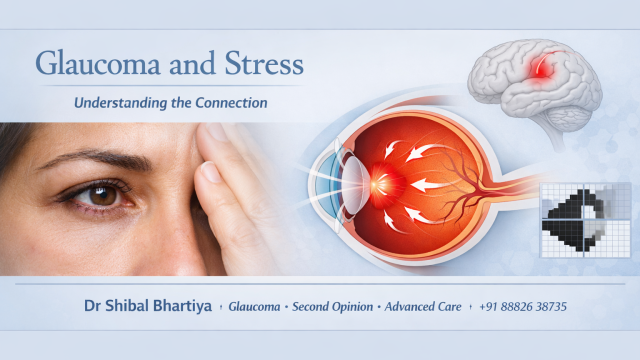
Stress can raise eye pressure briefly, but evidence that it causes or speeds up glaucoma is limited. Managing stress and sleep may help your overall care, but it never replaces drops or monitoring.
If you have glaucoma, you probably have stress too. A new diagnosis, a lifetime of drops and the fear of losing sight would stress anyone.
Many patients then ask a second question. Is my stress making my eyes worse?
The honest answer sits in the middle. Stress is not a proven cause of glaucoma. It may play a small part for some people. The larger risk is practical, because stress and poor sleep make it easier to miss drops and visits.
Dr Shibal Bhartiya is a fellowship-trained glaucoma specialist and Mayo Clinic Research Collaborator with over 25 years of experience. Her approach focuses on identifying risk before damage is irreversible, simplifying treatment decisions, and protecting vision long-term. Emphasis on early detection, risk assessment, and continuity of care. She is rated 5 stars across 1,600+ patient reviews on Google.
How Stress May Affect Glaucoma: What We Know and Do Not Know
Researchers have suggested several routes. Some are better supported than others. This table shows how strong the evidence is.
| Route | What may happen | How strong is the evidence? |
|---|---|---|
| Short-term stress or anxiety | A brief rise in eye pressure in some people | Small studies, modest effect |
| Long-term stress and raised cortisol | Higher pressure in some people | Mostly observational, so it shows links, not proof |
| Poor sleep and sleep apnoea | Possible link to glaucoma and its progression | Mixed results across studies |
| Missed drops and visits | Less treatment reaches the eye | Strong. Stress and cost are known barriers to adherence |
| Steroid medicines | Pressure rises in people who are sensitive | Well established |
The first three routes are plausible. They are not proven in people with glaucoma. The last two are where I see the clearest harm.
Stress, Cortisol and Steroids
Your body makes its own cortisol. Steroid medicines are a different matter. Steroid tablets, creams, inhalers, eye drops and injections can raise eye pressure in susceptible people.
Tell your glaucoma specialist about every steroid you use. This matters more than your stress score.
Stress, Sleep and the Optic Nerve
Sleep and glaucoma have been linked in some studies, but results are not consistent. Untreated sleep apnoea is the most discussed link.
Blood flow to the optic nerve also dips at night. Some researchers think this matters in normal tension glaucoma. Read more on glaucoma and ocular blood flow.
If your pressure looks controlled but your visual field keeps worsening, I look at sleep, snoring and night-time blood pressure. See also why glaucoma may progress despite treatment.
Does Reducing Stress Help Glaucoma?
Probably a little, and it is worth doing. The evidence is still maturing.
Yoga, meditation and breathing exercises have shown modest drops in eye pressure in small trials. Trials are small, and results vary.
In a 2014 review with my colleague from GMCH, I found little evidence behind most complementary approaches. We noted they matter most when glaucoma progresses despite good pressure control, in normal tension glaucoma, and at end stage.
More recently, my AIIMS colleague Tanuj Dada and I wrote an editorial on lifestyle medicine for glaucoma. It frames lifestyle measures as an addition to pressure-lowering treatment. In my view, they add to your drops and monitoring. They never replace them.
One safety point. Avoid head-down yoga postures and holding your breath while straining. Both can raise eye pressure. Read more in yoga and glaucoma.
What You Can Do To Decrease Stress
These steps support your care. They never replace your drops or monitoring.
- Protect your sleep. Aim for seven to eight hours at consistent times. If you snore or wake unrefreshed, ask about a sleep study.
- Move most days. Brisk walking or swimming is associated with a modest drop in eye pressure.
- Build a calm routine. Slow breathing and a wind-down hour before bed help many people. Cut screens late in the evening.
- Tie your drops to a daily habit. Link them to brushing your teeth or your morning tea. A fixed cue protects your treatment when life gets hard.
- Tell your specialist about high-stress periods. Bereavement, job loss and caring for a family member all count. Your clinic reading may not match your real 24-hour pressure.
- Know more about Coping Strategies for Living With Glaucoma
What Doctors Often Miss
- Steroid use. Many patients do not mention creams, inhalers or tablets.
- Snoring and sleep apnoea. Few glaucoma visits ask about them.
- The calm clinic reading. One measurement in a quiet room misses what happens at home and at night.
- The emotional weight of the diagnosis. Anxiety about glaucoma is common. It deserves attention. See glaucoma and depression.
When to See a Doctor
See a Doctor Urgently
Go the same day for sudden eye pain with headache or nausea, halos around lights with a red eye, or sudden loss of vision. Stress does not cause these. Do not wait or blame a bad week.
See a Doctor
Book a review if:
- Your pressure at a routine visit is higher than your usual baseline.
- Your visual field is worsening even though your pressure looks controlled.
- You have slept poorly for more than two to three weeks, or you snore heavily.
- Stress or low mood is making you skip drops or visits.
- You have new eye discomfort or headaches that do not settle.
What This Means for You
Stress is part of living with a long-term condition. It is not your fault, and it does not mean your glaucoma is out of control.
Focus on what you can do. Keep your drops and visits. Sleep well. Move daily. Tell me about your life, not only your eyes. If you are at risk but do not yet have glaucoma, see family history and glaucoma screening.
Is Stress Making Glaucoma Harder to Manage?
Talk it through with me. I will look at your pressure readings, your scans and your medicines, and ask about sleep and stress. Then I will tell you what matters for your eyes, and what does not.
Bring your recent pressure readings, visual fields, OCT scans and your list of drops. Include any steroid medicines or creams.
Book an Appointment:
📍 My clinic in Gurgaon 📞 +91 88826 38735 | 🌐 Contact Us | Second Opinion Form for teleconsults. See what to bring.
Frequently Asked Questions
Can stress cause glaucoma?
Stress alone is unlikely to cause glaucoma in a person with no other risk. In someone with a family history, raised pressure or early optic nerve changes, the link is plausible but unproven. Poor sleep and missed treatment matter more.
Does anxiety affect eye pressure?
It can, briefly. Acute anxiety can raise eye pressure for a short time in some people. The effect of long-term anxiety is less clear.
Can yoga or meditation lower eye pressure?
Small studies suggest modest drops with regular practice. That is not enough to replace treatment, but it may support it. Avoid head-down postures and breath-holding.
How does sleep affect glaucoma?
Poor sleep and untreated sleep apnoea have been linked to glaucoma in some studies, but results are mixed. Reduced blood flow to the optic nerve at night is one proposed route in normal tension glaucoma.
Should I tell my glaucoma doctor about my stress?
Yes. Stress, sleep, steroid use and mood all affect how well you can follow treatment. A good glaucoma specialist wants to know.
Known for her structured approach to glaucoma risk assessment and progression analysis, Dr Shibal Bhartiya provides trusted second opinions in person and online.
This page is a part of the Glaucoma Hub. you may want to read about Glaucoma Progression, , and Risk Stratification in Glaucoma. Other articles of interest could be Advanced Glaucoma Care in Gurgaon, What Good Glaucoma Care Actually Optimises For, What Happens If Glaucoma Is Left Untreated?, More Glaucoma Eye Drops is Not Better Glaucoma Care, 5 Mistakes Patients Make in Glaucoma Care, Glaucoma Tests Explained, and Do You Really Need Treatment for Glaucoma?
Dr Bhartiya’s Pubmed Indexed Publications on Lifestyle and Glaucoma
Dada T, Bhartiya S. Lifestyle medicine for glaucoma. J Curr Glaucoma Pract 2026;20(2):39-42. doi:10.5005/jp-journals-10078-1511. PMID 42582284
Dada T, Verma S, Gagrani M, Bhartiya S, Chauhan N, Satpute K, Sharma N. Ocular and systemic factors associated with glaucoma. J Curr Glaucoma Pract 2022;16(3):179-191. doi:10.5005/jp-journals-10078-1383. PMID 36793269
Bhartiya S, Ichhpujani P. Complementary and alternate management of glaucoma: the verdict so far. J Curr Glaucoma Pract 2014;8(2):54-57. PMID 26997809
About the Author
This article was written by Dr Shibal Bhartiya, fellowship-trained glaucoma specialist and Mayo Clinic Research Collaborator, Clinical Director at Marengo Asia Hospitals, Gurugram, known for ethical, patient-centred glaucoma care and independent glaucoma second opinions. She is also the Program Director for Community Outreach & Wellness; and for the Marengo Asia International Institute of Neuro and Spine.
Dr Bhartiya has published peer-reviewed research on glaucoma management, examining how treatment decisions should balance medical evidence, patient preferences, and long-term vision outcomes. She is also a committed patient advocate and mainstream medical columnist, translating complex ophthalmic evidence into actionable public health insights across leading national platforms including NDTV and OnlyMyHealth
As Editor-in-Chief of Clinical and Experimental Vision and Eye Research and Executive Editor of the Journal of Current Glaucoma Practice (Pubmed Indexed, official journal of the International Society of Glaucoma Surgery). Her 200+ publications, including 90+ PubMed-indexed publications and 28 edited textbooks span glaucoma biology, surgical outcomes, health equity, and emerging diagnostics.
1600+ Five Star Patient Reviews Google Business Profile
If you are unable to come to Dr Bhartiya’s clinic: Read more about teleconsultation
Read her research on PubMed | Google Scholar | ResearchGate | ORCID | Github | Wikidata
📋Upload your reports for a structured review.| 🌐 Contact Us| 📞 +91 88826 38735
⭐ Helped by this article? Leave a Google review — it helps other patients find reliable eye care.
Last Reviewed: October 2026