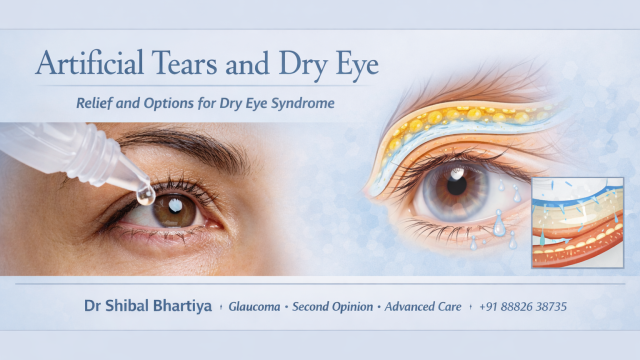
The wrong artificial tear eye drops can actually worsen your dry eye. Eye drops with preservatives, or low viscosity, or even those that contain vasoconstrictors- can all compound the problem.
Not all artificial tears are created equal. Picking one off a pharmacy shelf without understanding what type of dry eye you have is one of the most common, and most correctable, mistakes patients make.
The wrong drop does not just fail to help. In some cases, it actively worsens the surface, delays accurate diagnosis, and masks symptoms that needed proper treatment months earlier.
Here is what you need to know before you reach for another bottle, explains Dr Shibal Bhartiya.
Dr Shibal Bhartiya is afellowship-trained eye specialist and Mayo Clinic Research Collaborator with over 25 years of experience. Her approach focuses on identifying risk before damage is irreversible, simplifying treatment decisions, and protecting vision long-term. Emphasis on early detection, risk assessment, and continuity of care. She is rated 5 stars across 1,500+ patient reviews on Google.
Why Dry Eye Is Not One Condition
Dry eye disease has two main subtypes, and they behave differently.
Aqueous deficient dry eye means your lacrimal glands are not producing enough watery tear fluid. The eye is genuinely under-hydrated.
Evaporative dry eye — the more common subtype, accounting for roughly 85% of cases, means your meibomian glands are not producing enough oil. Tears evaporate too quickly, not because there is too little fluid, but because the oily lid layer that should hold them in place is inadequate.
Many patients have both. The treatment logic for each is different. A drop designed primarily for aqueous deficiency does little for evaporative dry eye. And certain drops, used wrongly, can worsen the very surface they claim to protect.
The Preservative Problem
Most over-the-counter artificial tears contain preservatives, benzalkonium chloride (BAK) being the most common.
BAK is a detergent-like molecule that keeps the bottle free from contamination. It also disrupts the corneal epithelium. Used occasionally in someone with mild dryness, this is manageable. Used multiple times a day in someone with moderate to severe dry eye disease, it causes toxic keratoconjunctivitis, a condition where the very drops meant to soothe the eye are chemically damaging its surface.
The rule is simple: if you are using artificial tears more than four times a day, you need a preservative-free formulation. Single-dose vials are the safest format. Multi-dose preservative-free bottles with patented one-way valve systems are an acceptable alternative.
If your eyes feel worse after using drops, more burning, more redness, more sensitivity, preservative toxicity should be the first thing you investigate.
Viscosity: Getting It Wrong in Both Directions
Artificial tears range from thin, watery solutions to thick gels to ointments. The thickness, viscosity, determines how long the drop stays on the eye surface and how clearly you see after using it.
Too thin: A low-viscosity drop washes off within minutes. In someone with significant evaporative dry eye or a damaged surface, this provides momentary relief and no lasting benefit. Patients use it more and more frequently without improving.
Too thick: A gel or ointment used during the day blurs vision and may trap debris on the ocular surface. Gels and ointments are designed for overnight use, they work while the eye is closed, protecting the surface through the night.
The right viscosity depends on your tear film stability, your lifestyle, and how severe your surface disease is. A specialist can guide this. A pharmacist generally cannot.
The Vasoconstrictor Trap
Some eye drops marketed for redness and irritation, “get the red out” formulations, contain vasoconstrictors such as naphazoline or tetrahydrozoline. These constrict blood vessels on the eye surface, making the eye look whiter within minutes.
They do not treat dry eye. In fact, they do not reduce inflammation. They provide no surface protection either.
With regular use, rebound redness develops. The eye becomes dependent on the drop to look normal. Patients use them more frequently to achieve the same effect. Surface inflammation continues unchecked underneath the apparent whiteness.
If you are using vasoconstrictor drops regularly, stop. The redness they are masking is information your eye specialist needs.
Lipid-Based Drops: When They Help and When They Do Not
Lipid-containing artificial tears, drops that include an oil component to supplement the meibomian layer, are the most appropriate choice for evaporative dry eye. They are not universally better. In someone with primarily aqueous deficiency, adding lipid does not address the underlying deficit.
The distinction matters because evaporative dry eye requires addressing the meibomian glands themselves: through warm compresses, lid hygiene, and in more significant cases, in-office treatments, not just supplementing the tear film with drops.
Lipid drops used alone, without treating the underlying meibomian gland dysfunction, are a partial solution at best. At worst, they delay the proper treatment that would actually restore gland function.
When Artificial Tears Are Not Enough
Artificial tears are a support, not a cure. If you have been using drops for more than four to six weeks without meaningful improvement, you need a proper dry eye assessment, not a different brand of drops.
A structured assessment will identify your tear film break-up time, your meibomian gland status, the degree of corneal and conjunctival staining, and whether inflammation is driving your symptoms. From there, a treatment plan can be built. This may include prescription anti-inflammatory drops, omega-3 supplementation, in-office meibomian gland therapy, or scleral lenses in more severe cases.
The solution is rarely a better artificial tear. It is usually understanding why the surface is failing in the first place.
Frequently Asked Questions
Are preservative-free eye drops always better?
For anyone using artificial tears more than four times daily, yes. Preservatives, especially benzalkonium chloride, cause cumulative surface toxicity with frequent use. Preservative-free single-dose vials are the safest choice for regular use.
Can I use eye drops with contact lenses?
Most preserved drops should not be used with soft contact lenses in place, the preservative concentrates in the lens material. Some drops are specifically formulated for use with lenses. Check the label, or ask your eye specialist.
Why do my eyes feel worse after using artificial tears?
Burning or increased redness after using drops is a common sign of preservative sensitivity or preservative toxicity. Switch to a preservative-free formulation and book a review if symptoms persist.
How many times a day is too many for artificial tears?
More than four times daily with a preserved drop signals two things: your dry eye is not mild, and you need a preservative-free option. Frequency above this with any drop, without improvement, means the underlying cause needs proper assessment.
What is the difference between eye drops, gel drops, and eye ointments?
Drops are thin and clear, best for daytime use. Gel drops are thicker, last longer, and may cause temporary blurring, suitable for daytime if vision impact is acceptable. Ointments are dense and greasy, designed for overnight use only. Using an ointment during the day blurs vision significantly and is not recommended.
Do red-eye drops help with dry eye?
No. Vasoconstrictor drops that whiten the eye do not treat dryness or inflammation. Regular use causes rebound redness and masks the underlying problem. They should not be used as a dry eye treatment.
Read the research articles
This article was written by Dr Shibal Bhartiya, fellowship-trained glaucoma specialist and Mayo Clinic Research Collaborator, Clinical Director at Marengo Asia Hospitals, Gurugram, known for ethical, patient-centred glaucoma care and independent glaucoma second opinions. This article was edited in April 2026.
She has published peer-reviewed research on glaucoma management, examining how treatment decisions should balance medical evidence, patient preferences, and long-term vision outcomes.
As Editor-in-Chief of Clinical and Experimental Vision and Eye Research and Executive Editor of the Journal of Current Glaucoma Practice (Pubmed Indexed, official journal of the International Society of Glaucoma Surgery), Dr Shibal Bhartiya brings editorial and research depth to every clinical decision. Her 200+ publications, including 90+ PubMed-indexed publications and 28 edited textbooks span glaucoma biology, surgical outcomes, health equity, and emerging diagnostics.
Her work can be accessed on Pubmed, Google Scholar, ResearchGate and ORCID.
Dr Shibal Bhartiya
Glaucoma • Second Opinion • Advanced Care
www.drshibalbhartiya.com
+91 88826 38735
1500+ Five Star Patient Reviews Google Business Profile