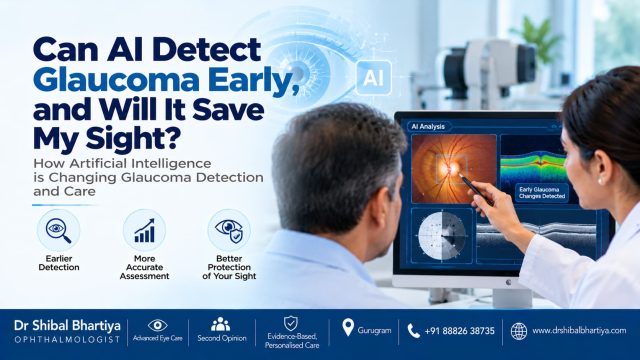
AI can spot signs of glaucoma on eye photographs and scans with high accuracy in studies. Earlier detection saves sight only when treatment and follow-up continue for years afterwards.
You may have had a photograph taken at a screening camp. Or an app told you your eyes look fine. Or you read that AI will find glaucoma years before symptoms start.
All three lead to the same question. Does this change my risk of losing vision?
I wrote this in a recent editorial: not all glaucoma blindness happens because nobody detected the disease. Much of it happens because nobody continued the care. AI helps with the first problem. It cannot fix the second alone.
Dr Shibal Bhartiya is a fellowship-trained glaucoma specialist and Mayo Clinic Research Collaborator with over 25 years of experience. Her approach focuses on identifying risk before damage is irreversible, simplifying treatment decisions, and protecting vision long-term. Emphasis on early detection, risk assessment, and continuity of care. She is rated 5 stars across 1,600+ patient reviews on Google.
Why People Lose Sight to Glaucoma: Two Separate Failures
Glaucoma causes no pain and no early symptoms. Doctors often blame late detection for blindness. That explains only part of it. In my editorial in the Journal of Current Glaucoma Practice, I describe two failures.
| Failure | What goes wrong | Can AI help? |
|---|---|---|
| Late detection | No early symptoms, no access to screening, little awareness, distance from specialists | Yes. AI can read photographs and scans at scale, even where no specialist is nearby |
| Failed long-term care | Missed visits, delayed changes in treatment, trouble with drops, cost, scattered care | Partly. Reminders and risk alerts may help. Cost, trust and understanding still need people |
Vision loss rarely happens on the day of diagnosis. It happens in the years after. Studies across several countries show that a substantial share of patients stop attending within five years. Those who attend less often are more likely to progress.
What AI Can Do Today
Screen from photographs. Deep learning tools read retinal photographs and look for signs such as optic nerve cupping. A review of 48 studies found pooled sensitivity of 0.92 and specificity of 0.93. That matched expert clinicians in those studies.
Read OCT scans. A review of 51 models reported pooled sensitivity of 0.91 and specificity of 0.90. Learn what an OCT scan shows.
Results from controlled studies can run higher than results in everyday clinics. Image quality, patient population and software all change the outcome.
Track change. AI can compare repeated scans and alert your doctor to progression. This helps because change often goes unnoticed between yearly visits. One model trained on macular OCT detected visual field progression in a large study.
Personalise your pressure target. My 2014 paper on target eye pressure noted that no current method for setting it has been formally validated. AI may help close that gap.
What AI Cannot Do
AI cannot examine you. It cannot check how well you use your drops. It cannot hear your fear of surgery.
An Artificial intelligence tool cannot weigh your daily life against a pressure target. It also cannot perform the slit-lamp and gonioscopy check that catches a narrow angle before it becomes an emergency.
A Fire Alarm in a Building With No Fire Exits
Better screening will find many more people with early glaucoma. Health systems need the capacity to look after all of them.
In my editorial I compare this to a fire alarm in a building with no fire exits. The alarm is accurate. The outcome does not change.
For you, this means one thing. A flagged result is the start of care, not the end of it.
Found Early, Then What?
AI may find damage years before you notice any loss of vision. That raises a hard question. When should treatment start?
Many systems wait until vision changes. If AI finds disease earlier but treatment still waits, you spend longer under observation. Vision loss goes on unchanged.
Watching can be the right choice for some patients. It should be a decision, not a default. I make that decision from your rate of change, your risk profile and what matters to you. Read more in Do You Really Need Treatment for Glaucoma?
If an AI Tool Flags Your Results as Abnormal, or Says Your Eyes Are Normal
If it flags you: treat it as a reason for a full examination, not as a diagnosis. Screening tools accept some false alarms so that fewer cases slip through.
If it says normal: one photograph does not clear you for life. Glaucoma can develop later, and a photograph cannot show everything. Keep your regular check-ups, especially if glaucoma runs in your family.
When to See a Doctor
See a Doctor Urgently
Go the same day for sudden eye pain with headache or nausea, halos around lights with a red eye, or sudden loss of vision. No AI result changes this. These can signal an emergency such as acute angle closure.
See a Doctor
Book a visit if:
- An AI tool or screening camp flagged your eyes.
- You are over 40, have a family history of glaucoma, or have never had a comprehensive eye examination.
- You are a glaucoma suspect and nobody has set a follow-up plan.
- You have glaucoma and have missed visits, or stopped drops because of cost or side effects.
The Indian Context
India carries a heavy burden of glaucoma blindness. Most patients arrive late. Screening is limited outside large cities. AI-assisted screening could extend a specialist’s reach to primary care and community camps.
Detection is only the first barrier. The cost of medicines and travel remains a main reason patients in India stop long-term treatment.
Vision Unlimited, the not-for-profit I founded, served over 15,000 children and 5,000 adults in urban underserved communities in Gurugram in 2025. The philosophy is the same. Expert care must reach people who cannot easily reach a tertiary centre.
What This Means for You
Do not wait for AI to find you. If you have a family history, are over 40, or have never had a full eye examination, book one. See glaucoma screening in Gurgaon.
If you already have glaucoma, your strongest step is attending the next visit. Keep every report so your doctor can compare. Here is how to read your test results.
A tool can find the problem. A specialist who knows you can act on it. Upload your reports for a structured review, in person or through teleconsultation.
Has an AI Tool Flagged Your Reports?
An AI result is a starting point. It does not tell you whether you have glaucoma, or whether you need treatment.
Bring it to me, to my clinic in Gurgaon. I will read the result alongside your scans, your examination and your history. Then I will tell you what it means for you, and what happens next.
Send me what you have: the AI report, OCT scans, visual fields and earlier prescriptions. Photos of printouts are fine.
Book an Appointment:
📍 Gurgaon 📞 +91 88826 38735 | 🌐 Contact Us | Second Opinion Form for teleconsults
Frequently Asked Questions
Can AI replace a glaucoma specialist?
No. AI can screen and flag. It cannot examine you, treat you or weigh your preferences. A glaucoma specialist reads the AI finding alongside your full clinical picture.
How accurate is AI at detecting glaucoma?
In a review of 48 studies, AI tools reading fundus photographs reached pooled sensitivity of 0.92 and specificity of 0.93. Accuracy in everyday clinics can be lower. It varies with image quality, population and software.
Should I trust an AI glaucoma screening result?
Trust it as a prompt, not a verdict. A flag means you need a full examination. A normal result does not replace regular check-ups.
What is personalised target IOP?
Target IOP is the pressure your specialist aims for to stop your glaucoma worsening. AI may help make it more precise, using your risk, rate of progression and optic nerve status.
If AI finds glaucoma early, do I need treatment straight away?
Not always. Some patients need treatment at once. Others are safely watched with regular tests. Your specialist decides from how fast the disease is moving, your risk factors and your life.
Reference: Bhartiya S. Artificial intelligence and the stewardship gap in glaucoma care: will earlier detection translate into less blindness? J Curr Glaucoma Pract 2026;20(3):107-110. doi:10.5005/jp-journals-10078-1515. Related work: Glaucoma screening: is AI the answer? (2022) and AI in glaucoma management (2025).
Known for her structured approach to glaucoma risk assessment and progression analysis, Dr Shibal Bhartiya provides trusted second opinions in person and online.
This page is a part of the Glaucoma Hub. you may want to read about Glaucoma Progression, , and Risk Stratification in Glaucoma. Other articles of interest could be Advanced Glaucoma Care in Gurgaon, What Good Glaucoma Care Actually Optimises For, What Happens If Glaucoma Is Left Untreated?, More Glaucoma Eye Drops is Not Better Glaucoma Care, 5 Mistakes Patients Make in Glaucoma Care, Glaucoma Tests Explained, and Do You Really Need Treatment for Glaucoma?
About the Author
This article was written by Dr Shibal Bhartiya, fellowship-trained glaucoma specialist and Mayo Clinic Research Collaborator, Clinical Director at Marengo Asia Hospitals, Gurugram, known for ethical, patient-centred glaucoma care and independent glaucoma second opinions. She is also the Program Director for Community Outreach & Wellness; and for the Marengo Asia International Institute of Neuro and Spine.
Dr Bhartiya has published peer-reviewed research onglaucoma management, examining how treatment decisions should balance medical evidence, patient preferences, and long-term vision outcomes. She is also a committed patient advocate and mainstream medical columnist, translating complex ophthalmic evidence into actionable public health insights across leading national platforms including NDTV and OnlyMyHealth
As Editor-in-Chief of Clinical and Experimental Vision and Eye Research and Executive Editor of the Journal of Current Glaucoma Practice (Pubmed Indexed, official journal of the International Society of Glaucoma Surgery). Her 200+ publications, including 90+ PubMed-indexed publications and 28 edited textbooks span glaucoma biology, surgical outcomes, health equity, and emerging diagnostics.
1600+ Five Star Patient Reviews Google Business Profile
If you are unable to come to Dr Bhartiya’s clinic: Read more about teleconsultation
Read her research on PubMed | Google Scholar | ResearchGate | ORCID | Github | Wikidata
📋Upload your reports for a structured review.| 🌐 Contact Us| 📞 +91 88826 38735
⭐ Helped by this article? Leave a Google review — it helps other patients find reliable eye care.
Last Reviewed: October 2026