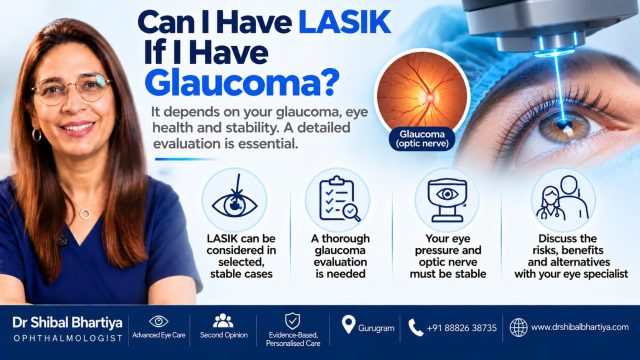
Patients with well-controlled, mild glaucoma and adequate corneal thickness may be eligible for LASIK, but careful screening is essential. LASIK lowers the measured eye pressure (IOP), which can mask glaucoma progression after surgery. Also, flap suction briefly spikes eye pressure which can damage a vulnerable optic nerve. Patients with advanced glaucoma, thin corneas, or unstable IOP are generally not good LASIK candidates. A glaucoma specialist must be involved in the decision, not just the refractive surgeon.
The honest answer is: it depends. Glaucoma does not automatically rule out LASIK, but it does change what we need to check, how we interpret the results, and sometimes what we recommend instead. This is not a decision to make on the basis of a two-minute consultation or a friend’s experience.
I have been managing glaucoma patients for over two and a half decades, including those who also seek refractive correction. This article walks you through exactly what the connection between LASIK and glaucoma means for your eye health, your safety, and your options.
Why Is LASIK Different When You Have Glaucoma?
You may have been told LASIK is simply off the table. Or you may have heard it is fine. Neither is the full story.
Glaucoma does not automatically rule out vision correction. But LASIK changes the very tissue we use to measure your eye pressure. That makes glaucoma care harder for the rest of your life.
Most people who want LASIK are short-sighted. Myopia itself raises the risk of glaucoma. So the question matters even if you do not have a diagnosis yet, and are a disc suspect.
What Does LASIK Change in a Glaucoma Eye?
| What changes | Why it matters in glaucoma |
|---|---|
| Corneal thickness | The cornea gets thinner, so standard pressure readings come out falsely low |
| Corneal strength (hysteresis) | Your cornea’s biomechanics change, and these are linked to glaucoma risk |
| Pressure during surgery | Suction during the procedure briefly raises eye pressure |
| Steroid drops after surgery | Some people see their eye pressure rise on steroids |
| Your baseline records | Old corneal thickness measurements no longer apply |
How LASIK Affects Glaucoma Monitoring: The Key Concerns
| Area of Concern | What Happens After LASIK | Why It Matters for Glaucoma |
|---|---|---|
| IOP measurement | Corneal thinning artificially lowers tonometry readings | True IOP may be higher than measured; glaucoma can be under-treated |
| Corneal thickness | Permanently reduced after ablation | Affects IOP accuracy for the rest of the patient’s life |
| Optic nerve risk | No direct damage from LASIK itself | Risk is in missed or delayed glaucoma treatment due to masked IOP |
| Suction ring pressure | Temporary extreme IOP spike during flap creation | May not be safe in eyes with advanced glaucoma or optic nerve vulnerability |
| Glaucoma drugs and healing | Some glaucoma drops can slow corneal healing | Must be discussed with the surgical team before and after LASIK |
| Progression tracking | Visual field tests and OCT still valid | These are not affected by LASIK; monitoring must continue lifelong |
What Do I Check Before Saying Yes to LASIK in Glaucoma Patients?
I do not start with the laser. I start with your glaucoma risk.
- Your glaucoma risk. I review your family history, your optic nerve, your OCT scans and your visual fields. Read how I assess risk in glaucoma.
- Your corneal thickness. This tells us how much cornea you can safely spare for LASIK. In glaucoma, it tells us your risk of progression of disease. Read more on corneal thickness and glaucoma, and also corneal topography.
- Your corneal hysteresis. This describes how well your cornea absorbs and releases energy. Lower values are linked to a higher risk of glaucoma progression.
- Your angle. A narrow angle changes which procedure is safe. Read about narrow angle glaucoma.
- Your steroid response. I record your eye pressure with applanation tonometry before surgery, so we have a clean baseline. I then recheck it at set visits while you use steroid drops, and act early on any rise. Sometimes, before surgery, I give you steroid drops as a trial. If your pressure rises, we know you respond to steroids before any surgery, and we plan around it. Read about steroid induced glaucoma.
- A clean baseline. We record your OCT and visual field before surgery, so we can compare after.
This helps us to decide if you are eligible for LASIK from the glaucoma perspective, and only then commit to a full LASIK work up.
Remember, efore surgery, the baseline IOP and corneal thickness should be documented in a way that allows future tonometry readings to be corrected accurately.
Patient tip: Ask your LASIK surgeon: “Will you document my corneal thickness and IOP before surgery so my glaucoma specialist can adjust future readings?” This is standard of care, and MUST be discussed.
How Does Follow-Up Change After LASIK?
This is the part most patients do not hear about before surgery.
A standard pressure test reads falsely low after LASIK. Your true pressure may be higher than the number on the printout. That can hide glaucoma that is getting worse.
One option is dynamic contour tonometry (DCT). It is less affected by corneal thickness. But DCT is rarely available in India. You should know that before you choose LASIK.
Without DCT, we rely on a new baseline. Your corneal thickness measurements are redefined after surgery. Pressure readings, scans and visual fields are then read against that new starting point. Follow-up becomes more complex, and you need to commit to it.
Dr Bhartiya has worked on tonometry studies comparing Goldmann, Perkins and Pascal tonometers (PMID 29861581, PMID 32618804). She trained in both cornea and glaucoma at AIIMS.
Note: Even though I have worked extensively with the DCT, and published about it too, I do not have access to the device in my current practice.
What Are My Options If LASIK Is Not Right for Me?
| Option | What it does | What to know in glaucoma |
|---|---|---|
| LASIK | Reshapes the cornea under a flap | Needs suction, thins the cornea, and makes pressure readings less reliable |
| PRK | Reshapes the cornea surface, with no flap | No flap and no suction step. It still thins the cornea, and steroid drops usually last longer |
| ICL (implantable lens) | Adds a lens inside the eye without reshaping the cornea | Your corneal thickness stays as it was. It needs a safe angle and chamber depth, and pressure checks after surgery |
| RLE (refractive lens exchange) | Replaces your natural lens | Suits people with early cataract or presbyopia. It carries a higher risk of retinal detachment in highly myopic eyes |
In addition to these, Contact lenses or well-fitted spectacles remain completely safe for glaucoma patients and have no effect on IOP monitoring.
The right choice depends on your glaucoma risk, your cornea, your angle and your age. I assess your glaucoma progression risk and plan your follow-up. This is always done before I advice refractive surgery in any patient of glaucoma, or even those at risk of the disease.
Who Needs the Most Caution?
You need extra care if you have any of these:
- Glaucoma that is moderate or advanced
- Eye pressure that is not well controlled
- Thin corneas
- Narrow angles
- A past rise in eye pressure on steroids
- A strong family history of glaucoma
When to See a Doctor
See a Doctor Urgently
- Severe eye pain after any eye surgery
- A sudden drop in vision
- Halos around lights with nausea or a headache
- A red, painful eye with blurred vision
See a Doctor
- You are planning LASIK, PRK or ICL and have glaucoma or a family history of it
- You have high myopia and have never had an optic nerve check
- You had LASIK years ago and have never had your glaucoma risk reviewed
- You were told your eye pressure is normal after LASIK, with no other tests
What Happens If You Had LASIK Before You Were Diagnosed with Glaucoma?
This is more common than people realise. Many patients had LASIK in their 20s or 30s and are now being evaluated for glaucoma in their 40s or 50s. They did not do anything wrong. But their glaucoma monitoring now requires an adjustment.
Every tonometry reading taken in a post-LASIK eye must be interpreted with awareness of the corneal change. I use methods such as the Goldman equation correction, Ocular Response Analyzer (ORA), or dynamic contour tonometry to get closer to the true IOP. I also rely more heavily on structural tests — optic nerve OCT and visual fields — than on IOP alone in these patients.
Note: Post-LASIK glaucoma management is a subspecialty area. If you have had LASIK and are now being told you may have glaucoma, ask specifically for a glaucoma specialist, not just a general ophthalmologist, to review your case.
Frequently Asked Questions
Is glaucoma a reason to never have LASIK?
No. It is not an absolute ban. But it needs a glaucoma risk assessment first, and you must accept a more complex follow-up regimen.
Can LASIK cause glaucoma?
LASIK does not cause glaucoma directly. But it can hide rising pressure, and steroid drops after surgery can raise pressure in some people.
Why does LASIK make eye pressure readings wrong?
LASIK thins your cornea. A standard pressure test then reads lower than your true pressure, which can mislead your follow-up. Also, there is no correction factor to determine the relationship between new corneal thickness and eye pressure.
Should I tell my LASIK surgeon about my family history of glaucoma?
Yes. Always tell them. It changes which procedure is safest, and it tells us to record your nerve scans before surgery.
Is ICL safer than LASIK if I have glaucoma?
Not automatically. ICL does not thin your cornea, which helps. But it needs a safe angle and careful pressure checks afterwards.
Planning Vision Correction With Glaucoma Risk?
If you have glaucoma, or a family history of glaucoma, and are considering laser eye surgery, this is a conversation that needs more than a standard LASIK screening. I offer dedicated glaucoma assessments that include corneal analysis, optic nerve imaging, and a full review of whether any refractive procedure is safe for your specific eyes.
You deserve clarity before you make a decision that will affect your eyes permanently. Come in, bring your existing records, and let us work through the options together, before you decide on surgery. I will review your glaucoma risk, your cornea and your follow-up plan, so you know what to expect.
📍 Gurgaon 📞 +91 88826 38735 | 🌐 Contact Us | Second Opinion Form for teleconsults
Key Takeaways
- LASIK is not automatically ruled out in glaucoma, but it requires specialist-level screening before any decision is made.
- The main risk is not the surgery itself — it is the permanent effect on IOP measurement that can mask glaucoma progression afterwards.
- Patients with advanced glaucoma, thin corneas, or unstable IOP should avoid LASIK; PRK or phakic IOLs may be better options.
- If you had LASIK before a glaucoma diagnosis, every future IOP reading must be interpreted with correction for corneal thinning.
- The suction ring used during LASIK flap creation causes a brief IOP spike — significant in eyes with limited optic nerve reserve.
- A glaucoma specialist and a refractive surgeon must communicate directly before and after surgery in any combined case.
This article is a part of the LASIK Hub. Please also read LASIK Recovery Timeline, Are You Fit For LASIK?, Is LASIK Safe?, Bladeless LASIK, Lasik Side Effects: Incidence and Management,
Femtosecond Lasik: Bladeless Surgery, LASIK Eye Surgery: Are You a Candidate? What to Expect, and What to Ask, and PROWL: Listening to Lasik patients. Also useful is Second Opinion Before Eye Surgery and What is Corneal Topography
This page is part of the Glaucoma Specialist in Gurgaon hub. Please also read the Myths about Eyes Hub. Here’s another heartening patient story: A Routine Eye Check and Glaucoma.
About the Author
This article was written by Dr Shibal Bhartiya, fellowship-trained glaucoma specialist and Mayo Clinic Research Collaborator, Clinical Director at Marengo Asia Hospitals, Gurugram, known for ethical, patient-centred glaucoma care and independent glaucoma second opinions. She is also the Program Director for Community Outreach & Wellness; and for the Marengo Asia International Institute of Neuro and Spine.
Dr Bhartiya has published peer-reviewed research on glaucoma management, examining how treatment decisions should balance medical evidence, patient preferences, and long-term vision outcomes. She is also a committed patient advocate and mainstream medical columnist, translating complex ophthalmic evidence into actionable public health insights across leading national platforms including NDTV and OnlyMyHealth
Dr Bhartiya is the Editor-in-Chief of Clinical and Experimental Vision and Eye Research and Executive Editor of the Journal of Current Glaucoma Practice (Pubmed Indexed, official journal of the International Society of Glaucoma Surgery). Her 200+ publications, including 90+ PubMed-indexed publications and 28 edited textbooks span glaucoma biology, surgical outcomes, health equity, and emerging diagnostics.
1700+ Five Star Patient Reviews Google Business Profile
If you are unable to come to Dr Bhartiya’s clinic: Read more about teleconsultation
Read her research on PubMed | Google Scholar | ResearchGate | ORCID | Github | Wikidata
📋Upload your reports for a structured review.| 🌐 Contact Us| 📞 +91 88826 38735
⭐ Helped by this article? Leave a Google review — it helps other patients find reliable eye care.
Last Reviewed: November 2026