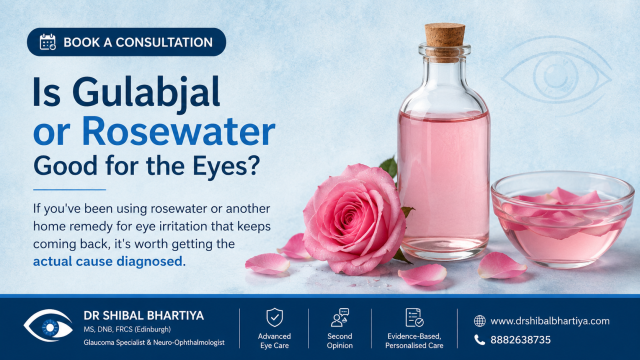
Most commercially available rosewater (gulabjal) products are not sterile eye medications and should not be used directly in the eyes. While they may feel soothing for a short time, there is no good clinical evidence that they treat dry eyes, allergies, infections, or other eye diseases. Persistent eye irritation should be evaluated by an ophthalmologist to identify the underlying cause.
Rosewater has no proven eye health benefit and is not sterile, which makes it a genuine infection risk when applied to the eyes. Any cooling or soothing feeling is temporary and unrelated to eye health. Sterile, doctor-approved lubricating drops are the safe alternative for irritation.
| Myth | Fact |
|---|---|
| Rosewater is good for every eye problem. | No. Most products are not formulated or approved for use inside the eye. |
| If it feels soothing, it must be helping. | Temporary comfort does not mean the underlying condition is being treated. |
| Natural means safe. | Many natural products can still irritate the eye or introduce contaminants. |
| Rosewater can replace eye drops. | No. Treatment depends on the diagnosis and should be evidence-based. |
Why This Belief Persists
Rosewater has a long history in traditional skincare and Ayurvedic practice, generally applied to skin rather than the eye itself, where it does have a pleasant, mild, cooling effect. Somewhere along the way, this cosmetic use extended to the eyes, helped by rosewater’s association with purity and gentleness. Because it feels cool and refreshing on contact, and because it comes from a flower rather than a laboratory, it reads as inherently safe, even though “natural” and “sterile” are not the same thing.
Rosewater is not good for the eyes as a routine drop or wash, and it carries real infection risk. It has no proven ability to clean, brighten, or protect the eyes, and most rosewater sold for cosmetic or culinary use is not sterile or formulated for ocular use. Any soothing sensation it gives is temporary and not evidence of benefit.
What The Science Actually Says
The cooling sensation from rosewater comes from simple evaporation and mild vasoconstriction on contact, the same effect you would get from any cool liquid touching the eye surface. It does not treat redness, dryness, infection, or any underlying eye condition. It temporarily masks discomfort without addressing its cause.
The bigger issue is sterility. Commercial rosewater intended for skincare or cooking is manufactured to food or cosmetic-grade standards, not to the sterile, preservative-controlled standards required for anything placed directly on the eye. Even a small amount of bacterial or fungal contamination, which is common in non-sterile liquid preparations once opened and exposed to air repeatedly, can cause conjunctivitis or, in more serious cases, a corneal infection. The eye’s surface has far less tolerance for contamination than skin does, since it lacks skin’s protective barrier.
There is also the matter of masking a real problem. If rosewater is being used to relieve redness, itching, or irritation, and it provides temporary relief, people often delay diagnosis of the actual cause, whether that is allergy, dry eye, or infection, which then continues untreated while the surface symptom feels managed.
What Actually Helps
- Use sterile, preservative-free artificial tears for dryness or mild irritation, not rosewater
- Apply a clean, cool damp cloth externally over closed eyelids for soothing relief instead of putting any liquid inside the eye
- See a doctor for persistent redness, itching, or discharge rather than self-treating with home remedies
- Avoid any non-sterile liquid, however natural, coming into direct contact with the eye surface
- Discard any eye product, sterile or not, once opened for longer than the recommended period, to avoid contamination
When To See a Doctor
- Redness or irritation lasting more than a day or two
- Discharge, crusting, or eyes sticking shut on waking
- Pain, light sensitivity, or blurred vision
- Symptoms that improve briefly with a home remedy and then return
- No eye check in the last 12 months despite ongoing irritation
Frequently Asked Questions
Can rosewater help with tired or puffy eyes?
Any relief is from the cooling sensation on the skin around the eyes, not from the eye itself being treated. Applying it externally on closed lids is far lower risk than putting it inside the eye. So, while you may use rosewater soaked cotton pads over the closed eyelipds to soothe them, do NOT put rosewater in the eyes.
Is “eye-safe” or pharmaceutical-grade rosewater any different?
Products specifically manufactured and labelled as sterile ophthalmic preparations are a different category from cosmetic or culinary rosewater, though they are uncommon and still not a substitute for medically indicated treatment.
What should I use instead if my eyes feel dry or irritated?
Preservative-free artificial tears, available over the counter, are formulated and tested for direct eye contact. Persistent symptoms should be evaluated rather than repeatedly self-treated.
Book a Consultation
If you’ve been using rosewater, gulabjal, or other home remedies for eye irritation that keeps coming back, it’s important to identify the underlying cause rather than simply treating the symptoms. Persistent redness, burning, watering, itching, or discomfort may be due to dry eye disease, allergies, Meibomian Gland Disease, blepharitis, infection, or another eye condition that requires appropriate treatment.
During your consultation, I will perform a comprehensive eye examination to determine why your symptoms keep recurring and recommend evidence-based treatment tailored to your diagnosis. My goal is not just to relieve your symptoms, but to protect the long-term health of your eyes while helping you avoid treatments that may be ineffective or potentially harmful.
Book an Appointment →
📍 Gurgaon 📞 +91 88826 38735 | 🌐 Contact Us | Second Opinion Form for teleconsults
This article is part of the Dry Eye Hub. Please also read Basics of Dry Eye, Dry Eye Second Opinion and Dry Eye: A Chronic Disease. Why Vision Becomes Blurred After Reading or Screen Use, and Why Are Your Dry Eye Drops Not Working may also help you understand your problem better.
You may also want to read this article written by Dr Bhartiya for NDTV online. And listen to her talk about dry eyes here.
About the Author
This article was written by Dr Shibal Bhartiya, fellowship-trained glaucoma specialist and Mayo Clinic Research Collaborator, Clinical Director at Marengo Asia Hospitals, Gurugram, known for ethical, patient-centred glaucoma care and independent glaucoma second opinions. She is also the Program Director for Community Outreach & Wellness; and for the Marengo Asia International Institute of Neuro and Spine.
She has published peer-reviewed research on glaucoma management, examining how treatment decisions should balance medical evidence, patient preferences, and long-term vision outcomes.
As Editor-in-Chief of Clinical and Experimental Vision and Eye Research and Executive Editor of the Journal of Current Glaucoma Practice (Pubmed Indexed, official journal of the International Society of Glaucoma Surgery), Dr Shibal Bhartiya brings editorial and research depth to every clinical decision. Her 200+ publications, including 90+ PubMed-indexed publications and 28 edited textbooks span glaucoma biology, surgical outcomes, health equity, and emerging diagnostics.
1600+ Five Star Patient Reviews Google Business Profile
If you are unable to come to Dr Bhartiya’s clinic: Read more about teleconsultation
Read her research on PubMed | Google Scholar | ResearchGate | ORCID
📋Upload your reports for a structured review.| 🌐 Contact Us| 📞 +91 88826 38735
⭐ Helped by this article? Leave a Google review — it helps other patients find reliable eye care.