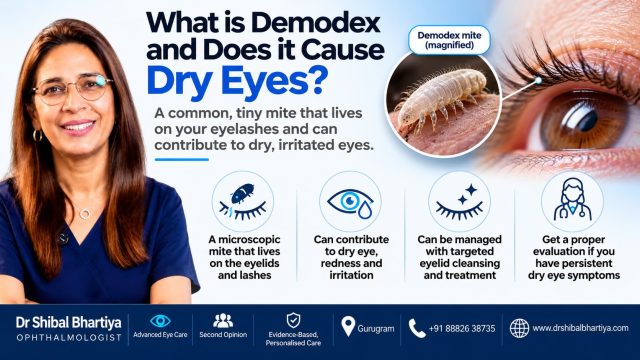
Demodex or eye lash mites live on most adults and usually do no harm. In some eyes they build up and inflame the roots of eye lashes, and oil glands. This can aggravate dry eye despite drops and lid care.
You have tried artificial tears. You clean your lids. Your eyes still itch, burn or feel gritty, mostly in the morning.
Then your doctor mentions eyelash mites, and you wonder what you did wrong. You did nothing wrong. Demodex lives on almost every adult’s skin. Hygiene is not the cause.
Five Things to Know About Demodex
- Demodex is a normal skin resident. Trouble starts only when numbers build up.
- It tends to cause itching, burning and crusting at the lash roots.
- It can sit behind blepharitis and meibomian gland dysfunction (MGD).
- It is diagnosed at the slit lamp, not guessed from symptoms.
- Treatment works best when it is steady and the underlying lid disease is treated too.
What Is Demodex?
Demodex is a tiny mite that lives in hair follicles. Two types affect people. One lives at the base of the eyelashes. The other lives in the oil glands of the eyelid.
Numbers rise with age. Almost everyone older than 70 carries them. Most people never feel a thing.
Mites become a problem when they crowd the lash roots and block the glands. The lid edge then gets red and irritated, and oil flow worsens. Oil quality matters because it stops your tears from evaporating.
What Does Demodex Feel Like?
You may notice:
- Itchy lids, often worse on waking
- Burning or a gritty feeling
- Crusts or flakes on the lashes
- Red lid margins
- Dry eye that returns after each treatment
- Recurrent styes or lid lumps
Many other lid conditions cause the same symptoms. Your symptoms alone cannot confirm Demodex.
Why Does Demodex Hide Behind Blepharitis and MGD?
Demodex, blepharitis and MGD often occur together, and each worsens the others. Mites irritate the lash roots. Irritated lids make poor oil. Poor oil worsens dry eye.
So treating only the dry eye can leave the cause in place.
For the wider picture, read Blepharitis page and MGD page. Both are a part of the Dry Eye hub.
How Is Demodex Diagnosed?
I look at the lashes under the slit lamp. The most telling sign is a cuff of waxy debris at the lash root, called a collarette. Other signs include red lid margins and lash debris.
The signs are not exclusive to Demodex. I read them with your history, lid margin and gland findings. Some clinics also count mites from a few plucked lashes under a microscope.
Finding mites alone does not mean you need treatment. Treatment makes sense when mites and symptoms match.
How Is Demodex Treated?
Treatment aims to lower mite numbers and calm the lid. It also aims to fix the oil glands.
- Lid hygiene. Gentle daily cleaning of the lash base.
- Tea tree oil products. These can help, but undiluted tea tree oil burns the lids and the eye surface. Use only products made for eyelid use and follow the directions.
- Gland care. Warm compresses and lid massage if oil glands are blocked.
- Prescription options. Some medicines target the mite directly. [Confirm what is available in India and what you offer before listing any.]
- Treat the root cause. Rosacea, seborrhoeic dermatitis or MGD may need their own plan.
Mites regrow. Plan for steady care, not a one-time cure. Contact lens wearers should read Contact Lenses and Dry Eye.
Why Do Symptoms Come Back?
Mites return when lid care stops. Pillowcases, makeup brushes and facial skin all matter. Untreated rosacea or MGD also keeps lids vulnerable.
A good plan sets a maintenance routine once you feel better.
Symptoms, Causes and When to Worry
| Symptom | Cause | When to Worry |
|---|---|---|
| Itchy lid edges | Demodex or other blepharitis | When itching persists beyond a few weeks |
| Waxy collars on lashes | Mite build-up at lash roots | Not urgent, but needs a slit lamp exam |
| Burning, gritty eyes | Lid inflammation and poor oil | When symptoms keep returning |
| Recurrent styes or lid lumps | Blocked glands from mites | When lumps repeat or grow |
| Red, swollen lid | Inflamed lid margin | When swelling spreads or lid becomes very painful |
| Blurred vision | Dry or unstable tear film | When it does not clear with blinking |
What Doctors Often Miss
- Nobody looks at the lash roots. Many dry eye exams focus on the tear film alone.
- Symptoms are treated, not the lid. Tears alone cannot fix inflamed lids.
- Contact lens discomfort is blamed on the lenses. Lid disease may be the real cause.
- Treatment stops too early. Lid care needs weeks, then upkeep.
When to See a Doctor in Gurgaon for Demodex
See a Doctor Urgently
- Severe eye pain or a sudden drop in vision
- A red, painful, swollen eyelid with fever
- Light sensitivity with a very red eye
- Any eye injury or chemical exposure
See a Doctor
- Itchy, crusted lids that persist for weeks
- Dry eye that returns despite drops
- Recurrent styes or lid lumps
- Waxy debris at the base of your lashes
- Contact lens discomfort that keeps coming back
What This Means for You
Eyelash mites are common. You did not cause them. If your dry eye keeps returning, the lid may be the missing piece.
A proper exam finds the cause. A steady plan then treats the lid, the glands and the surface together.
Frequently Asked Questions
Are eyelash mites caused by poor hygiene?
No. Almost every adult carries Demodex. Mites become a problem when numbers build up and the lid gets inflamed, not because of dirt.
How do I know if I have Demodex on my eyelashes?
Symptoms alone cannot tell you. An eye doctor looks at the lash roots under the slit lamp. A waxy collar around the lashes is a key sign.
Can Demodex cause dry eye?
Yes. Mites can inflame the lid and block the oil glands. Poor oil makes tears evaporate faster, which worsens dry eye.
Is tea tree oil safe for my eyelids?
Only products made for eyelid use are safe, and you should follow the directions. Undiluted tea tree oil can burn the lids and the eye surface. Talk to your eye doctor before you start.
Will Demodex go away completely?
Treatment lowers mite numbers, but mites can return. Steady lid care after treatment helps keep symptoms away.
Dry eye or itchy lids kept returning?
Discuss your lid and tear film plan with Dr Bhartiya, at her clinic in Gurgaon. Dry eye disease has multiple causes, including meibomian gland dysfunction, reduced tear production, inflammation, and nerve-related pain. The C.L.E.A.R.™ Framework, devised by Dr Shibal Bhartiya, systematically evaluates each factor to create an individualised treatment plan.
Book an Appointment:
📍 Gurgaon 📞 +91 88826 38735 | 🌐 Contact Us | Second Opinion Form for teleconsults
This article is part of the Dry Eye Hub. Please also read Basics of Dry Eye, Dry Eye Second Opinion and Dry Eye: A Chronic Disease. Why Vision Becomes Blurred After Reading or Screen Use, Why Dry Eye Symptoms and Tests Don’t Match, and Why Are Your Dry Eye Drops Not Working may also help you understand your problem better.
You may also want to read this article written by Dr Bhartiya for NDTV online. And listen to her talk about dry eyes here.
About the Author
This article was written by Dr Shibal Bhartiya, fellowship-trained glaucoma specialist and Mayo Clinic Research Collaborator, Clinical Director at Marengo Asia Hospitals, Gurugram, known for ethical, patient-centred glaucoma care and independent glaucoma second opinions. She is also the Program Director for Community Outreach & Wellness; and for the Marengo Asia International Institute of Neuro and Spine.
Dr Bhartiya has published peer-reviewed research onglaucoma management, examining how treatment decisions should balance medical evidence, patient preferences, and long-term vision outcomes. She is also a committed patient advocate and mainstream medical columnist, translating complex ophthalmic evidence into actionable public health insights across leading national platforms including NDTV and OnlyMyHealth
Dr Bhartiya is the Editor-in-Chief of Clinical and Experimental Vision and Eye Research and Executive Editor of the Journal of Current Glaucoma Practice (Pubmed Indexed, official journal of the International Society of Glaucoma Surgery). Her 200+ publications, including 90+ PubMed-indexed publications and 28 edited textbooks span glaucoma biology, surgical outcomes, health equity, and emerging diagnostics.
1700+ Five Star Patient Reviews Google Business Profile
If you are unable to come to Dr Bhartiya’s clinic: Read more about teleconsultation
Read her research on PubMed | Google Scholar | ResearchGate | ORCID | Github | Wikidata
📋Upload your reports for a structured review.| 🌐 Contact Us| 📞 +91 88826 38735
⭐ Helped by this article? Leave a Google review — it helps other patients find reliable eye care.
Last Reviewed: November 2026