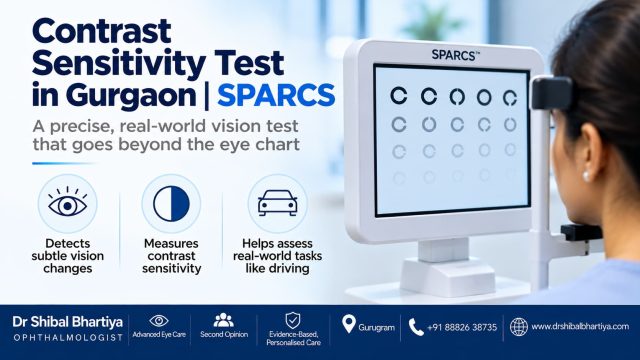
Quick Answer: Quick Answer: You can get a contrast sensitivity test in Gurgaon at Dr Shibal Bhartiya’s clinic, using the SPARCS computer test. It checks five zones of your vision and can help find glaucoma damage that an eye chart misses.
Many patients tell me the same thing. “My eye chart reading is fine, doctor, but the world looks washed out.”
They are not imagining it. The eye chart tests one thing: how small a black letter you can read in bright light. Real life is rarely that kind.
You walk down steps at dusk. You recognise a face against a pale wall. Or, you drive home in the rain. All of these depend on contrast, and you can lose contrast while your chart reading stays at 6/6.
I measure this with the Spaeth/Richman Contrast Sensitivity test, called SPARCS. I offer this contrast sensitivity test in Gurgaon for glaucoma, cataract and other conditions that change how clearly you see.
What Is Contrast Sensitivity?
Contrast sensitivity is your ability to tell an object from its background when the difference is small. Think of a grey cup on a white table, or a kerb on a grey road.
Visual acuity measures size. Contrast sensitivity measures faintness. You need both to see well.
Glaucoma often reduces contrast sensitivity early. The loss can come before you notice a gap in your side vision. That is why a normal chart result does not close the question.
Please read Dim Light, Driving at Night, and Tests Normal but Vision Feels Off
What Is the SPARCS Contrast Sensitivity Test?
SPARCS is a computer-based test of contrast sensitivity. Dr George Spaeth and Dr Jesse Richman designed it at Wills Eye Hospital in Philadelphia.
It uses grey vertical bars on a white background. The bars fade step by step until they blend into the white.
Most contrast tests check only the centre of your vision. SPARCS checks five zones: the centre and the four outer quadrants. Glaucoma damages the outer field first, so this matters.
Each zone gets its own score. The five scores add up to a total out of 100.
What Happens During a Contrast Sensitivity Test in Gurgaon?
The test is short and painless. You sit in front of a screen and look at a central point.
- We test one eye at a time. The other eye stays covered.
- Bars flash briefly in one of the five zones while you keep looking at the centre.
- You tell us what you saw, using the answer choices on screen.
- The bars get fainter with each correct answer, down to very low contrast.
- The program records the faintest bars you could see in each zone.
You do not need to read letters. The test works for people who read any language, or none. I explain which glasses to wear before we start.
Who Should Have a SPARCS Test?
I suggest it when your symptoms do not match your chart reading. I also use it to follow glaucoma between visual field tests.
| What You Notice | What It May Mean | What To Do |
|---|---|---|
| Vision looks hazy or washed out, but the chart reads 6/6 | Reduced contrast sensitivity from early glaucoma or cataract | Book a SPARCS test with a full glaucoma assessment |
| Trouble seeing steps, kerbs or stairs in dim light | Loss of contrast in the lower or outer field | Book a contrast test and a visual field test |
| Difficulty driving at dusk or in rain | Low contrast sensitivity, a known driving risk | Book a test and read my page on night vision and driving |
| Glaucoma diagnosed, and you feel your vision has changed | Possible progression not yet clear on other tests | Ask for SPARCS alongside your visual field and OCT |
| Glaucoma suspect with normal pressure and normal chart | Early functional change before a field defect appears | Add SPARCS to your baseline tests |
| Cataract plus glaucoma, and unsure which one blurs your vision | Both conditions lower contrast | Use SPARCS to track change over time |
What Does the Research Show?
The original study compared 136 eyes with glaucoma or suspected glaucoma against healthy eyes. SPARCS identified glaucoma with about 79% sensitivity and 93% specificity. Repeat testing gave very similar scores, which means the result is reliable. Richman J, et al. Br J Ophthalmol 2015;99(1):16-20. PMID 25053760
An Indian study compared SPARCS with the Pelli-Robson chart, the common wall chart for contrast. SPARCS repeated more consistently. It also separated glaucoma patients from healthy people better. Thakur S, Ichhpujani P, et al. Eye 2018;32:1392-1400. PMID 29755121
Researchers have also linked lower SPARCS scores to more advanced disease. Low total scores predicted severe visual field loss. This helps in late glaucoma, where the standard field test becomes hard to use. Spaeth/Richman Contrast Sensitivity in Staging Glaucoma. Transl Vis Sci Technol 2020;9(13):39. PMID 33384893
SPARCS also shows how cataract lowers contrast as the lens clouds. That helps when both conditions sit in the same eye. Gupta L, et al. SPARCS and Pelli-Robson in normal controls and patients with cataract. Eye 2017;31:753. PMID 28106888
What a Low Score Means, and What It Does Not
A low score tells me your vision has lost contrast. It does not tell me why.
Glaucoma, cataract, a dry ocular surface, retinal disease and optic nerve problems can all lower the score. Dr Spaeth himself describes SPARCS as a test that detects deterioration, not one that names the disease.
So I never diagnose glaucoma from SPARCS alone. I read it with your visual field, OCT, eye pressure, gonioscopy and corneal thickness. A normal score also does not rule glaucoma out.
What Doctors Often Miss
- The chart reading. A patient with 6/6 vision can still struggle to drive at night. Acuity alone hides this.
- The cause of a low score. A cataract can lower SPARCS scores. If I blame glaucoma without checking the lens, I may over-treat.
- The trend. One score tells me little. Repeat scores over months tell me whether your vision is stable.
- Your daily life. Contrast loss affects walking, driving and reading faces. I ask about these before I look at any number.
How SPARCS Fits With Your Other Glaucoma Tests
The visual field maps blind spots. OCT measures nerve thickness. SPARCS measures how clearly you see what is left.
Each test answers a different question. I use SPARCS as an extra layer, not a replacement. You can read how I interpret the field test in How Do I Read My Visual Field Test for Glaucoma?.
When to See a Doctor
See a Doctor Urgently
Seek same-day care if you notice any of these:
- Sudden loss or dimming of vision in one eye
- A curtain or shadow across your vision
- Severe eye pain with headache, nausea or vomiting
- Halos around lights with a red, painful eye
- Vision loss after an eye injury
See a Doctor
Book a visit within a few weeks if you notice any of these:
- Vision looks hazy or faded, but your chart reading is normal
- Growing trouble with stairs, kerbs or dim rooms
- Difficulty driving at night or in the rain
- Glare that bothers you more than before
- A family history of glaucoma and no recent full eye exam
- Changes in only one eye, even if mild
- A child who bumps into objects or struggles in low light
What This Means for You
If your vision feels worse than your chart says, believe your own experience. A contrast sensitivity test gives that experience a number.
SPARCS is quick and comfortable. It adds useful information to your glaucoma tests, especially when I need to track small changes over time.
Frequently Asked Questions
What is a contrast sensitivity test?
It measures the faintest difference between an object and its background that you can see. An eye chart uses dark letters and misses this. A contrast test uses fading shades of grey instead.
Is the SPARCS test painful?
No. You sit at a screen and answer what you see. There are no drops and no contact with your eye. We test each eye separately.
Can SPARCS diagnose glaucoma?
No test diagnoses glaucoma alone. SPARCS can raise suspicion and show how your vision functions. I confirm glaucoma with the visual field, OCT, pressure, gonioscopy and a full clinical examination.
Why is my contrast sensitivity low if I have 6/6 vision?
Acuity and contrast are separate functions. Glaucoma, cataract, dry eye and retinal disease can lower contrast while acuity stays normal. I look for the cause after the test.
Does cataract surgery improve contrast sensitivity?
Often yes, because a clear lens lets more contrast through. If glaucoma is also present, some contrast loss may remain. A SPARCS test before and after surgery shows the difference.
Has Your Vision Changed Even Though Your Eye Chart Looks Normal?
Book a contrast sensitivity test with me in Gurgaon. Bring your previous visual field, OCT and glaucoma reports. At my clinic in Gurgaon, we will see what your tests show and what they miss.
Book an Appointment:
📍 Gurgaon 📞 +91 88826 38735 | 🌐 Contact Us | Second Opinion Form for teleconsults
This page is a part of the Glaucoma Hub. You may want to read about Glaucoma Progression, and Risk Stratification in Glaucoma. You may want to read more about OCT and Visual Field, Glaucoma Tests Explained, Normal OCT but Vision Symptoms and How to Understand Your OCT Better. Also of help could be Why Do I Need a Visual Field Test? Glaucoma Diagnosis in Gurgaon, Get a Glaucoma Second Opinion in Gurgaon and Get an Online Glaucoma Consult.
This page is part of the Vision Symptoms hub. Read more about Neuro-Ophthalmology and about our full approach to neurological vision conditions. Request an urgent appointment if you’ve experienced unexplained vision loss. Read more at Vision Feels Off — When Normal Tests Miss the Real Problem, One Eye Feels Different, Vision Not Clear But Tests Normal, Why Do I See Well in Clinic, but Struggle in Real Life?, Vision Worse in Dim Light or Crowded Spaces, Glaucoma Visual Symptoms in Real Life, and Why Good Vision Does Not Always Mean Safe Vision.
About the Author
This article was written by Dr Shibal Bhartiya, fellowship-trained glaucoma specialist and Mayo Clinic Research Collaborator, Clinical Director at Marengo Asia Hospitals, Gurugram, known for ethical, patient-centred glaucoma care and independent glaucoma second opinions. She is also the Program Director for Community Outreach & Wellness; and for the Marengo Asia International Institute of Neuro and Spine.
Dr Bhartiya has published peer-reviewed research on glaucoma management, examining how treatment decisions should balance medical evidence, patient preferences, and long-term vision outcomes. She is also a committed patient advocate and mainstream medical columnist, translating complex ophthalmic evidence into actionable public health insights across leading national platforms including NDTV and OnlyMyHealth
Dr Bhartiya is the Editor-in-Chief of Clinical and Experimental Vision and Eye Research and Executive Editor of the Journal of Current Glaucoma Practice (Pubmed Indexed, official journal of the International Society of Glaucoma Surgery). Her 200+ publications, including 90+ PubMed-indexed publications and 28 edited textbooks span glaucoma biology, surgical outcomes, health equity, and emerging diagnostics.
1700+ Five Star Patient Reviews Google Business Profile
If you are unable to come to Dr Bhartiya’s clinic: Read more about teleconsultation
Read her research on PubMed | Google Scholar | ResearchGate | ORCID | Github | Wikidata
📋Upload your reports for a structured review.| 🌐 Contact Us| 📞 +91 88826 38735
⭐ Helped by this article? Leave a Google review — it helps other patients find reliable eye care.
Last Reviewed: November 2026