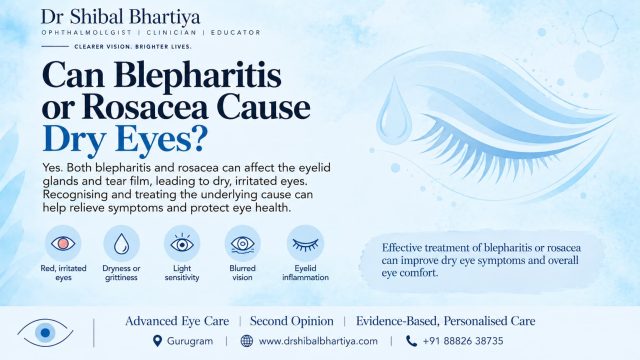
Blepharitis and ocular rosacea cause chronic eyelid margin inflammation that drives persistent dry eye symptoms. Daily eyelid hygiene and, in rosacea-linked cases, treatment of the underlying skin condition, are often what finally resolves symptoms that artificial tears alone couldn’t fix..
Many patients come to me after months of using artificial tears with only partial relief, never having been told the actual driver of their discomfort sits along their eyelid margin, not on the surface of the eye itself. Blepharitis, inflammation of the eyelid margins, and its close relative ocular rosacea are two of the most overlooked, undertreated causes of chronic dry eye symptoms.
Could Blepharitis or Rosacea Be the Real Cause of Your Dry, Irritated Eyes?
These conditions are common, often mild-looking on the surface, and easy to miss unless your doctor examines the eyelid margins specifically rather than just the tear film. Treating the dry eye symptoms alone, without addressing the underlying eyelid inflammation, explains why so many patients feel stuck despite trying drop after drop.
This article explains how to recognize blepharitis and ocular rosacea, and why treating them changes the whole picture.
Signs of Blepharitis and Ocular Rosacea
| Symptom | What It Means | What To Do About It |
|---|---|---|
| Crusting or flaking at the base of the eyelashes, especially on waking | Classic sign of anterior blepharitis | Start a consistent daily eyelid hygiene routine with lid wipes or diluted baby shampoo |
| Persistent dry eye symptoms despite regular artificial tear use | Suggests an eyelid margin cause tears alone can’t fix | Ask your doctor to specifically examine your eyelid margins, not just your tear film |
| Facial redness, flushing, or visible small blood vessels on the cheeks or nose | Signs of rosacea, which frequently has an ocular component | Mention this to your eye doctor even if you’re only being seen for eye symptoms |
| Recurrent styes or chalazia | Can indicate chronic meibomian gland involvement linked to blepharitis or rosacea | Recurrent episodes warrant a full eyelid margin evaluation, not just treatment of each individual episode |
| Burning or foreign-body sensation that’s worse in the morning | Typical timing pattern for blepharitis-related irritation | Warm compresses and lid massage first thing in the morning often help significantly |
| Eyelid redness along the margin, visible on close inspection | Direct sign of eyelid margin inflammation | Needs an eyelid-focused eye exam, not just a general dry eye check |
When To See a Doctor
See a Doctor Urgently (same-day)
- Sudden, painful eyelid swelling with fever
- Vision changes alongside eyelid symptoms
- Rapidly worsening redness spreading beyond the eyelid margin
See a Doctor (routine booking)
- Persistent dry eye symptoms despite consistent artificial tear use
- Recurrent styes or chalazia
- Facial rosacea alongside ongoing eye irritation
- Crusting or flaking at the eyelash base most mornings
Why Blepharitis and Rosaceae Get Missed So Often
A standard dry eye assessment often focuses on tear volume and tear film stability, examining the surface of the eye itself. Blepharitis and ocular rosacea live at the eyelid margin, a step earlier in the process, and can be easy to overlook unless your doctor specifically flips the lids and examines the lash line and gland openings closely. Patients themselves rarely connect facial skin symptoms like rosacea flushing to their eye discomfort, since the two seem unrelated at first glance.
How Blepharitis and Ocular Rosacea Are Related
Ocular rosacea is a manifestation of the same inflammatory skin condition that causes facial redness and flushing, and it frequently drives chronic blepharitis. The eyelid margin inflammation in rosacea-related blepharitis often affects the meibomian glands as well, contributing to the evaporative component of dry eye. This is a distinct but closely related condition from general meibomian gland dysfunction; read more in [Meibomian Gland Disease (MGD) Explained]. Recognizing rosacea as the underlying driver matters because treating the eyelids alone, without addressing the skin condition, often leads to symptoms returning repeatedly.
What Actually Helps
- Daily eyelid hygiene, using warm compresses followed by gentle lid margin cleaning with a lid wipe or diluted baby shampoo, is the foundation of treatment for most cases.
- Warm compresses for 5 to 10 minutes, ideally in the morning, help loosen crusting and support meibomian gland function.
- Omega-3 supplementation has some evidence supporting improved meibomian gland function over time.
- Topical or oral antibiotics, such as low-dose doxycycline, are sometimes prescribed for rosacea-related blepharitis, working through an anti-inflammatory rather than purely antibacterial effect.
- Dermatology co-management is worth considering if facial rosacea is significant, since treating the skin condition can meaningfully improve eye symptoms too.
- Consistency matters more than intensity. Daily eyelid hygiene, kept up over weeks, tends to outperform occasional intensive treatment.
Frequently Asked Questions
How is blepharitis different from regular dry eye?
Blepharitis is inflammation specifically at the eyelid margin, often the root cause behind dry eye symptoms rather than a separate condition. Treating dry eye without addressing blepharitis, when it’s present, usually leads to incomplete or short-lived relief.
Can rosacea really affect my eyes if I don’t have bad skin symptoms?
Yes, ocular rosacea can occur even with mild or minimal facial skin involvement, and in some cases eye symptoms appear before obvious skin changes. This is part of why the connection is so often missed.
How long does eyelid hygiene take to improve symptoms?
Most patients notice meaningful improvement within 2 to 4 weeks of consistent daily eyelid hygiene, though full resolution of chronic cases can take longer, especially with rosacea-related blepharitis.
Do I need antibiotics for blepharitis, or is eyelid hygiene enough?
Many mild cases improve with eyelid hygiene alone. More persistent or rosacea-related cases sometimes benefit from a course of low-dose oral or topical antibiotics, which your doctor can determine based on examination.
Can blepharitis come back after it clears up?
Yes, blepharitis is often a chronic, recurring condition, particularly when linked to rosacea. Ongoing daily eyelid hygiene, even after symptoms improve, helps reduce the frequency and severity of flare-ups.
Should I see a dermatologist as well as an eye doctor for ocular rosacea?
It can help, especially if facial rosacea is significant. Coordinated care between dermatology and ophthalmology often improves both skin and eye symptoms more effectively than treating either in isolation.
Key Takeaways
- Blepharitis and ocular rosacea are common, overlooked causes of persistent dry eye symptoms
- Standard dry eye assessments can miss eyelid margin inflammation unless specifically examined
- Ocular rosacea often coexists with facial rosacea, even when skin symptoms are mild
- Daily eyelid hygiene is the foundation of treatment and needs consistency over weeks
- Recurrent styes or chalazia are a sign worth a full eyelid margin evaluation
- Dermatology co-management can improve outcomes when facial rosacea is significant
Book a Consultation
If artificial tears haven’t given you lasting relief, it’s worth having your eyelid margins specifically examined for blepharitis or ocular rosacea.
I offer detailed dry eye evaluations, and second opinions for dry eyes for patients in Gurgaon and beyond.
Book an Appointment →
Gurgaon 📞 +91 88826 38735 | 🌐 Contact Us | Second Opinion Form for teleconsults
This article is part of the Dry Eye Hub. Please also read Basics of Dry Eye, Dry Eye Second Opinion, Meibomian Gland Disease (MGD) Explained, Meibography, IPL and IRPL, and Dry Eye: A Chronic Disease. Why Vision Becomes Blurred After Reading or Screen Use, and Why Are Your Dry Eye Drops Not Working may also help you understand your problem better.
You may also want to read this article written by Dr Bhartiya for NDTV online. And listen to her talk about dry eyes here.
About the Author
This article was written by Dr Shibal Bhartiya, fellowship-trained glaucoma specialist and Mayo Clinic Research Collaborator, Clinical Director at Marengo Asia Hospitals, Gurugram, known for ethical, patient-centred glaucoma care and independent glaucoma second opinions. She is also the Program Director for Community Outreach & Wellness; and for the Marengo Asia International Institute of Neuro and Spine.
She has published peer-reviewed research onglaucoma management, examining how treatment decisions should balance medical evidence, patient preferences, and long-term vision outcomes.
As Editor-in-Chief of Clinical and Experimental Vision and Eye Research and Executive Editor of the Journal of Current Glaucoma Practice (Pubmed Indexed, official journal of the International Society of Glaucoma Surgery), Dr Shibal Bhartiya brings editorial and research depth to every clinical decision. Her 200+ publications, including 90+ PubMed-indexed publications and 28 edited textbooks span glaucoma biology, surgical outcomes, health equity, and emerging diagnostics.
1600+ Five Star Patient Reviews Google Business Profile
If you are unable to come to Dr Bhartiya’s clinic: Read more about teleconsultation
Read her research on PubMed | Google Scholar | ResearchGate | ORCID | Github | Wikidata
📋Upload your reports for a structured review.| 🌐 Contact Us| 📞 +91 88826 38735
⭐ Helped by this article? Leave a Google review — it helps other patients find reliable eye care.