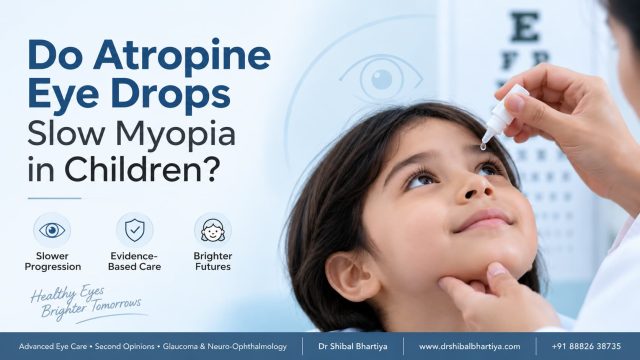
Low-dose atropine (0.01% to 0.05%), used nightly, slows both, progression of myopia and axial elongation in myopic children. There is strong evidence from multiple randomized trials, including Indian data. It does not reverse existing myopia and works best combined with outdoor time and regular monitoring, not as a standalone fix.
Parents often ask me this the moment I mention atropine: “Isn’t that the drop that dilates the pupil? Won’t it damage my child’s eyes long-term?” The confusion is understandable. Atropine has been used in eye clinics for over a century, but at much higher concentrations than the ones used for myopia control today.
At low doses, atropine is one of the most researched tools we have for slowing progressive myopia in children, backed by trials across India, East Asia, Europe, and the US. It is not a cure and it does not reverse existing myopia, but it consistently reduces how fast a child’s prescription worsens.
This article separates the real evidence from the myths, and explains what to actually expect if your child starts atropine therapy.
Myths vs. Evidence about Atropine Drops
| Symptom / Concern | What It Means | What To Do About It |
|---|---|---|
| “Atropine will dilate my child’s pupils and cause permanent light sensitivity” | Low-dose atropine (0.01%) causes only mild, temporary pupil dilation in most children, far less than clinical dilation drops | Photophobia usually settles within days; sunglasses help during the initial weeks |
| “It’s just going to stop working after some time” | Trials over 1 to 2 years, including a 2025 Indian RCT, show sustained reduction in progression, not a fading effect | Continue scheduled dosing and annual monitoring rather than stopping early |
| “Higher dose atropine works better, so we should start there” | 0.05% shows the strongest effect on progression in recent Indian data, but comes with more pupil and near-vision side effects than 0.01% | Your doctor will balance dose against your child’s tolerance and rebound risk |
| “My child’s blurred near vision on the drop means something is wrong” | Reduced accommodation causes temporary near-blur, especially with higher concentrations | Progressive reading glasses can offset this if it interferes with schoolwork |
| “Once we stop the drops, myopia will just come back worse” | A rebound effect can occur after stopping, more pronounced with higher doses | Doctors typically taper the dose gradually rather than stopping abruptly |
| “This is unproven and experimental” | Atropine for myopia control has multiple randomized controlled trials behind it, including recent Indian, Chinese, and American cohorts | Ask your doctor to walk you through the specific trial data relevant to your child’s age and myopia level |
When To See a Doctor
- Any sudden vision change, not just gradual myopia progression
- One eye progressing significantly faster than the other
- Pain, redness, or unusual light sensitivity beyond the expected mild initial dilation
- Signs of an allergic reaction to the drop, such as swelling or persistent redness
- A child under 5 developing myopia, which needs closer monitoring than older children
- Any family history of high myopia, retinal detachment, or early glaucoma
Home Measures That Support the Treatment
- Combine atropine with outdoor time. At least 60 to 90 minutes of daily outdoor light has an independent, measurable protective effect on myopia progression.
- Keep dosing consistent. Nightly instillation at the same time each day maintains steady effect; missed doses reduce benefit.
- Track near-work habits. Reducing continuous close-up screen or reading time supports the drop’s effect rather than working against it.
- Attend every monitoring visit. Axial length and refraction need checking every 6 to 12 months to confirm the treatment is actually working for your child.
What the Dosing Decision Actually Involves
0.01% Atropine
The most studied concentration, with a well-established safety profile and minimal side effects. Effect on progression is real but modest compared to higher doses.
0.05% Atropine
Indian trial data from 2025 shows meaningfully stronger reduction in both refractive progression and axial elongation compared to 0.01%, though with more noticeable pupil dilation and near-vision blur.
Choosing Between Them
This is not a one-size-fits-all decision. A child with fast-progressing myopia and a strong family history of high myopia may need the stronger dose despite the side effects. A child with mild, slow progression may do well on 0.01% with fewer daily disruptions.
Frequently Asked Questions
At what age can a child start atropine eye drops for myopia?
Most published trials enrol children from age 5 to 16, and treatment decisions depend more on the rate of progression than age alone. Discuss timing with your ophthalmologist based on your child’s specific refraction and axial length trend.
How long does a child need to stay on atropine drops?
There is no fixed universal duration. Many children remain on treatment through the years of fastest progression, often into the early teens, with dosing reviewed at each monitoring visit.
Will my child’s vision go back to normal after stopping atropine?
Atropine slows progression; it does not reverse existing myopia. Stopping the drops does not restore vision to a pre-myopic state, but a properly tapered stop reduces the risk of rebound progression.
Is 0.05% atropine safe for long-term use in children?
Current evidence supports its safety with regular monitoring, though side effects like pupil dilation and near blur are more noticeable than with 0.01%. Your ophthalmologist will weigh this against how fast your child’s myopia is progressing.
Can atropine be combined with glasses or Ortho-K lenses?
Yes, and combination therapy is increasingly common in children with fast-progressing myopia. Your doctor can advise whether adding a second strategy makes sense based on your child’s progression rate.
Does atropine work for every child with myopia?
No single treatment works identically for every child. Most children show a meaningful slowing of progression, but individual response varies, which is why regular monitoring matters more than the drop alone.
Key Takeaways
- Low-dose atropine has strong, repeated trial evidence for slowing myopia progression, including recent Indian data
- 0.05% shows a stronger effect than 0.01% but comes with more side effects
- Atropine slows progression; it does not reverse existing myopia
- Outdoor time and consistent nightly dosing both matter for real-world effectiveness
- Stopping abruptly can trigger rebound progression; tapering is safer
- Regular axial length and refraction monitoring confirms whether the treatment is actually working
Book a Consultation
If your child’s myopia is progressing and you want to know whether atropine, Ortho-K, or specialized lenses make the most sense for their specific case, a proper evaluation with axial length measurement gives you a real answer, not a generic recommendation.
Please also read Paediatric Myopia Control Clinic in Gurgaon. I offer detailed pediatric myopia evaluations for children in Gurgaon and beyond.
Book an Appointment →
📍 Gurgaon 📞 +91 88826 38735 | 🌐 Contact Us | Second Opinion Form for teleconsults
This article is a part of the Myopia in Children hub. Please read Myopia in Children, Low Dose Atropine for Myopia, Do Myopia Control Lenses Work, Ortho-K versus Myopia Control contact Lenses and Myopia Prevention in Children. Read more about how we evaluate a child’s myopia in detail. Please also read Paediatric Myopia Control Clinic in Gurgaon, and Myopia in Teenagers.
This page is also a part of the Eye Care for Children hub. You may also want to read about Eye Specialist for Children, Routine Eye Exam for Children, Lazy Eye, and How to Choose Glasses for Children. Please also read Children’s Eye Care, Nutrition, Are Children’s Eyes More Vulnerable, Lazy Eye, and Eye Care Tips for Screen Use, and 7 Ways to Take Care of Your Child’s Eye Health also may be of interest.
You may want to see some eye care tips for children here, here, and here.
About the Author
This article was written by Dr Shibal Bhartiya, fellowship-trained glaucoma specialist and Mayo Clinic Research Collaborator, Clinical Director at Marengo Asia Hospitals, Gurugram, known for ethical, patient-centred glaucoma care and independent glaucoma second opinions. She is also the Program Director for Community Outreach & Wellness; and for the Marengo Asia International Institute of Neuro and Spine.
She has published peer-reviewed research onglaucoma management, examining how treatment decisions should balance medical evidence, patient preferences, and long-term vision outcomes.
As Editor-in-Chief of Clinical and Experimental Vision and Eye Research and Executive Editor of the Journal of Current Glaucoma Practice (Pubmed Indexed, official journal of the International Society of Glaucoma Surgery), Dr Shibal Bhartiya brings editorial and research depth to every clinical decision. Her 200+ publications, including 90+ PubMed-indexed publications and 28 edited textbooks span glaucoma biology, surgical outcomes, health equity, and emerging diagnostics.
1600+ Five Star Patient Reviews Google Business Profile
If you are unable to come to Dr Bhartiya’s clinic: Read more about teleconsultation
Read her research on PubMed | Google Scholar | ResearchGate | ORCID | Github | Wikidata
📋Upload your reports for a structured review.| 🌐 Contact Us| 📞 +91 88826 38735
⭐ Helped by this article? Leave a Google review — it helps other patients find reliable eye care.