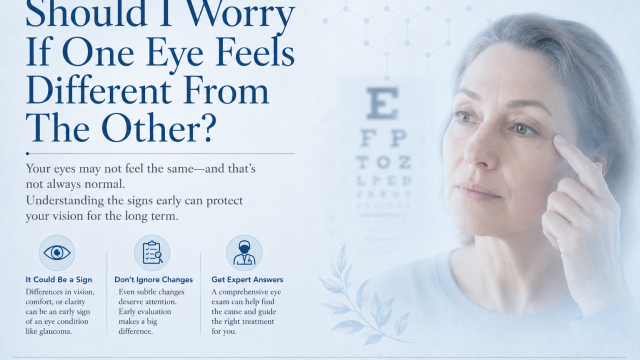
Yes, you should take it seriously if one eye feels different from the other. Asymmetry between eyes is one of the most reliable early signals of eye disease, and it is a symptom that patients are uniquely placed to notice before any test confirms it, says Dr Shibal Bhartiya.
Dr Shibal Bhartiya is a fellowship-trained glaucoma specialist and Mayo Clinic Research Collaborator with over 25 years of experience. Her approach focuses on identifying risk before damage is irreversible, simplifying treatment decisions, and protecting vision long-term. Emphasis on early detection, risk assessment, and continuity of care. She is rated 5 stars across 1,500+ patient reviews on Google.
When One Eye Feels Different: What It Means and What to Do
Your two eyes should feel and function symmetrically. When they do not, something has changed in one of them. That change may be minor and entirely correctable. It may also be the first detectable sign of a condition that, left unexamined, causes permanent vision loss.
Patients are often told not to worry about symptoms they cannot explain precisely. This is the wrong advice for asymmetric eye symptoms. Vague is not the same as unimportant. The fact that you noticed a difference between your eyes matters clinically, regardless of whether you can describe it in medical terms.
📍 Gurgaon 📞 +91 88826 38735 | 🌐 Contact Us | Second Opinion Form for teleconsults
The Most Common Reason: Different Glasses Power in Each Eye
The single most frequent cause of one eye feeling different from the other is a refractive difference between the two eyes. This is called anisometropia.
Most people have slightly different prescriptions in each eye. When the difference is small, the brain blends the two images seamlessly and the asymmetry goes unnoticed. When the difference is larger, or when one eye’s prescription has changed while the other has stayed the same, the imbalance becomes noticeable. One eye feels sharper. The other feels slightly soft, effortful, or strained.
This is the most benign explanation and also the most common. A straightforward refraction by an ophthalmologist resolves it. Glasses or contact lenses matched to the current prescription in each eye restore symmetry. If you have not had your glasses checked in more than a year and one eye feels less sharp than the other, start here.
What patients say: “One eye feels like it needs a stronger prescription.” “I close one eye and everything gets clearer.” “My left eye always feels like it is doing more work.”
When the Difference Is About Clarity and Sharpness
If one eye sees less sharply than the other even with correct glasses in place, the explanation lies beyond refractive error.
Early cataract in one eye. A cataract that has started in one eye but not the other creates asymmetric blur, glare, and sometimes a colour shift. The affected eye may perceive whites as slightly yellowed or images as hazier in bright light. The fellow eye looks and feels completely normal by comparison.
Macular changes. The macula is the small central area of the retina responsible for fine detail vision. Distortion, reduced sharpness, or central blur in one eye that is absent in the other may indicate early macular degeneration or an epiretinal membrane. Straight lines appearing wavy in one eye but not the other is a specific and important symptom that needs prompt assessment.
Corneal irregularity. A cornea that has become irregular in shape, as in keratoconus, produces blur and distortion in one eye that cannot be corrected fully with standard glasses. Patients often describe one eye as simply never quite right regardless of their prescription.
When One Eye Sees Colours Differently or the World Looks Dimmer
This symptom category is the most clinically significant and the one most often dismissed.
If the same light source looks brighter through one eye than the other, or if colours appear more washed out, less vivid, or shifted in hue through one eye, this is not a refractive problem. Lenses and glasses do not affect colour or brightness perception. The visual pathway itself is involved.
The optic nerve carries visual signals from the retina to the brain. When the optic nerve is damaged or inflamed on one side, the affected eye perceives light and colour as reduced in intensity compared to the fellow eye. This asymmetric dimness or colour desaturation is a hallmark symptom of optic nerve disease.
Conditions that cause this include optic neuritis, which is inflammation of the optic nerve often associated with multiple sclerosis, glaucoma with significant nerve fibre loss, compressive lesions affecting one optic nerve, and ischaemic optic neuropathy.
None of these are optician-level diagnoses. All of them require ophthalmologist assessment and, in most cases, further imaging.
What patients say: “Colours look duller through my left eye.” “The room looks darker when I close my right eye.” “Whites look slightly grey through one eye.”
If you recognise this description, do not wait for a routine appointment. Book within days.
When One Eye Misses Things at the Edges
If one eye seems to miss objects, movement, or people at the periphery that the other eye catches easily, this is asymmetric peripheral field loss.
Peripheral vision loss is associated with glaucoma, retinal detachment, retinal vascular disease, and neurological conditions affecting the visual pathway. In daily life with both eyes open, the better eye compensates for the worse eye so effectively that the patient notices nothing. The asymmetry only becomes apparent when each eye is tested alone.
A simple self-check: cover each eye in turn and look at a fixed point straight ahead. Without moving your gaze, note whether you are aware of objects at the edges of your vision on each side. A consistent difference in peripheral awareness between the two eyes needs formal visual field testing.
When One Eye Feels Physically Different
Sometimes the asymmetry is not about vision quality but about how the eye itself feels.
Pressure or heaviness in one eye. A sensation of fullness, weight, or pressure behind one eye can sometimes accompany elevated intraocular pressure. It can also reflect sinus disease, orbital inflammation, or a retrobulbar process. It is not a normal sensation and should not be attributed to tiredness if it is consistent and reproducible.
One eye more sensitive to light. Asymmetric photophobia, where one eye is much more bothered by bright light than the other, points toward inflammation inside the eye, corneal disease, or optic nerve dysfunction on that side. It is not a symptom of refractive error.
One eye feels dry, gritty, or uncomfortable while the other does not. Dry eye disease frequently affects one eye more than the other, particularly when there is a difference in blink pattern, lid anatomy, or meibomian gland function between the two sides.
When the Asymmetry Came on Suddenly
Sudden asymmetry between the eyes is a different clinical situation from gradual or longstanding asymmetry. Any of the following require same-day assessment:
Sudden vision loss or blur in one eye. Any sudden dimness or colour change in one eye. Sudden peripheral loss in one eye. Sudden eye pain with or without visual change. Flashing lights or a new floater shower in one eye.
These symptoms can indicate retinal detachment, acute optic neuritis, vascular occlusion, or acute angle-closure glaucoma. All are time-sensitive. The window for effective treatment is measured in hours, not days.
What You Need To Remember
| Symptom | Most Likely Cause | What Is Needed | Urgency |
|---|---|---|---|
| One eye less sharp or blurry | Refractive error, cataract, corneal irregularity | Refraction, slit lamp, keratometry | Routine, within four weeks |
| One eye sees colours less vividly or world looks dimmer | Optic nerve disease, optic neuritis | Ophthalmologist, OCT, visual field, MRI if indicated | Within days |
| One eye misses things at the periphery | Glaucoma, retinal disease, neurological | Formal perimetry, optic nerve imaging | Within one to two weeks |
| One eye feels heavy or pressured | Elevated IOP, sinus disease, orbital disease | IOP measurement, examination | Within one week |
| One eye more light sensitive | Uveitis, corneal disease, optic nerve disease | Slit lamp, full anterior and posterior segment assessment | Within one week |
| One eye dry, gritty, uncomfortable | Asymmetric dry eye, lid disease | Dry eye assessment, meibomian gland evaluation | Routine |
| Sudden any asymmetric symptom | Retinal detachment, vascular occlusion, acute angle closure | Emergency eye assessment | Same day |
What We Often Miss
Patients reporting asymmetric eye symptoms are sometimes reassured because their visual acuity is equal in both eyes. Equal acuity on a chart does not exclude asymmetric optic nerve disease, asymmetric peripheral field loss, or early cataract affecting quality of vision rather than measured sharpness. Acuity tests central sharpness only. It is one measurement among many.
If you have reported a consistent difference between your eyes and been told they are fine based on acuity alone, the assessment is incomplete. Ask specifically about optic nerve assessment, visual field testing, and intraocular pressure measurement. If these are not available in the setting where you were seen, seek a second opinion with an ophthalmologist who can perform them.
Noticing a Difference in One Eye?
If one eye feels different from the other, I’m happy to help you understand why. Sometimes it is something simple, but a new or persistent change deserves a proper eye examination.
If you’re concerned, book a consultation with me. We can assess what is happening and decide together whether any further evaluation is needed.
Book a consultation with Dr. Shibal Bhartiya →
📍 Gurgaon 📞 +91 88826 38735 | 🌐 Contact Us | Second Opinion Form for teleconsults
This page is part of the Vision Symptoms hub. Read more aboutNeuro-Ophthalmology and about our full approach to neurological vision conditions. Request an urgent appointment if you’ve experienced unexplained vision loss.
Frequently Asked Questions
Is it normal for one eye to be slightly stronger than the other?
A small refractive difference between eyes is common and correctable with glasses. What is not normal is a difference in brightness, colour perception, or peripheral awareness that persists after correct glasses are worn. That kind of asymmetry needs investigation beyond a standard refraction.
Can tiredness cause one eye to feel different?
Tiredness can cause mild fluctuation in focus. It does not cause consistent, reproducible asymmetry in colour, brightness, or peripheral vision. If the asymmetry is reliably present when you check it carefully, it is not fatigue.
My optician checked both eyes and said they are healthy. Should I still be concerned?
A standard optician examination includes refraction and a basic retinal view. It does not routinely include formal visual field testing, OCT of the optic nerve, or a detailed optic nerve assessment. If your concern is about brightness asymmetry, colour change, or peripheral loss, you need an ophthalmologist.
The difference has been there for months without changing. Does that mean it is not serious?
Not progressing does not mean not significant. A stable asymmetry still needs explanation. Stable optic nerve damage looks identical to a stable refractive difference until you investigate properly. Duration does not determine whether something needs assessment.
Can children have one eye that feels different?
Yes, and in children this is particularly important to investigate promptly. A significant refractive difference between a child’s eyes is one of the most common causes of amblyopia, where the brain suppresses the weaker eye and vision in that eye fails to develop normally. This is treatable if caught early and much harder to treat after the age of seven or eight. Any parent who notices a child favouring one eye, tilting the head, or closing one eye should seek assessment without delay.
About the Author
This article was written by Dr Shibal Bhartiya, fellowship-trained glaucoma specialist and Mayo Clinic Research Collaborator, Clinical Director at Marengo Asia Hospitals, Gurugram, known for ethical, patient-centred glaucoma care and independent glaucoma second opinions. She is also the Program Director for Community Outreach & Wellness; and for the Marengo Asia International Institute of Neuro and Spine.
She has published peer-reviewed research on glaucoma management, examining how treatment decisions should balance medical evidence, patient preferences, and long-term vision outcomes.
As Editor-in-Chief of Clinical and Experimental Vision and Eye Research and Executive Editor of the Journal of Current Glaucoma Practice (Pubmed Indexed, official journal of the International Society of Glaucoma Surgery), Dr Shibal Bhartiya brings editorial and research depth to every clinical decision. Her 200+ publications, including 90+ PubMed-indexed publications and 28 edited textbooks span glaucoma biology, surgical outcomes, health equity, and emerging diagnostics.
1600+ Five Star Patient Reviews Google Business Profile
If you are unable to come to Dr Bhartiya’s clinic: Read more about teleconsultation
Read her research on PubMed | Google Scholar | ResearchGate | ORCID | Github
📋Upload your reports for a structured review.| 🌐 Contact Us| 📞 +91 88826 38735
⭐ Helped by this article? Leave a Google review — it helps other patients find reliable eye care.