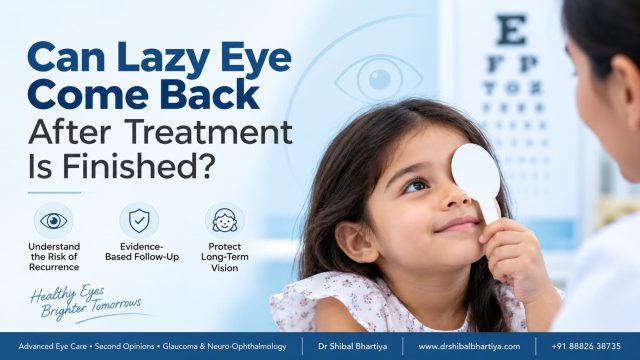
Lazy eye can come back after treatment is finished. Amblyopia regression after stopping treatment is common, affecting a meaningful proportion of children within the first year, more often when treatment is stopped abruptly. Gradual tapering and scheduled follow-up visits after treatment ends significantly reduce this risk.
Parents are often relieved the day patching or atropine treatment ends, understandably so, after months of daily routines built around it. What surprises many is learning that stopping treatment isn’t always the final step. Amblyopia can regress, meaning vision in the treated eye can worsen again after treatment stops.
This isn’t a failure of the original treatment. It’s a recognized part of amblyopia care that needs its own plan, just like the initial treatment did.
This article explains how common regression actually is, what causes it, and how we reduce the risk.
Signs and Risk Factors for Lazy Eye Coming Back
| Sign or Situation | What It Means | What To Do About It |
|---|---|---|
| Vision was fully recovered at the end of treatment | Good outcome, but doesn’t eliminate regression risk, especially in the first year | Attend all scheduled post-treatment follow-up visits, even with no symptoms |
| Treatment stopped abruptly rather than tapered | Abrupt discontinuation carries a higher regression risk than gradual tapering | Ask your doctor about a tapering schedule before fully stopping treatment |
| Severe amblyopia before treatment began | More severe initial amblyopia is linked to higher regression risk after stopping | Expect closer, more frequent monitoring in the months after treatment ends |
| Child squinting or covering one eye again | A possible behavioral sign that vision in the treated eye is declining | Book a follow-up evaluation rather than waiting for the next scheduled visit |
| Missed or inconsistent follow-up visits after treatment ended | Regression can happen without obvious symptoms and needs testing to catch early | Keep all follow-up appointments even if your child seems to be seeing fine |
| Regression caught early at a routine follow-up | Early detection makes retreatment more effective and often shorter | Resume treatment promptly as advised rather than waiting to see if it self-corrects |
When To See a Doctor For Lazy Eye Coming Back
See a Doctor Urgently (same-day)
- Sudden, noticeable change in vision after treatment has ended
- A child suddenly covering or closing one eye again
- Any new eye misalignment appearing after treatment
See a Doctor (routine booking)
- Scheduled post-treatment follow-up visits, even with no symptoms
- General questions about your child’s ongoing monitoring schedule
- Concerns about resuming or extending treatment after a regression is caught
📍 Gurgaon 📞 +91 88826 38735 | 🌐 Contact Us | Second Opinion Form for teleconsults
Why Can Lazy Eye Come Back After Treatment Is Finished
The visual system, particularly in young children, remains adaptable for years after amblyopia treatment ends. This adaptability, which made treatment possible in the first place, is also what allows vision to worsen again if the brain reverts to favoring the stronger eye once treatment stops. Regression is more likely with more severe initial amblyopia, younger age at treatment completion, and abrupt rather than gradual discontinuation of patching or atropine.
How We Reduce Risk of Lazy Eye Coming Back After Treatment Is Finished
Gradual tapering rather than abrupt stopping. Reducing patching hours or atropine frequency in planned steps, rather than stopping all at once, gives the visual system time to adjust.
Scheduled follow-up visits. Regular checks in the months after treatment ends catch regression early, often before it’s noticeable at home.
Maintenance patching in some cases. For higher-risk children, a low-dose maintenance schedule, a few hours a week rather than daily, sometimes continues for a period after primary treatment ends.
Prompt retreatment if regression is caught. Vision that has regressed usually responds well to resuming treatment, especially when caught early rather than after a long gap.
Frequently Asked Questions About Lazy Eye Come Back After Treatment Is Finished
How common is it for lazy eye to come back after treatment?
Regression is relatively common in the first year after stopping treatment, particularly with abrupt discontinuation. This is why structured follow-up after treatment ends is considered part of the treatment plan, not optional extra monitoring.
How long after treatment ends should my child be monitored?
Most doctors recommend follow-up visits for at least a year after treatment ends, with the exact schedule depending on how severe the amblyopia was and how the child responded to treatment.
If regression happens, does my child have to start treatment all over again?
Usually not from the beginning. Vision that has regressed typically responds well to resuming treatment, and catching it early through scheduled follow-up often means a shorter course than the original treatment.
Is gradual tapering really better than just stopping the patch one day?
Yes, evidence generally supports gradual tapering over abrupt discontinuation as a way to reduce regression risk, giving the visual system time to stabilize without a sudden full return to old habits.
Can regression happen even if my child’s vision seemed perfect at the end of treatment?
Yes, a fully recovered result at the end of treatment does not eliminate regression risk, especially within the first year. This is exactly why follow-up visits continue even when there are no visible symptoms.
What can I watch for at home between follow-up visits?
Watch for your child covering or closing one eye, squinting, or any noticeable change in how they use their eyes together. However, regression can occur without obvious home signs, so scheduled visits remain important regardless.
Key Takeaways
- Amblyopia can regress after treatment ends; this is a recognized, manageable part of care
- Abrupt discontinuation carries a higher regression risk than gradual tapering
- More severe initial amblyopia increases the chance of regression after stopping
- Scheduled follow-up visits catch regression early, often before it’s noticeable at home
- Regression caught early usually responds well to resuming treatment, often more quickly than the original course
- Maintenance patching at a lower dose may be used for higher-risk children after primary treatment
Book a Consultation
If your child recently finished amblyopia treatment, staying on schedule with follow-up visits is what protects the progress you’ve already made.
I offer detailed pediatric amblyopia follow-up care for children in Gurgaon and beyond.
Book an Appointment →
📍 Gurgaon 📞 +91 88826 38735 | 🌐 Contact Us | Second Opinion Form for teleconsults
Few ophthalmologists in India have studied amblyopia at the level of a formal postgraduate thesis. Dr Shibal Bhartiya’s research explored levodopa as an adjunct to conventional patching therapy, investigating whether visual plasticity could be enhanced in older children who had missed the ideal treatment window. The work was presented at the XXIX International Congress of Ophthalmology, Sydney (2002), and published in leading ophthalmic journals.
This article is a part of the Paediatric Ophthalmology Hub. Please also read Children’s Eye Care, Nutrition, Are Children’s Eyes More Vulnerable, Lazy Eye, How Much Screen Time is Safe in Children, and Myopia Prevention in Children. Eye Care Tips for Screen Use, and 7 Ways to Take Care of Your Child’s Eye Health also may be of interest. Myopia in Teenagers.
You may want to see some eye care tips for children here, here, and here. Please also read Lazy Eye in Children, My Child Wont Wear Their Eye Patch, and Lazy Child or Lazy Eye?.
About the Author
This article was written by Dr Shibal Bhartiya, fellowship-trained glaucoma specialist and Mayo Clinic Research Collaborator, Clinical Director at Marengo Asia Hospitals, Gurugram, known for ethical, patient-centred glaucoma care and independent glaucoma second opinions. She is also the Program Director for Community Outreach & Wellness; and for the Marengo Asia International Institute of Neuro and Spine.
She has published peer-reviewed research onglaucoma management, examining how treatment decisions should balance medical evidence, patient preferences, and long-term vision outcomes.
As Editor-in-Chief of Clinical and Experimental Vision and Eye Research and Executive Editor of the Journal of Current Glaucoma Practice (Pubmed Indexed, official journal of the International Society of Glaucoma Surgery), Dr Shibal Bhartiya brings editorial and research depth to every clinical decision. Her 200+ publications, including 90+ PubMed-indexed publications and 28 edited textbooks span glaucoma biology, surgical outcomes, health equity, and emerging diagnostics.
1600+ Five Star Patient Reviews Google Business Profile
If you are unable to come to Dr Bhartiya’s clinic: Read more about teleconsultation
Read her research on PubMed | Google Scholar | ResearchGate | ORCID | Github | Wikidata
📋Upload your reports for a structured review.| 🌐 Contact Us| 📞 +91 88826 38735
⭐ Helped by this article? Leave a Google review — it helps other patients find reliable eye care.