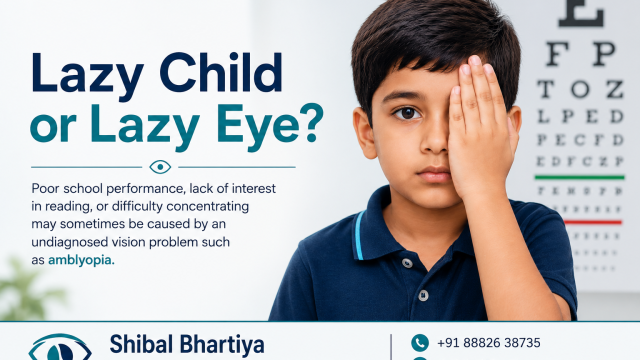
A child who seems uninterested in reading, schoolwork, or sports may not be lazy—they may have amblyopia (lazy eye) or another undiagnosed vision problem. Early eye examinations can help identify treatable causes of poor visual performance.
Not every “lazy child” is actually lazy. Conditions such as lazy eye (amblyopia), uncorrected refractive errors, or binocular vision problems can affect learning, attention, and confidence, especially during childhood, explains Dr Shibal Bhartiya.
Dr Shibal Bhartiya is a fellowship-trained glaucoma specialist and Mayo Clinic Research Collaborator with over 25 years of experience. Her approach focuses on identifying risk before damage is irreversible, simplifying treatment decisions, and protecting vision long-term. Emphasis on early detection, risk assessment, and continuity of care. She is rated 5 stars across 1,500+ patient reviews on Google.
The Child Called Lazy Was Losing Vision in One Eye
AR was seven when her mother brought her to see me. Her school had sent a note home twice that term. She was described as careless. She missed the ball during games, walked into the edge of doorframes. Her handwriting drifted off the lines of her notebook. Her teacher suggested she simply needed to concentrate harder.
When I asked her to cover her left eye and read the chart with her right eye alone, she read it easily. When I covered her right eye and asked her to read with her left eye alone, she could not see the largest letter on the chart. She was not being careless. She could barely see out of her left eye.
I examined her further. Her left eye had a much higher degree of long-sightedness than her right. Her brain had quietly stopped using that eye, a phenomenon called suppression, because the image it produced was too blurred to be useful. The eye itself was structurally healthy. The problem was that her brain had learned to ignore it.
She did not have a behaviour problem. She had amblyopia, commonly called lazy eye, and it had likely been present since early childhood.
It took six months of patching the good eye, along with her new glasses. Her vision has improved significantly, and she is doing much better in school!
Patient details have been changed to protect privacy.
Amblyopia and Learning
This case is common, and it is exactly why every child’s eye check must test each eye separately. Amblyopia affects roughly 2 to 3 percent of children, and it causes no visible sign that a parent or teacher would recognise. A child with amblyopia is often labelled clumsy, careless, or inattentive long before anyone checks her vision properly. Below, I explain what amblyopia is, how it differs from related conditions like squint and anisometropia, and why early treatment makes such a difference.
Quick Answer: Amblyopia, or lazy eye, occurs when the brain favours one eye over the other in early childhood, usually because one eye sees a clearer image than the other. It often causes no visible symptoms and is missed unless each eye is tested separately. Treatment before age seven gives the best results, which makes early detection essential.
What Amblyopia Actually Is
Amblyopia develops when the brain receives a clear image from one eye and a blurred or different image from the other. During early childhood, the visual pathways are still forming. If the brain consistently receives poor information from one eye, it begins to suppress that eye’s signal in favour of the clearer one. Over time, the suppressed eye’s connection to the brain weakens, even though the eye itself is structurally normal.
This is why amblyopia is sometimes misunderstood. The eye is not damaged. The problem is in how the brain has learned to process information from it. Glasses or surgery on the eye alone will not reverse this. The brain must be retrained to use the weaker eye, usually through patching or visual exercises, and this retraining works far better in younger children.
A brief and important distinction. Amblyopia is the loss of vision itself. It is usually caused by one of three underlying problems: a squint, where the eyes do not align and the brain ignores the misaligned eye to avoid double vision; anisometropia, where the two eyes have significantly different refractive errors, as in Ananya’s case; or a visual obstruction such as a cataract or drooping eyelid present from birth. Treating amblyopia means treating its underlying cause, then retraining the affected eye.
Lazy Eye vs Other Childhood Vision Problems
| Symptom or Sign | What It Suggests | What To Do |
|---|---|---|
| Child reads fine with both eyes open but struggles when one eye is covered | Amblyopia in the weaker eye, often missed by standard checks | Insist on a same-eye-only vision test at every paediatric eye check |
| One eye visibly turns in, out, up, or down | Squint (strabismus), a common cause of amblyopia | Paediatric ophthalmologist assessment as soon as noticed, ideally before age 4 |
| Child tilts head or closes one eye in bright light | May indicate uncorrected refractive error or early amblyopia | Comprehensive paediatric eye exam with cycloplegic refraction |
| Labelled clumsy, careless, or disinterested at school | Possible undetected vision problem affecting depth perception or reading | Full eye exam, not just a classroom vision screening |
| Family history of lazy eye, squint, or high refractive error in a parent or sibling | Significantly increases the child’s own risk | Screen by age 3, even with no visible symptoms |
| No symptoms noticed at all in a child under 7 | Amblyopia is frequently symptom-free at this age | Routine comprehensive eye exam by age 3 to 4, regardless of apparent normalcy |
Why This Diagnosis Is So Often Missed
The single biggest reason is that standard vision screening tests both eyes together.
A child with amblyopia in one eye will read a standard chart normally, because the stronger eye compensates completely. Ananya’s school screening and her earlier optician visit both tested her vision with both eyes open. Neither would have detected anything wrong. Amblyopia is only revealed when each eye is tested in isolation, which requires deliberately covering one eye at a time.
The second reason is behavioural masking. Children with amblyopia or undiagnosed refractive error often present as clumsy, inattentive, or uninterested in reading, because that is how reduced vision in one eye actually manifests at school and at play. These traits are far more likely to be interpreted as a discipline or attention issue than a vision problem, especially when the child’s behaviour at home seems otherwise normal.
The third reason is the false reassurance of a previous eye check. Many parents, like Ananya’s mother, had already taken their child for a check and were told things were fine. That earlier check was genuinely well-intentioned, but if it did not test each eye separately with a proper paediatric protocol, it could not have detected this specific problem.
When To See a Paediatric Eye Specialist
Book a comprehensive paediatric eye examination, with each eye tested separately, if any of the following apply:
- Your child has been called clumsy, careless, or inattentive at school or at home
- One eye appears to turn in any direction, even occasionally
- Your child tilts their head, squints, or closes one eye in normal light
- A parent or sibling has a history of squint, lazy eye, or high refractive error
- Your child has never had an eye exam where each eye was tested individually
- Your child is under 7 and has not yet had a comprehensive eye exam
The treatment window for amblyopia narrows significantly after age 7 to 9. The earlier this is identified, the more completely it can be corrected.
Expertise in Amblyopia (Lazy Eye)
Dr Shibal Bhartiya’s academic work in paediatric ophthalmology began with postgraduate research on amblyopia (lazy eye), exploring whether levodopa could enhance the effectiveness of conventional patching therapy in older children who had missed the usual treatment window. Her research was presented at the XXIX International Congress of Ophthalmology, Sydney, and published in pubmed indexed, leading peer-reviewed ophthalmology journals. Today, that same commitment to early diagnosis and evidence-based treatment guides her care of children with amblyopia, helping families understand why timely intervention offers the best chance of developing normal vision.
📍 Gurgaon 📞 +91 88826 38735 | 🌐 Contact Us | Second Opinion Form
This article is a part of the Paediatric Ophthalmology Hub. Please also read Children’s Eye Care, Nutrition, Are Children’s Eyes More Vulnerable, Lazy Eye, and Myopia Prevention in Children. Eye Care Tips for Screen Use, and 7 Ways to Take Care of Your Child’s Eye Health also may be of interest. Myopia in Teenagers. Please also read My Child Won’t Wear Their Eye Patch, and Can Lazy Eye Come Back After Treatment is Finished.
You may want to see some eye care tips for children here, here, and here.
Frequently Asked Questions
Can lazy eye be cured in older children or adults?
Treatment becomes less effective after age 7 to 9, though some improvement is still possible at older ages with intensive therapy. Early detection before this window closes gives by far the best results.
Is lazy eye the same as squint?
No. Squint is a misalignment of the eyes and is one possible cause of amblyopia. Amblyopia is the resulting loss of vision in the brain’s processing, and it can also be caused by anisometropia or a visual obstruction without any visible squint.
Why did my child’s school vision screening not catch this?
Most school screenings test vision with both eyes open together, which a child with one weak eye can pass easily using their stronger eye. Amblyopia requires testing each eye separately to detect.
What is anisometropia and why does it matter?
Anisometropia means the two eyes have significantly different refractive errors. It is one of the most common underlying causes of amblyopia, because the brain favours the eye with the clearer image and suppresses the other over time.
Book a Consultation
If your child has been described as clumsy or inattentive, or has never had each eye tested separately, a paediatric eye examination will give you a clear answer quickly. The test itself is simple and painless for a child.
In Gurugram, a paediatric assessment with Dr Shibal Bhartiya includes individual vision testing for each eye, a check for squint, and a cycloplegic refraction to detect any difference between the two eyes.
[Book an Appointment →📍 Gurgaon 📞 +91 88826 38735 | 🌐 Contact Us | Second Opinion Form]
About the Author
This article was written by Dr Shibal Bhartiya, fellowship-trained glaucoma specialist and Mayo Clinic Research Collaborator, Clinical Director at Marengo Asia Hospitals, Gurugram, known for ethical, patient-centred glaucoma care and independent glaucoma second opinions. She is also the Program Director for Community Outreach & Wellness; and for the Marengo Asia International Institute of Neuro and Spine.
She has published peer-reviewed research on glaucoma management, examining how treatment decisions should balance medical evidence, patient preferences, and long-term vision outcomes.
As Editor-in-Chief of Clinical and Experimental Vision and Eye Research and Executive Editor of the Journal of Current Glaucoma Practice (Pubmed Indexed, official journal of the International Society of Glaucoma Surgery), Dr Shibal Bhartiya brings editorial and research depth to every clinical decision. Her 200+ publications, including 90+ PubMed-indexed publications and 28 edited textbooks span glaucoma biology, surgical outcomes, health equity, and emerging diagnostics.
1600+ Five Star Patient Reviews Google Business Profile
If you are unable to come to Dr Bhartiya’s clinic: Read more about teleconsultation
Read her research on PubMed | Google Scholar | ResearchGate | ORCID
📋Upload your reports for a structured review.| 🌐 Contact Us| 📞 +91 88826 38735
⭐ Helped by this article? Leave a Google review — it helps other patients find reliable eye care.