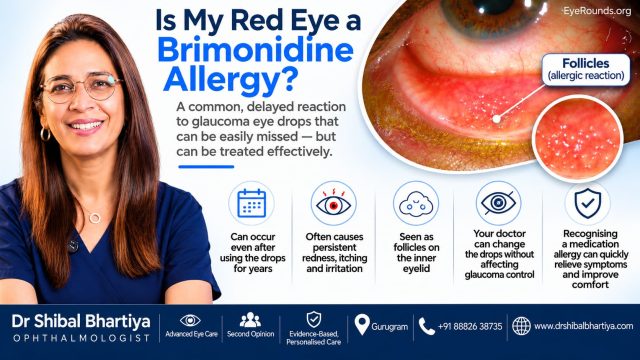
You can develop an allergy to your Brimonidine drops even after using them uneventfully for years. Your doctor can recognise this easily on a slit lamp examination, and change your treatment. Recognising delayed medication-related allergy can help relieve symptoms without compromising glaucoma control.
Why this problem is so easy to miss
Brimonidine-associated allergy is a delayed hypersensitivity reaction. Patients usually think a drug that was well tolerated cannot have an allergic reaction suddenly. So very often, brimonidine allergy is confused with preservative-related toxicity and ocular surface damage.
Patients often attribute the redness to ageing, prolonged screen use, dry eye or environmental irritation. Some assume that red eyes are simply an unavoidable part of long-term glaucoma treatment.
They are not.
A patient I will not forget: Allergic to a drop she had used for 10 years
An elderly patient under my care for many years came for a review. She said she had an eye infection, and it wasn’t getting better. Her glaucoma was stable on bimatoprost 0.01%) and a brimonidine + timolol fixed drug combination (FDC).
She had been using the drops for nearly 10–12 years without any apparent problems.
But on examination, I noticed marked conjunctival follicles and swollen eyelids.
When I asked how long she had been experiencing these symptoms, she told me it had been four to five weeks. She had assumed it was viral conjunctivitis and expected it to settle on its own.
I suspected brimonidine-associated allergic conjunctivitis.
We replaced the brimonidine + timolol bottle with an alternative pressure-lowering medication. A FDC with brinzolamide and timolol, and prescribed cold compresses, lubricants and a short, carefully monitored course of low dose topical steroids.
I asked her to return in five days.
She walked into my clinic grinning from ear to ear.
“I cannot believe something I have been using for ten years could suddenly cause an allergy! Doc, I thought when you are allergic to something, like peanuts, you choke and die immediately!”
I laughed and explained that not all allergic reactions work that way. Brimonidine allergy is often a delayed hypersensitivity reaction. It can develop gradually, even after years of apparently uneventful treatment.
She was genuinely astonished.
This is precisely why brimonidine allergy is so easily missed. Previous tolerance does not rule out a new allergic reaction.
This is a representative anonymised clinical experience. Patient details have been changed to protect confidentiality.
What does a brimonidine allergy look like?
The signs usually build slowly. Look for these:
- Red, bloodshot eyes that don’t settle
- Itching, especially in the corners and under the lids
- Watery eyes, or a sticky, stringy discharge
- A gritty feeling, as if sand is in the eye
- Swollen, pink or scaly eyelids
- Red, irritated skin around the eyes
Doctors often see small bumps called follicles inside the lower lid. This is a useful clue.
Why does Brimonidine allergy start after months of use?
Unlike an immediate allergic reaction, medication-related ocular surface inflammation may develop over time. Repeated exposure can contribute to progressive ocular surface irritation and sensitisation. Eventually, symptoms become noticeable, sometimes after months or even years of apparently uneventful treatment.
Is it an allergy, or something else?
Red eyes on glaucoma drops have several causes. The treatment differs for each.
| Symptom | Likely cause | When to worry |
|---|---|---|
| Itchy, red eyes with sticky discharge, months after starting | Brimonidine allergy | If lids swell badly or vision drops |
| Pink, full-looking eyes within days, little itching | Redness from prostaglandin drops | Rarely harmful. Mention it if it bothers you |
| Burning or stinging after each drop, gritty eyes | Preservative toxicity or dry eye | If burning persists or vision blurs |
| Pain, light sensitivity, falling vision | Infection or inflammation | Same-day review |
Why is the diagnosis often missed
- The drop hides inside a combination bottle. Many pressure-lowering bottles pair brimonidine with timolol or brinzolamide. Patients may know the brand name of the combination, and not the names of the drugs inside the bottle.
- The reaction comes late. A drop that caused no trouble for years is not considered a problem
- Treating the redness, not the cause. Anti-allergy drops or steroids can calm the eye while you keep using the drop that causes it.
- Mistaking it for dry eye. The two often coexist. Read more about glaucoma drops and dry eye.
What happens next?
I examine the eyes, including the inside of the lids. I check every bottle you use, including combination bottles.
If brimonidine is the cause, I replace it with a drop from another class. Your eye pressure still needs a plan.
Please do not stop glaucoma drops on your own without a plan. Call first. Because the target eye pressure has two pillars. One, is your quality of life, and comfort. The second is your long term optic nerve health.
Some patients also choose to cut their drop burden. Read about laser treatment for glaucoma, preservative-free drops and managing drop side effects.
When to See a Doctor
See a Doctor Urgently
- Swelling of the face, lips or tongue
- Trouble breathing or tightness in the throat
- Severe eye pain
- Light sensitivity with falling vision
- Rapidly spreading eyelid swelling
See a Doctor
- Red, itchy eyes that started after beginning a glaucoma drop
- Redness that has lasted more than two weeks
- Swollen or scaly eyelids
- Sticky discharge every morning
- Eyes that need allergy drops to stay comfortable
What this means for you
A reaction to a drop does not mean your glaucoma is worse. It means this drop does not suit you.
You have other options. The aim is to protect your vision and keep your eyes comfortable.
Frequently Asked Questions
Can I become allergic to brimonidine after years of using it?
Yes. The reaction can start after months or years of safe use. Brimonidine is known for a delayed hypersensitivity reaction.
Will the allergy go away if I stop the drop?
It usually settles within a few weeks after the drop is stopped. Your doctor will replace the drop, and give you eyedrops to soothe your eyes.
Can I use brimonidine again later?
Usually not. The reaction tends to return. A related drop called apraclonidine may react too.
Do other glaucoma drops contain brimonidine?
Yes. Some combination bottles do. Check the label or bring every bottle to your visit.
Does an allergy mean my glaucoma is getting worse?
No. An allergy is a reaction to the drug. It does not show that your glaucoma has progressed.
Book a Consultation with Dr Bhartiya
Red, itchy eyes since starting glaucoma drops? Bring every bottle to your visit at my clinic in Gurgaon, and I will help you find a solution.
Book an Appointment:
📍 Gurgaon 📞 +91 88826 38735 | 🌐 Contact Us | Second Opinion Form for teleconsults
This page is part of the Glaucoma hub. Read about our full approach to glaucoma eye drops. Please also read Second Opinion in Glaucoma, How to remember your glaucoma medication, How to manage side effects of glaucoma drops, Why my dry eye drops are not working, How to reduce glaucoma drops, Glaucoma drops not working, Should I Switch to Preservative Free Eye Drops for Glaucoma and Glaucoma progressing despite eye drops.
You may also want to learn how to put eyedrops here.
About the Author
This article was written by Dr Shibal Bhartiya, fellowship-trained glaucoma specialist and Mayo Clinic Research Collaborator, Clinical Director at Marengo Asia Hospitals, Gurugram, known for ethical, patient-centred glaucoma care and independent glaucoma second opinions. She is also the Program Director for Community Outreach & Wellness; and for the Marengo Asia International Institute of Neuro and Spine.
Dr Bhartiya has published peer-reviewed research onglaucoma management, examining how treatment decisions should balance medical evidence, patient preferences, and long-term vision outcomes. She is also a committed patient advocate and mainstream medical columnist, translating complex ophthalmic evidence into actionable public health insights across leading national platforms including NDTV and OnlyMyHealth
Dr Bhartiya is the Editor-in-Chief of Clinical and Experimental Vision and Eye Research and Executive Editor of the Journal of Current Glaucoma Practice (Pubmed Indexed, official journal of the International Society of Glaucoma Surgery). Her 200+ publications, including 90+ PubMed-indexed publications and 28 edited textbooks span glaucoma biology, surgical outcomes, health equity, and emerging diagnostics.
1700+ Five Star Patient Reviews Google Business Profile
If you are unable to come to Dr Bhartiya’s clinic: Read more about teleconsultation
Read her research on PubMed | Google Scholar | ResearchGate | ORCID | Github | Wikidata
📋Upload your reports for a structured review.| 🌐 Contact Us| 📞 +91 88826 38735
⭐ Helped by this article? Leave a Google review — it helps other patients find reliable eye care.
Last Reviewed: November 2026