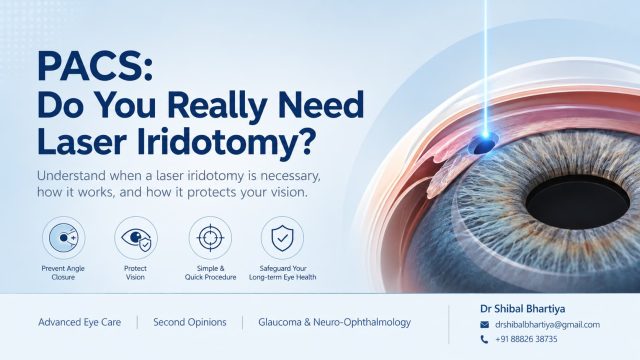
Not every person with PACS needs laser iridotomy or LPI. The decision depends on how occludable the angle is on gonioscopy, your risk factors for progression, and whether you can be monitored reliably. Large trial data show LPI lowers the risk of progression to angle closure, but most untreated PACS eyes never progress either. LPI is usually recommended for higher-risk eyes and discussed as an option for lower-risk ones.
If your eye doctor just told you that you have a “narrow angle” or “Primary Angle Closure Suspect,” you probably left the clinic with more questions than answers. Does this mean you have glaucoma? Will you go blind if you skip the laser? Is LPI mandatory, or optional?
I see this exact worry every week. PACS is a warning sign, not a diagnosis of disease. It means your eye’s drainage angle is narrow enough on gonioscopy that fluid could get blocked one day, but nothing has actually happened yet. Your pressure is normal. Your optic nerve is healthy. Nothing is damaged.
This article walks through how I actually decide, case by case, whether a patient needs laser peripheral iridotomy (LPI), what the evidence says, and the questions worth asking before you agree to any laser procedure.
Understanding What PACS Actually Means
Your eye has a drainage angle where the iris meets the cornea. Fluid exits through this angle constantly. In PACS, gonioscopy shows that the iris is close enough to the drainage structures that it touches or nearly touches them across a large portion of the angle. This is called iridotrabecular contact.
Despite this narrowing, your eye pressure is still normal. There is no scarring in the angle (no peripheral anterior synechiae) and no optic nerve damage. That combination is what separates PACS from the next stage, primary angle closure, and from angle closure glaucoma, which involves actual optic nerve damage.
Think of it as a doorway that is narrower than usual. The door still opens and closes normally today. The question is whether it is narrow enough, in your particular eye, to eventually get stuck.
Do All Narrow Angles Need Laser?
No. This is one of the most common misunderstandings I see in consultations. “Narrow angle” describes anatomy on a spectrum, not a single fixed diagnosis with one mandatory treatment.
| Angle Finding on Gonioscopy | What It Means | Do You Need LPI? |
|---|---|---|
| Less than 180° of iridotrabecular contact, no risk factors | Mild narrowing, low progression risk | Usually monitored, not treated |
| 180° or more of contact, no PAS, normal pressure | This is PACS, the focus of this article | Often recommended, individualised |
| Contact plus peripheral anterior synechiae (PAS) | Angle has started to scar, this is primary angle closure | Treatment recommended, LPI plus pressure management |
| Contact plus optic nerve damage or visual field loss | This is angle closure glaucoma, active disease | Treatment required, often beyond LPI alone |
| Narrow angle with plateau iris configuration | Angle stays crowded even after LPI in some cases | LPI often first step, may need additional laser (iridoplasty) |
The label on your file matters. “Narrow angle” alone is not the same as PACS, and PACS is not the same as angle closure glaucoma. Ask your doctor exactly which category you fall into.
When to Do a Laser Peripheral Iridotomy
The largest trial on this question, the ZAP study conducted in China, followed thousands of PACS patients over six years. One eye in each patient received prophylactic LPI, the other did not.
The results were nuanced. LPI-treated eyes had a lower rate of progressing to primary angle closure or an acute attack compared to untreated eyes. But the absolute difference was modest. The large majority of untreated PACS eyes in that trial did not progress at all during the study period.
This is why I don’t treat PACS as a one-size-fits-all recommendation. The trial tells us LPI works to lower risk, but it also tells us most PACS eyes are not on an urgent trajectory toward disease. The real clinical skill lies in identifying which eyes fall into the higher-risk group.
How I Assess Your Individual Risk
| Risk Factor | What It Means | What To Do About It |
|---|---|---|
| Degree of angle closure on gonioscopy (180° or more) | A wider zone of contact raises the odds of future blockage | Discuss LPI seriously if 180°+ is documented |
| High hyperopia (farsightedness) | Shorter eyes tend to have shallower chambers and narrower angles | Flag for closer monitoring or earlier LPI discussion |
| Shallow anterior chamber depth on imaging | Confirms structural crowding independent of gonioscopy grading | Use as supporting evidence, not sole decision factor |
| Family history of angle closure or acute attacks | Angle anatomy runs in families | Bring this up at your consultation, screen close relatives |
| Age over 50, female sex, South or East Asian ethnicity | Recognised demographic risk pattern for angle closure | Factor into overall risk score, not a standalone reason for LPI |
| Symptoms like halos around lights or intermittent brow ache | Can suggest subclinical intermittent angle closure | Report these clearly, they shift the decision toward treatment |
| Limited access to emergency eye care | If an acute attack occurred, delay in treatment risks vision | Weigh this heavily if you live far from urgent ophthalmic care |
| Difficulty attending regular follow-up | Monitoring without treatment only works if you actually return | Be honest about this with your doctor, it changes the calculus |
No single factor makes the decision alone. I weigh them together for each patient, which is exactly why two people with a “narrow angle” label can walk away with different recommendations.
What Laser Peripheral Iridotomy Actually Involves
LPI is a quick, in-clinic laser procedure. I create a small opening near the edge of your iris, which gives fluid an additional route out of the eye. This relieves the pressure difference that causes the iris to bow forward and crowd the angle.
The procedure itself takes a few minutes per eye. Most patients return to normal activity the same day, aside from some light sensitivity for 24 to 48 hours.
Important: LPI is a preventive procedure, not a treatment for an existing disease. It does not fix damage because in true PACS, there is no damage yet. Its job is to reduce your future risk.
Risks and Trade-Offs of LPI
LPI is low-risk, but it isn’t risk-free, and I discuss this openly before recommending it.
- A short-term pressure spike right after the procedure, usually managed with drops
- Mild inflammation (iritis) for a few days, treated with anti-inflammatory drops
- Rare glare, halos, or a faint line of light, more common when the opening is not fully covered by the eyelid
- Very rare bleeding at the treatment site during the procedure
- A very small chance the angle remains narrow enough to need further treatment later
These are the reasons I don’t recommend LPI reflexively for every narrow angle. For a genuinely low-risk eye, the small chance of side effects can outweigh a small absolute reduction in progression risk.
Laser Versus Observation for Narrow Angles
| Factor | Laser Iridotomy (LPI) | Observation (Monitoring) |
|---|---|---|
| Best suited for | Higher-risk eyes: 180°+ contact, symptoms, strong risk factors | Lower-risk eyes: limited contact, no symptoms, reliable follow-up possible |
| Effect on progression risk | Lowers risk based on trial evidence (ZAP study) | No change to underlying anatomy, risk stays as assessed |
| Upfront burden | One in-clinic laser session, brief recovery | None immediately, but requires committed follow-up |
| Ongoing requirement | Periodic monitoring still recommended, even after LPI | Gonioscopy and pressure checks every 6 to 12 months |
| Main downside | Small chance of glare, inflammation, or pressure spike | Relies entirely on you returning for every follow-up visit |
| What happens if you skip it | N/A, done once | Risk of an undetected change progressing unnoticed |
Neither option is universally “safer.” Observation without follow-up is riskier than LPI. LPI in a genuinely low-risk eye adds an unnecessary, if small, procedural risk. The right choice depends on your numbers, not a general preference for or against lasers.
Patient tip: If you choose monitoring over LPI, put your follow-up appointments in your calendar before you leave the clinic. The strategy only works if the monitoring actually happens.
LPI Versus Early Lens Extraction or “Cataract Surgery”
For a specific group of patients, usually older, with a visually significant or even early cataract contributing to the crowded angle, removing the natural lens can be a reasonable alternative to LPI.
The reasoning is anatomical. The natural lens thickens with age and pushes the iris forward, which is often a major contributor to angle narrowing. Removing it deepens the anterior chamber directly, addressing the root anatomical cause rather than only adding a drainage bypass.
Note: This is not a first-line option for most PACS patients, particularly younger patients with clear lenses. It becomes relevant when cataract and angle narrowing coexist, and the decision should weigh surgical risk against the benefit of skipping LPI altogether.
- Consider it if you already have some cataract-related vision change alongside PACS
- It is a bigger procedure than LPI, with its own recovery and risk profile
- It is not typically recommended purely to avoid a five-minute laser in a patient with a clear lens
- Discuss this route specifically if you are over 50 and your lens is already contributing to your symptoms
I’ve Been Advised LPI. Should I Get a Second Opinion?
Yes, and I say this even though I perform LPI myself regularly. A second opinion is reasonable any time a procedure is recommended, especially one meant to prevent a future problem rather than fix a current one.
This is not about doubting your doctor. It is about making sure the recommendation matches your specific gonioscopy findings, not a general rule of thumb applied to every narrow angle.
Patient tip: Before your second opinion visit, bring your original gonioscopy notes, any anterior segment imaging (AS-OCT or ultrasound biomicroscopy), and your intraocular pressure history. A second opinion without this data is just a guess repeated twice.
A second opinion is especially worth seeking if:
- The angle closure documented is borderline, not clearly 180° or more
- You have no symptoms and no strong risk factors like family history or high hyperopia
- You were told LPI is “just routine” without a discussion of your individual risk
- You have concerns about the procedure itself, such as prior eye surgery or a bleeding disorder
📍 Gurgaon 📞 +91 88826 38735 | 🌐 Contact Us | Second Opinion Form for teleconsults
Questions to Ask Before Laser Iridotomy
- What is my exact degree of iridotrabecular contact on gonioscopy, in degrees?
- Do I have any peripheral anterior synechiae already, or is the angle still open?
- What specific risk factors do I have that push you toward recommending LPI?
- What happens if I choose to monitor instead of proceeding with LPI today?
- What are the realistic risks for my eye specifically, not just in general?
- Will I still need regular follow-up visits after the procedure is done?
- Is my other eye affected the same way, and does it need treatment too?
- If I have a lens-related component, should we discuss lens extraction instead?
When To See a Doctor Urgently
Angle closure can occasionally become an emergency. Know these red flags and act on them immediately, even if you were told your angle is only “narrow” and not yet closed.
- Sudden, severe eye pain, especially in one eye
- Blurred vision that comes on quickly, sometimes with coloured halos around lights
- A red eye combined with a headache
- Nausea or vomiting alongside eye pain (this is a classic and often missed combination)
- A firm, hard-feeling eye on gentle touch through the closed lid
- Any of the above symptoms that start in dim lighting or after pupil dilation
If any of these occur, go to an emergency eye clinic the same day. An acute angle closure attack is treatable, but delay increases the risk of permanent vision loss.
📍 Gurgaon 📞 +91 88826 38735 | 🌐 Contact Us | Second Opinion Form for teleconsults
What This Means For You
A PACS label is not a glaucoma diagnosis, and it does not mean surgery is inevitable. It means your eye has an anatomical feature worth taking seriously and monitoring properly. Whether that translates into a laser procedure depends on your specific gonioscopy findings, risk factors, and ability to follow up. This is a conversation to have in detail with your ophthalmologist, not a decision to make from a single line on a report.
Frequently Asked Questions
Is PACS the same as glaucoma?
No. PACS means your angle is narrow enough to raise future risk, but your eye pressure and optic nerve are currently normal. Glaucoma involves actual optic nerve damage, which has not occurred in PACS. The label is a risk marker, not a disease diagnosis.
Will I definitely need LPI if I have PACS?
Not necessarily. The decision depends on how much of your angle shows iridotrabecular contact, your individual risk factors, and how reliably you can attend follow-up visits. Some PACS patients are monitored safely without laser treatment for years.
Does LPI hurt?
Most patients feel mild pressure or a brief stinging sensation during the laser, not significant pain. Numbing drops are used beforehand. Any discomfort typically resolves within a day.
Can PACS turn into an emergency without warning?
It is uncommon, but not impossible, especially in eyes with a high degree of angle closure. This is exactly why risk stratification matters, and why I explain acute attack warning signs to every PACS patient regardless of whether we choose LPI or monitoring.
If I already had LPI, am I fully protected from angle closure?
LPI significantly lowers risk but does not reduce it to zero. Continued monitoring is still recommended, since a small number of eyes retain a narrow angle configuration even after a successful iridotomy.
Should both my eyes be treated if only one shows PACS on gonioscopy?
Angle anatomy is usually similar between your two eyes, so both are typically assessed. If the second eye also shows a narrow, occludable angle, the same risk-based decision process applies to it.
Key Takeaways
- PACS means a narrow, occludable drainage angle with normal pressure and a healthy optic nerve
- Large trial data show LPI reduces progression risk, but most untreated PACS eyes do not progress
- The decision to treat depends on gonioscopy grading, risk factors, symptoms, and your ability to follow up reliably
- LPI is low-risk but not risk-free, and should be recommended selectively, not universally
- A second opinion is reasonable whenever LPI is advised, especially for borderline findings
- Know the acute angle closure red flags: sudden eye pain, blurred vision with halos, nausea, and a red, hard eye
- This decision deserves an individualised conversation with your ophthalmologist, not a blanket rule
This page is a part of the Glaucoma Hub. you may want to read about Glaucoma Progression, and Risk Stratification in Glaucoma. Other articles of interest could be Advanced Glaucoma Care in Gurgaon, What Good Glaucoma Care Actually Optimises For, What Happens If Glaucoma Is Left Untreated?, More Glaucoma Eye Drops is Not Better Glaucoma Care, 5 Mistakes Patients Make in Glaucoma Care and Do You Really Need Treatment for Glaucoma?
Book a Consultation
If you’ve been told your angle is narrow and you’re unsure whether laser treatment is right for you, don’t guess. Bring your gonioscopy findings and imaging in for a proper risk assessment, so the decision is based on your eye, not a generic rule.
Book an Appointment at my clinic in Gurgaon →
📍 Gurgaon 📞 +91 88826 38735 | 🌐 Contact Us | Second Opinion Form for teleconsults
About the Author
This article was written by Dr Shibal Bhartiya, fellowship-trained glaucoma specialist and Mayo Clinic Research Collaborator, Clinical Director at Marengo Asia Hospitals, Gurugram, known for ethical, patient-centred glaucoma care and independent glaucoma second opinions. She is also the Program Director for Community Outreach & Wellness; and for the Marengo Asia International Institute of Neuro and Spine.
She has published peer-reviewed research onglaucoma management, examining how treatment decisions should balance medical evidence, patient preferences, and long-term vision outcomes.
As Editor-in-Chief of Clinical and Experimental Vision and Eye Research and Executive Editor of the Journal of Current Glaucoma Practice (Pubmed Indexed, official journal of the International Society of Glaucoma Surgery), Dr Shibal Bhartiya brings editorial and research depth to every clinical decision. Her 200+ publications, including 90+ PubMed-indexed publications and 28 edited textbooks span glaucoma biology, surgical outcomes, health equity, and emerging diagnostics.
1600+ Five Star Patient Reviews Google Business Profile
If you are unable to come to Dr Bhartiya’s clinic: Read more about teleconsultation
Read her research on PubMed | Google Scholar | ResearchGate | ORCID | Github
📋Upload your reports for a structured review.| 🌐 Contact Us| 📞 +91 88826 38735
⭐ Helped by this article? Leave a Google review — it helps other patients find reliable eye care.