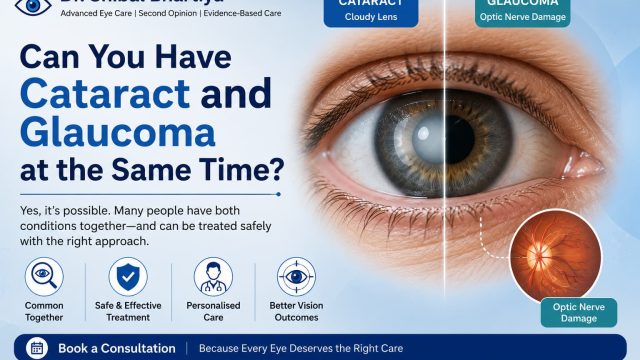
Yes, cataract and glaucoma can occur in the same eye, and having one does not prevent you from developing the other. Both conditions need to be assessed separately so that cataract treatment and glaucoma management can be planned safely to protect vision.
Cataract surgery may improve cloudy vision, but it does not cure glaucoma or reverse established optic nerve damage. If you have both conditions, your eye pressure, optic nerve, visual fields, and cataract should be evaluated together. A personalised treatment plan can help determine the safest timing and approach for cataract surgery while continuing appropriate glaucoma care.
Can You Have Cataract and Glaucoma at the Same Time, in the Same Eye
Yes — you can absolutely have cataract and glaucoma at the same time, and it’s more common than most patients expect. Both conditions become more likely with age, so by the time patients reach their sixties and seventies, I regularly see the two overlapping in the same eye.
What surprises people isn’t that both can occur together — it’s that having both changes how each is diagnosed, monitored, and treated. A cataract can make glaucoma harder to assess accurately. Some glaucoma medications can influence cataract development over time. And if surgery is needed, the sequencing and technique both matter.
In this article, I’ll walk through how these two conditions interact, how we tell what’s really driving your vision loss, when medical management is enough, and when combined surgery makes sense.
Quick Answer: Yes, cataract and glaucoma frequently coexist, especially after age 60. They’re unrelated in cause but often overlap in timing. A cataract can make glaucoma testing less reliable and blur vision independently of glaucoma damage, so your ophthalmologist needs to separate the two before deciding whether you need medical treatment, cataract surgery alone, glaucoma surgery alone, or a combined procedure.
How Cataract and Glaucoma Interact
| Symptom | What It Means | What To Do About It |
|---|---|---|
| Blurred vision with normal eye pressure and stable visual fields | Likely the cataract alone, not glaucoma progression | Cataract surgery can usually proceed as planned, with glaucoma monitored separately |
| Blurred vision plus worsening visual field tests | Could be glaucoma progression, cataract, or both together | Needs repeat, careful field testing — a cataract can make field tests less reliable |
| Rising eye pressure despite consistent drop use | The cataract itself isn’t the cause, but a coexisting angle-closure risk from lens changes might be | Ask specifically whether your lens is contributing to angle narrowing |
| Glare and halos around lights | Common to both conditions, so overlaps easily | Clinical exam (not symptoms alone) is needed to identify which is responsible |
| Difficulty getting a clear, sharp OCT or visual field image | A dense cataract can distort test accuracy for glaucoma monitoring | Your surgeon may recommend proceeding with cataract surgery specifically to restore reliable glaucoma testing |
| Needing more frequent glasses changes | Usually the cataract progressing, not glaucoma | Still worth confirming glaucoma is stable at the same visit |
Does Having Glaucoma Affect Your Cataract Surgery?
Having glaucoma doesn’t rule out cataract surgery — but it does change the plan in a few specific ways:
- Anaesthesia and technique are largely unaffected, but your surgeon will plan the incision site carefully if you may need glaucoma surgery later, to preserve future surgical options
- Eye pressure needs closer monitoring in the days after surgery, since cataract surgery can cause a temporary pressure spike in glaucomatous eyes
- Some glaucoma drops may be paused or adjusted around surgery day — never stop them yourself without confirming with your surgeon
- Visual field and OCT testing are usually deferred for a few weeks after surgery, since a freshly operated eye can give inaccurate readings
Does Glaucoma Treatment Affect Cataract Development?
This is a common question, and a fair one.
- Long-term steroid use — sometimes used in eye conditions, though not typically first-line for glaucoma — is a well-known cataract accelerant
- Standard glaucoma eye drops (prostaglandins, beta-blockers, and others) are not major direct cataract accelerants, though any chronic eye surface irritation from drops can compound discomfort
- Prior glaucoma surgery, particularly trabeculectomy, is associated with somewhat faster cataract progression in some patients — a known trade-off your surgeon will have discussed with you at the time
When Combined Surgery Makes Sense
Some patients need both conditions addressed at once, rather than as two separate procedures. Combined cataract-glaucoma surgery is generally considered when:
- Glaucoma is inadequately controlled on maximum tolerated medication, and cataract is also visually significant
- Angle-closure risk is present, where cataract removal itself can help open the drainage angle
- MIGS (minimally invasive glaucoma surgery) devices can be implanted at the same time as the cataract lens, through the same incision
- Patients prefer a single recovery period over two separate surgeries and their glaucoma severity allows this approach
Not everyone with both conditions needs combined surgery — many patients do perfectly well with cataract surgery alone while glaucoma continues to be managed with drops.
📍 Gurgaon 📞 +91 88826 38735 | 🌐 Contact Us | Second Opinion Form for teleconsults
When To See a Doctor
- Sudden eye pain, especially with nausea or headache (can indicate an acute pressure spike)
- Rapid vision loss over days rather than the slow blur typical of cataract
- Halos around lights that appear suddenly, rather than gradually
- Redness or pain that worsens instead of improving after any eye procedure
- Missed or reduced peripheral vision that you or family members notice
Home Measures That Help
- Take glaucoma drops exactly on schedule, even if cataract surgery is being planned — don’t self-pause them
- Keep a simple log of your eye pressure readings if you’re being monitored closely around the time of cataract evaluation
- Bring your current visual field and OCT reports to every consultation, so old and new tests can be compared properly
- Ask specifically whether your vision changes are being attributed to cataract, glaucoma, or both, at each visit
Frequently Asked Questions
Can I have cataract surgery if I already have glaucoma? Yes. Glaucoma doesn’t prevent cataract surgery, though your surgeon will monitor your eye pressure more closely afterward and may plan the incision with future glaucoma surgery in mind.
Will cataract surgery improve my glaucoma? It can, in specific cases. In patients with a narrow drainage angle, removing the cataract lens can open up the angle and lower eye pressure. It does not reverse existing optic nerve damage from glaucoma, however.
Do glaucoma eye drops cause cataracts? Standard glaucoma drops are not major direct causes of cataract. Long-term steroid use and certain prior glaucoma surgeries carry more established links to faster cataract progression.
How do doctors tell if my blurred vision is from cataract or glaucoma? Cataract typically causes generalised blur, glare, and halos, while glaucoma affects peripheral vision first, usually without noticeable blur until advanced. Visual field tests, OCT scans, and a detailed exam are used to separate the two.
What is combined cataract-glaucoma surgery? It’s a single procedure where cataract removal and a glaucoma-lowering surgery (often a MIGS device) are performed together, through the same incision, so the patient goes through one recovery instead of two separate surgeries.
Is it riskier to have cataract surgery if I have glaucoma? The core cataract procedure carries similar low risk either way, but eyes with glaucoma need more careful pressure monitoring afterward, since a temporary post-operative pressure rise is more consequential in an eye with existing optic nerve damage.
Key Takeaways
- Cataract and glaucoma frequently coexist, especially with age, but arise from unrelated causes
- A cataract can make glaucoma testing less accurate, so clear separation of the two matters clinically
- Standard glaucoma drops aren’t major cataract accelerants; long-term steroids and some glaucoma surgeries are
- Cataract surgery can sometimes improve angle-closure-related glaucoma, but doesn’t reverse nerve damage
- Combined surgery (cataract + MIGS) is an option for select patients, not a default for everyone with both conditions
- Never pause glaucoma drops on your own around cataract surgery — confirm any changes with your surgeon
Book a Consultation
If you’re managing glaucoma and have also been told you have a cataract, I can help you understand how the two are interacting in your specific eyes — and whether medical management, cataract surgery alone, or a combined approach is the right path for you.
If you have both cataract and glaucoma, a detailed assessment can help determine the right treatment approach for each condition. Book a consultation at my clinic in Gurgaon for personalised, evidence-based eye care and a clear plan for protecting your vision.
Book an Appointment →
📍 Gurgaon 📞 +91 88826 38735 | 🌐 Contact Us | Second Opinion Form for teleconsults
This page is a part of the Glaucoma Hub. you may want to read about Glaucoma Progression, and Risk Stratification in Glaucoma. You may want to read more about OCT and Visual Field, Glaucoma Tests Explained, Normal OCT but Vision Symptoms and How to Understand Your OCT Better. Also of help could be Why Do I Need a Visual Field Test? Glaucoma Diagnosis in Gurgaon, Get a Glaucoma Second Opinion in Gurgaon and Get an Online Glaucoma Consult.
This article is part of the Cataract Hub. Read more Cause of cataract, Cataract Surgery, Cataract Surgery Does Not Protect You From Glaucoma, Femtosecond Laser Cataract Surgery: Contraindications, Femtosecond Laser-Assisted Cataract Surgery, Cataract Surgery , Cataract in Glaucoma Patients, Is Cataract Surgery Painful?, Vision Not Clear After Cataract Surgery? What It Really Means, Second opinion Before Cataract Surgery, Which Lens is Best for Cataract Surgery, and Premium Lenses for Cataract Surgery in Gurgaon.
You can also watch these videos to understand more, here and here
About the Author
This article was written by Dr Shibal Bhartiya, fellowship-trained glaucoma specialist and Mayo Clinic Research Collaborator, Clinical Director at Marengo Asia Hospitals, Gurugram, known for ethical, patient-centred glaucoma care and independent glaucoma second opinions. She is also the Program Director for Community Outreach & Wellness; and for the Marengo Asia International Institute of Neuro and Spine.
She has published peer-reviewed research on glaucoma management, examining how treatment decisions should balance medical evidence, patient preferences, and long-term vision outcomes.
As Editor-in-Chief of Clinical and Experimental Vision and Eye Research and Executive Editor of the Journal of Current Glaucoma Practice (Pubmed Indexed, official journal of the International Society of Glaucoma Surgery), Dr Shibal Bhartiya brings editorial and research depth to every clinical decision. Her 200+ publications, including 90+ PubMed-indexed publications and 28 edited textbooks span glaucoma biology, surgical outcomes, health equity, and emerging diagnostics.
1600+ Five Star Patient Reviews Google Business Profile
If you are unable to come to Dr Bhartiya’s clinic: Read more about teleconsultation
Read her research on PubMed | Google Scholar | ResearchGate | ORCID | Github
📋Upload your reports for a structured review.| 🌐 Contact Us| 📞 +91 88826 38735
⭐ Helped by this article? Leave a Google review — it helps other patients find reliable eye care.