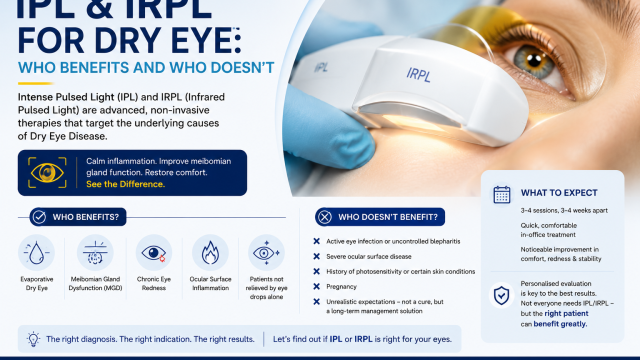
IPL (Intense Pulsed Light) and its newer variant IRPL (Intense Regulated Pulsed Light) are advanced treatments for selected patients with dry eye, particularly those with meibomian gland dysfunction and ocular rosacea. Patients with aqueous-deficient dry eye, autoimmune disease, neuropathic ocular pain, or other underlying conditions may need different or additional treatments. A detailed examination helps determine whether light-based therapy is appropriate or whether another treatment will provide better and more lasting relief.
The most important decision in dry eye treatment is not choosing the right machine. It is making the right diagnosis.
Before becoming a glaucoma specialist, I spent three years in the Cornea and Ocular Surface Service at AIIMS, New Delhi, where I worked as a Senior Research Associate managing patients with some of the most challenging forms of dry eye disease. That experience taught me a lesson I still carry into every clinic today: dry eye is not one disease, and no single treatment—including IPL or IRPL—is right for every patient.
IPL and IRPL for Dry Eye: Who Benefits and Who Doesn’t
A fair number of patients walk into my clinic asking for “the laser treatment for dry eyes” they read about online, expecting one session to end months of grittiness and burning. I understand the appeal — IPL (Intense Pulsed Light) and its newer cousin IRPL (Intense Regulated Pulsed Light) genuinely help a specific group of dry eye patients, and the results can be striking. But they are not a universal fix, and using them on the wrong patient wastes time, money, and hope.
As a specialist who evaluates ocular surface disease alongside glaucoma and neuro-ophthalmic conditions every week, I see the full spectrum of dry eye — from simple evaporative dryness to complex autoimmune disease. The single biggest predictor of whether IPL or IRPL will work for you is not the device used, but the underlying cause of your dry eye.
In this article, I explain how IPL and IRPL work, the real difference between them, which patients tend to respond well, which patients are better served by a different approach altogether, and what a realistic treatment course actually looks like.
Quick Answer: IPL and IRPL work on the eyelid skin near your lower lashes, using light pulses to shrink abnormal blood vessels and calm inflammation around the meibomian glands — the tiny oil glands that keep tears from evaporating too fast. They help patients whose dry eye is driven mainly by meibomian gland dysfunction (MGD), especially when there is visible redness or blood vessel changes along the lid margin. They do little for dry eye caused by low tear production or autoimmune conditions such as Sjögren’s syndrome. IRPL uses a more filtered, precise wavelength range and is generally the safer choice for darker skin tones. The right candidate is identified through a proper ocular surface evaluation, not by trial and error.
Who Typically Benefits From IPL or IRPL
These are the patient profiles I see respond best, based on both the published evidence and what I observe in clinic:
| Candidate Profile | Why It Responds Well | What To Expect |
| Meibomian gland dysfunction (MGD) with visible lid margin blood vessels | The light targets and closes down the abnormal vessels feeding inflammation around the glands | Noticeable improvement in gland oil quality over 3–4 sessions, spaced 2–4 weeks apart |
| Evaporative dry eye confirmed on tear break-up time testing | Evaporative dryness responds to improved oil layer stability more than aqueous-deficient dryness does | Longer comfortable intervals between blinks; less end-of-day burning |
| Rosacea-associated ocular surface disease | Ocular rosacea shares the same vascular and inflammatory pathway that IPL/IRPL targets | Both facial rosacea flushing and lid margin inflammation often improve together |
| Chronic blepharitis unresponsive to warm compresses alone | Heat and pressure alone don’t address the vascular inflammation component; light therapy does | Reduced lid margin crusting and redness within 2–3 sessions |
| Contact lens intolerance from an unstable tear film | Restoring the oil layer improves lens comfort and wear time | Longer comfortable lens-wearing hours reported by most patients within a month |
| Fair to medium skin tone with confirmed MGD | Standard IPL wavelengths are well absorbed by vessels without excess pigment interference | Classic IPL protocol; predictable, well-studied response pattern |
| Medium to darker skin tones with confirmed MGD | IRPL’s filtered, narrower wavelength band reduces pigment absorption risk while still treating vessels | Similar benefit to IPL with a lower risk of skin pigment changes |
Who Typically Doesn’t Benefit — And Needs a Different Approach
This is the list I go through with every patient before recommending light-based therapy, because setting the wrong expectation is worse than declining the treatment:
| Profile | Why It Doesn’t Respond Well | What To Do Instead |
| Aqueous-deficient dry eye with normal-looking glands | IPL/IRPL address the oil layer, not tear volume — there is nothing for it to fix here | Punctal plugs, autologous serum drops, or prescription anti-inflammatory drops instead |
| Sjögren’s syndrome or other autoimmune dry eye | The underlying immune-driven gland destruction isn’t reversed by light therapy | Rheumatology co-management alongside topical immunomodulators like cyclosporine |
| Very dark skin tone (Fitzpatrick V–VI) considered for standard IPL | Higher melanin absorbs the broader IPL wavelength and raises the risk of burns or pigment change | IRPL specifically, or an alternative such as thermal pulsation (LipiFlow) instead of light therapy |
| Active periocular skin infection, dermatitis, or open lesions near the treatment area | Light energy on inflamed or broken skin risks worsening the reaction | Treat the skin condition first; reassess candidacy once it has resolved |
| Recent isotretinoin (Accutane) use, generally within the last 6 months | Isotretinoin thins skin and increases photosensitivity and scarring risk | Wait for the standard post-isotretinoin interval before any light-based procedure |
| Photosensitising medication use (certain antibiotics, some acne treatments) | These increase the risk of an adverse skin reaction to the light pulse | Medication review with your prescribing doctor before scheduling treatment |
| Pregnancy | Not studied for safety in pregnancy; most protocols defer treatment as a precaution | Postpone until after delivery and breastfeeding, if dryness is manageable meanwhile |
| Expecting a one-session cure | Meaningful change needs a course of sessions plus maintenance — not a single visit | Plan for 3–4 initial sessions with realistic, staged expectations |
When To See a Doctor
Dry eye is usually a chronic, manageable condition — but certain signs mean you should be seen promptly rather than trying home measures or booking a light-therapy session:
- One eye affected much more than the other, or a sudden one-sided change
- Significant pain, redness, warmth to the touch, or fever alongside eye symptoms
- Any new blurring, double vision, or reduction in vision
- Bulging or forward protrusion of one or both eyes (proptosis)
- Dry eye or lid symptoms appearing for the first time in a child
- Symptoms that started soon after beginning a new medication
- Facial or ankle swelling alongside eye symptoms, which can point to a systemic cause
Before recommending IRPL I ask five questions:
- Is this evaporative or aqueous-deficient dry eye?
- Are the meibomian glands still functioning?
- Is inflammation driving the symptoms?
- Could glaucoma medication be contributing?
- Is there an autoimmune disease?
| Question | If YES | If NO |
|---|---|---|
| Meibomian gland dysfunction? | Consider IRPL | Look elsewhere |
| Tear deficiency? | Additional treatment needed | IRPL may help |
| Autoimmune disease? | Treat immune disease first | Proceed if appropriate |
| Rosacea? | Excellent candidate | Doesn’t exclude treatment |
Sometimes more than one problem exists. A patient may have meibomian gland dysfunction, glaucoma medications causing ocular surface toxicity, and early Sjögren’s syndrome simultaneously. In these situations, IRPL may be helpful—but it is rarely the whole answer.
📞 +91 88826 38735 | 🌐 Contact Us | Second Opinion Form for teleconsults
Home Measures Worth Trying First
Before — and alongside — any procedure, these evidence-grounded steps genuinely help evaporative dry eye:
- Warm compresses at a consistent 40–45°C for a full 10 minutes daily, not a quick 2-minute pass — the meibum needs sustained heat to liquefy
- Gentle lid margin hygiene with a lid-safe cleanser to clear debris that blocks gland openings
- Omega-3 supplementation (algae or fish-oil derived), which has reasonable evidence for improving tear film quality over 8–12 weeks
- A humidifier in the bedroom, especially with air conditioning or heating running overnight
- Deliberate full-blink exercises during screen use — most people under-blink and under-close during concentrated screen time
- Preservative-free artificial tears for symptomatic relief between definitive treatment
Medical & Treatment Options
How IPL Works
IPL delivers broad-spectrum pulses of light through the skin just below the lower lashes. The light is absorbed by haemoglobin in the small abnormal blood vessels that develop along an inflamed lid margin, causing them to close. Fewer abnormal vessels means less inflammatory signalling reaching the meibomian glands, which allows gland function to gradually normalise. A course typically means 3–4 sessions spaced 2–4 weeks apart, often followed by maintenance sessions every 6–12 months.
How IRPL Differs
IRPL is a refinement of the same underlying principle, using a narrower, more tightly filtered wavelength range delivered with more consistent, regulated pulses. In practice this means less stray energy reaching surrounding pigment in the skin, which translates to a meaningfully lower risk of burns or pigment change in medium and darker skin tones — a real limitation of older, broad-spectrum IPL devices. Clinical response rates for appropriately selected patients are comparable between the two technologies; the choice mainly comes down to skin tone and the specific device available.
What a Treatment Session Involves
Protective eyewear is placed, a cooling gel is applied to the treatment area, and the device delivers a series of light pulses along the lower lid skin in under 15 minutes. Most patients describe it as a mild snapping or warming sensation rather than pain. This is typically followed immediately by meibomian gland expression — manual pressure to clear softened gland secretions — which is where much of the immediate symptomatic relief comes from.
Here’s a short video where you can see the procedure being performed:
Complementary and Alternative Treatments
For patients who aren’t ideal IPL/IRPL candidates, or who need additional support, options include thermal pulsation devices (such as LipiFlow), low-dose oral doxycycline for its anti-inflammatory rather than antibiotic effect, topical cyclosporine or lifitegrast for inflammation-driven dryness, punctal plugs to conserve tear volume, and autologous serum drops for more severe aqueous-deficient disease. The right combination depends entirely on which layer of the tear film is failing — which is why an accurate diagnosis matters more than the treatment technology itself.
Note: IPL and IRPL treat the lid margin and gland function — they do not correct eyelid malposition, treat active eye infections, or replace a proper glaucoma or ocular surface work-up if your dryness has an underlying structural or systemic cause.
Myth: IPL cures dry eye.
Reality: IPL improves one important cause of dry eye—meibomian gland dysfunction—but many patients need additional treatments because dry eye is often multifactorial.
How I Decide Whether a Patient Needs IRPL
I do not begin by asking whether a patient wants IPL or IRPL.
I begin by asking why the eye is dry.
Once we understand the mechanism—meibomian gland dysfunction, inflammation, aqueous deficiency, glaucoma medication toxicity, allergy, or autoimmune disease—the correct treatment often becomes obvious.
One of the most important parts of my job is helping patients avoid treatments they don’t need. If IPL or IRPL is unlikely to benefit you, I’ll explain why—and recommend the approach that is more likely to improve your symptoms.
Frequently Asked Questions
How many IPL or IRPL sessions will I actually need?
Most protocols involve 3–4 initial sessions spaced 2–4 weeks apart, followed by maintenance sessions roughly every 6–12 months depending on how quickly your symptoms recur. A single session rarely produces lasting change, since the goal is cumulative reduction in lid margin inflammation rather than an instant fix.
Is IRPL better than IPL for dry eye?
Neither is universally “better” — they target the same problem through the same mechanism. IRPL’s narrower, filtered wavelength range makes it the safer choice for medium to darker skin tones, while standard IPL remains well-studied and effective for fair to medium skin. The right choice depends on your skin tone and candidacy, not on which technology is newer.
Will IPL or IRPL help if my dry eye is from low tear production, not oily glands?
Generally, no. Both technologies work on the oil-producing meibomian glands and the vessels feeding lid margin inflammation. If your dryness comes mainly from insufficient tear volume — as in Sjögren’s syndrome or other aqueous-deficient dry eye — light therapy is unlikely to give meaningful relief, and other treatments should be prioritised instead.
Does IPL or IRPL treatment for dry eye hurt?
Most patients describe a mild warming or snapping sensation rather than genuine pain, and a cooling gel is used throughout to keep the skin comfortable. The immediate gland expression step afterward can feel like brief pressure but is typically well tolerated without anaesthesia.
Can IPL or IRPL be done if I have dark skin?
Standard IPL carries a higher risk of burns or pigment change in darker skin tones because more of the light energy is absorbed by melanin rather than the target blood vessels. IRPL’s regulated, filtered wavelength significantly reduces this risk, making it the more appropriate option for Fitzpatrick skin types IV to VI.
How do I know if I’m actually a good candidate before booking a session?
A proper ocular surface evaluation — including tear break-up time, meibomian gland assessment, and a look at your lid margin for abnormal vessels — is what determines candidacy, not symptoms alone. Two patients with identical complaints of “dry, burning eyes” can have completely different underlying causes and very different responses to light therapy.
Key Takeaways
- IPL and IRPL work by calming inflammation and abnormal blood vessels around the meibomian glands — they treat evaporative dry eye, not low tear production
- Best candidates: confirmed meibomian gland dysfunction, visible lid margin vessels, rosacea-associated eye disease, or chronic blepharitis unresponsive to compresses
- Poor candidates: aqueous-deficient dry eye, Sjögren’s syndrome or other autoimmune disease, active skin infection, recent isotretinoin use, or pregnancy
- IRPL’s filtered wavelength makes it the safer option for medium to darker skin tones; standard IPL remains effective and well-studied for fair to medium skin
- Expect a course of 3–4 sessions plus periodic maintenance — not a single-visit cure
- Candidacy should be confirmed with a proper ocular surface evaluation, not decided by symptoms alone
Book a Consultation
IRPL treats inflammation associated with meibomian gland dysfunction, but it is not the right treatment for every form of dry eye. Careful patient selection is as important as the technology itself.
If you’ve been told you “just have dry eye” without ever having your meibomian glands or tear film properly assessed, it’s worth getting a clear diagnosis before spending money on any device-based treatment — IPL and IRPL included.
I evaluate the ocular surface as part of every comprehensive eye exam at the clinic, and can tell you honestly whether light-based therapy is likely to help in your specific case.
At our Gurgaon clinic, we use Intense Regulated Pulsed Light (IRPL) because its filtered wavelength profile allows safer treatment in a wider range of Indian skin tones while following the same evidence-based principles as IPL.
Book an Appointment →📍 Gurgaon 📞 +91 88826 38735 | 🌐 Contact Us | Second Opinion Form for teleconsults
One of the most satisfying consultations I have is telling a patient that they do not need an expensive procedure. If IRPL is unlikely to help you, I will tell you so—and explain what is more likely to work instead.
This article is part of the Dry Eye Hub. Please also read Basics of Dry Eye, Dry Eye Second Opinion and Dry Eye: A Chronic Disease. Why Vision Becomes Blurred After Reading or Screen Use, and Why Are Your Dry Eye Drops Not Working may also help you understand your problem better.
You may also want to read this article written by Dr Bhartiya for NDTV online. And listen to her talk about dry eyes here.
About the Author
This article was written by Dr Shibal Bhartiya, fellowship-trained glaucoma specialist and Mayo Clinic Research Collaborator, Clinical Director at Marengo Asia Hospitals, Gurugram, known for ethical, patient-centred glaucoma care and independent glaucoma second opinions. She is also the Program Director for Community Outreach & Wellness; and for the Marengo Asia International Institute of Neuro and Spine.
She has published peer-reviewed research on glaucoma management, examining how treatment decisions should balance medical evidence, patient preferences, and long-term vision outcomes.
As Editor-in-Chief of Clinical and Experimental Vision and Eye Research and Executive Editor of the Journal of Current Glaucoma Practice (Pubmed Indexed, official journal of the International Society of Glaucoma Surgery), Dr Shibal Bhartiya brings editorial and research depth to every clinical decision. Her 200+ publications, including 90+ PubMed-indexed publications and 28 edited textbooks span glaucoma biology, surgical outcomes, health equity, and emerging diagnostics.
1600+ Five Star Patient Reviews Google Business Profile
If you are unable to come to Dr Bhartiya’s clinic: Read more about teleconsultation
Read her research on PubMed | Google Scholar | ResearchGate | ORCID
📋Upload your reports for a structured review.| 🌐 Contact Us| 📞 +91 88826 38735
⭐ Helped by this article? Leave a Google review — it helps other patients find reliable eye care.