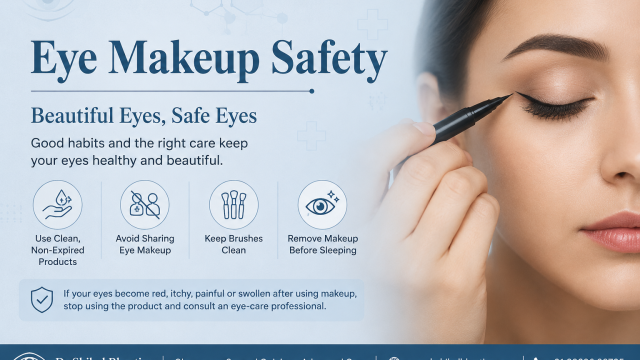
Eye makeup is generally safe when products are not shared, are replaced every three to six months, are applied outside the lash line, and are fully removed each night with a gentle oil-based remover or micellar water and a lint-free pad. The biggest risks are infection from expired or contaminated products, corneal abrasion from glitter particles, and dry eye worsening from products that migrate into the tear film.
Eye makeup can be safe if you follow good hygiene: use clean, non-expired products, avoid sharing makeup, and remove it completely before sleeping. Applying eyeliner on the waterline may increase irritation or infection risk, and dirty brushes can transfer bacteria to the eyes.
If your eyes become red, itchy, painful, or swollen after using makeup, stop using the product and seek advice from an eye-care professional.
Dr Shibal Bhartiya is a fellowship-trained glaucoma specialist and Mayo Clinic Research Collaborator with over 25 years of experience. Her approach focuses on identifying risk before damage is irreversible, simplifying treatment decisions, and protecting vision long-term. Emphasis on early detection, risk assessment, and continuity of care. She is rated 5 stars across 1,500+ patient reviews on Google.
────────────────────────────────────────────
Eye Makeup Safety: An Eye Doctor’s Guide to Application, Risks & Removal
Eye makeup is one of the most intimate cosmetic rituals we have — applied millimetres from the cornea, often with applicators shared between friends or stored in warm bags for months. In my clinic, I see a steady stream of patients with red, irritated, or infected eyes who have no idea that their mascara wand or glittery eyeshadow is the culprit.
As a fellowship-trained ophthalmologist, I want to be clear: most eye makeup is safe when used correctly and removed properly. The problems arise from old products, incorrect technique, contaminated brushes, and — most commonly — makeup not fully removed at the end of the day. This guide covers everything from how to apply eye makeup safely to what to do when it lands on your actual eye.
Whether you are a daily makeup wearer, a teenager using kajal for the first time, or a patient with dry eyes or glaucoma wondering what is safe to use, this article is for you.
General Rules for Safe Eye Makeup Application
Before we look at individual products, a few principles apply to everything you put near your eyes.
| Safety Rule | Why It Matters | What To Do |
| Never share eye makeup | Bacteria and viruses transfer instantly on applicators. This includes mascara, kajal sticks, and shadow brushes. | Keep all eye products personal. Never share — not even once. |
| Check the expiry date | Mascara and liquid liner harbour bacteria from day one of opening. Most are safe for only three months. | Write the date you open each product on the cap. Discard mascara after 3 months, powders after 12 months. |
| Do not apply in a moving vehicle | A jolt can cause the applicator to scratch the cornea, the clear front surface of the eye. | Only apply makeup when seated still, with good light. |
| Keep products at room temperature | Heat accelerates bacterial growth. A warm car or bathroom shelf degrades preservatives faster. | Store away from direct sunlight and heat. Never leave products in a parked car. |
| Do not apply if you have an eye infection | Conjunctivitis and styes can contaminate your entire product range. | Discard all open eye products if you have had an active eye infection. Start fresh once resolved. |
| Remove fully every night | Residual makeup clogs meibomian glands (the oil glands of the eyelid), accelerating dry eye and blepharitis. | Never sleep in eye makeup. No exceptions. |
Mascara: The Most Common Offender
Mascara is the product I am asked about most often. It is also the most easily contaminated, because every use pumps air and bacteria into the tube via the wand.
| Product / Behaviour | Risk to Eyes | Safer Practice |
| Pumping the wand in and out of the tube | Forces air and bacteria into the tube. Rapidly degrades the product. | Swirl the wand inside the tube instead. Never pump. |
| Applying to the inner lash line (waterline / tightline) | Blocks meibomian gland openings, worsens dry eye, and increases infection risk. | Apply only to the outer surface of lashes, not the waterline. |
| Using mascara beyond 3 months | Staphylococcal contamination builds up. Increases risk of stye, conjunctivitis, keratitis. | Date the tube at opening. Discard at 3 months, opened or not. |
| Waterproof mascara every day | Requires heavier removal products; aggressive rubbing thins and weakens the delicate orbital skin and can damage lashes. | Use waterproof only when needed. Regular formula on most days. |
| Lash extensions or serums combined with mascara | Growth serums can cause periorbital skin darkening and changes in iris colour (a rare but documented side-effect). | Discuss lash serum use with an ophthalmologist before starting. |
Kajal, Kohl and Eyeliner: What Every South Asian Patient Should Know
Kajal (kohl) is deeply embedded in South Asian cosmetic tradition, applied from infancy in some families. As an ophthalmologist practising in Gurugram, I discuss kajal safety almost daily.
| Type / Use | Concern | What I Recommend |
| Traditional kohl / kajal imported from outside India | May contain lead (galena). Absorbed through conjunctiva; a particular risk in children and infants. | Use only certified cosmetic-grade kajal. Avoid traditional kohl from unverified sources. Never apply in a child’s eyes. |
| Applying kajal inside the lower waterline | Introduced directly into the tear film and lacrimal drainage; particles migrate to the cornea and into tear ducts. | Apply below the lash line on the outer skin, not inside the eye. |
| Smudged kajal not removed at night | Migrates further during sleep. Contributes to chronic blepharitis and stye formation. | Use a dedicated oil-based remover or micellar water on a cotton pad before bed. |
| Gel liner in pot applied with brush | Multiple dipping of brushes is a rapid contamination route. | Use a fresh disposable wand or wash the brush after every use. |
| Liquid eyeliner with fine-tip applicator | The fine felt tip accumulates bacteria and dries out, making users over-apply. | Replace liquid liner at 3 months. Cap tightly immediately after use. |
Eyeshadow: Pressed, Loose, and Pigment — Risk by Format
Eyeshadow palettes look glamorous but they carry real risks, particularly from loose or finely milled formulas and from shared palettes.
| Format | Eye Risk | Safe Use Tip |
| Pressed powder eyeshadow | Relatively low risk if brushes are clean. Particles can still drift into the tear film. | Use clean, dedicated brushes. Apply with eyes looking down. Tap off excess before applying. |
| Loose pigment / craft glitter used cosmetically | High risk. Jagged particles can abrade the cornea. Cases of corneal ulceration reported with glitter. | Avoid loose craft glitter near eyes entirely. Use only cosmetic-grade fine glitter designed for eye area. |
| Glitter eyeshadow (pressed with binders) | Lower risk than loose. Still migrates. Increased risk in contact lens wearers. | Contact lens wearers should insert lenses before application and avoid glitter near the lid margin. |
| Creamy or mousse eyeshadow | Heavier formula; can migrate into the eye more readily. Shorter shelf life. | Replace after 6 months. Avoid applying near the lash root. |
| Palettes shared between users | Highest contamination risk in any eyeshadow format. | Never share palettes. If used professionally, sanitise with isopropyl alcohol spray between clients. |
Important: Cosmetic-grade glitter is not the same as craft glitter. Craft glitter has sharp, irregularly cut edges that can cause corneal abrasions and ulcers. It should never be used near the eyes. If your glitter did not specifically state ‘eye-safe’ or ‘cosmetic-grade’ on the packaging, treat it as unsafe.
Eye Makeup and Contact Lenses: The Right Order Matters
If you wear contact lenses, the sequence in which you apply makeup — and the products you choose — makes a significant difference to both eye comfort and contact lens lifespan.
- Insert contact lenses before applying any makeup. Hands are cleanest at this point, and lenses are in place before any product is near the eye.
- Choose products labelled ‘for contact lens wearers’ or ‘ophthalmologist-tested’ where possible.
- Avoid fibrous or flaky mascaras, loose powder near the lid margin, and glitter entirely.
- Remove lenses before removing makeup. This protects the lens from solvent residue.
- Never use saliva to wet lenses — a common and dangerous habit that introduces oral bacteria directly to the eye surface.
- Soft lenses absorb preservatives from makeup products. This can cause chronic irritation that is difficult to trace back to the real cause.
Makeup Got Into My Eye — What Do I Do?
This happens to almost everyone. The key is knowing what is a minor irritant event and what needs urgent attention.
| Situation | What Is Likely Happening | Immediate Action |
| Mascara or powder drifts into the eye; mild stinging | Surface irritation of the conjunctiva. Usually self-limiting. | Flush immediately with clean water or sterile saline for 2–3 minutes. Do not rub. |
| Glitter particle in the eye; foreign body sensation persists | Particle lodged on conjunctiva or cornea. Can cause abrasion. | Do not rub. Flush with saline. If sensation persists after 15 minutes, see an ophthalmologist urgently. |
| Liquid eyeliner or mascara in eye; sharp pain or vision blur | Possible corneal involvement. Chemical preservatives in the product may be irritating the cornea. | Flush thoroughly with water for 10–15 minutes. Seek same-day ophthalmology review. |
| Glue (lash glue, stage makeup adhesive) in the eye | High-risk. Adhesive can bond to the ocular surface. | Flush with copious water immediately. Do not attempt to remove bonded material. Go to eye casualty. |
| Makeup in eye followed by increasing redness over 24 hours | Early infection or allergic conjunctivitis. | Do not apply more makeup. See an ophthalmologist within 24–48 hours. Do not self-prescribe antibiotic drops. |
Patient tip: Keep a small bottle of sterile saline eyewash (available from any pharmacy) in your makeup bag. It is the safest first response if any product enters the eye. Clean tap water is the second choice. Do not use contact lens solution as an eyewash — it is not formulated for this.
How to Remove Eye Makeup Safely
Removal is where most damage is done — not application. Aggressive rubbing around the eyes is one of the fastest routes to thinning orbital skin, worsening dry eye, and in patients with predisposing anatomy, a form of mechanical glaucoma called floppy eyelid syndrome.
Micellar Water
Micellar water contains tiny surfactant molecules (micelles) that attract and lift oil, pigment, and debris without requiring water or harsh rubbing. It is my first recommendation for most patients — gentle enough for contact lens wearers, suitable for sensitive skin, and effective on most formulas except heavy waterproof mascara.
How to use: Saturate a lint-free cotton pad (not a cotton ball — fibres shed). Press gently against the closed eye for 10–15 seconds. Swipe once, outward from the inner corner. Never rub back and forth. Repeat with a fresh pad until the pad comes away clean.
Oil-Based Removers
Oil-based formulas are more effective for waterproof mascara and long-wear liner. They dissolve the polymer bonds in waterproof formulas without the mechanical force that water alone requires. A small drop on a cotton pad, held against the lash line for a few seconds, then a gentle outward swipe, is sufficient.
Caution: Oil-based removers should be used carefully by contact lens wearers. Even after removal, a residual oil film can coat soft lenses. Always remove lenses first.
Lid Wipes
Pre-moistened lid wipes are one of the most underused tools in eye care — and one of the most useful. Originally developed for patients with blepharitis (chronic eyelid inflammation), they are now available over the counter in India and are a worthwhile addition to any makeup removal routine.
They are particularly useful for: cleaning the base of the lashes where makeup residue accumulates, patients with chronic blepharitis or dry eye who wear makeup, removing kajal from the lower lid margin, and as a quick cleanse for anyone who cannot complete a full removal routine.
Use after your main makeup remover step, not as a replacement for it. Run the folded wipe along the upper and lower lash margins once each. They are single-use.
Removing Eye Makeup Over the Waterline — The Right Way
The waterline (inner rim of the eyelid where lashes meet the eye surface) is the most difficult area to clean. A saturated cotton bud (Q-tip) with micellar water, gently drawn along the inner rim, is effective. Do not press into the eye. One stroke outward is sufficient. This area needs cleaning every time kajal or tight-line liner has been applied.
| Product Type | Best Removal Method | Common Mistake to Avoid |
| Regular mascara | Micellar water on lint-free pad; hold and swipe | Rubbing downward with a dry tissue — causes lash loss and skin damage |
| Waterproof mascara | Oil-based remover held against lashes for 10 seconds; then micellar water | Pulling off with a dry wipe — strips lashes |
| Pressed eyeshadow | Micellar water on pad; gentle circular motion on lid — not near lash margin | Rubbing aggressively — causes pigment to migrate toward the eye |
| Glitter eyeshadow | Oil-based remover first; then micellar; check with a mirror for residual particles | Flushing with water — glitter floats and can re-enter the eye |
| Kajal on the lower lid (outer skin) | Micellar water; cotton bud for precise lash-line area | Leaving it ‘for the morning’ — migrates to the eye surface overnight |
| Waterline kajal | Saturated cotton bud with micellar water along the inner rim | Dry-rubbing with a cotton ball — abrades the delicate mucosa |
| Gel liner in pot | Oil-based remover on a cotton bud; then swipe outward with a pad | Ignoring the outer corner — liner accumulates and harbours bacteria |
Eye Makeup and Existing Eye Conditions
Patients with glaucoma, dry eye, blepharitis, or those who have had eye surgery should take particular care. Here is what I advise in each situation.
| Condition | Specific Concern with Makeup | Recommendation |
| Dry eye syndrome | Products migrating into the tear film reduce already-depleted lipid layer. Kajal and mascara are common triggers. | Minimise liner on the waterline. Use fragrance-free, ophthalmologist-tested products. Remove makeup before instilling evening eye drops. |
| Blepharitis (chronic lid inflammation) | Makeup accelerates meibomian gland blockage and bacterial load on lashes. | Use daily lid wipes as part of the bedtime routine. Avoid heavy liner at the lash root during flares. |
| Glaucoma (on eye drops) | Preservatives in eye drops can interact with makeup residue; applying makeup over preserved drops reduces drop efficacy. | Allow glaucoma drops to absorb fully before applying makeup. Remove makeup before evening drops. |
| Post LASIK / PRK (first 6 months) | Eye surface is healing. Makeup particles increase infection and dry eye risk. | No eye makeup for at least one month post-LASIK. Discuss extension of this period with your surgeon. |
| Contact lens wearers | Particles in the tear film coat the lens surface, reducing comfort and increasing deposit formation. | Insert lenses before makeup. Remove lenses before removing makeup. Choose lens-friendly formulas. |
| Allergic conjunctivitis | Many eye makeup ingredients are common allergens — fragrances, preservatives, nickel in pigments. | Patch-test new products on the inner wrist first. Switch to hypoallergenic, fragrance-free, preservative-free formulas. |
When To See an Ophthalmologist
Most makeup-related eye events resolve with simple flushing. But certain symptoms should prompt same-day or urgent review.
- Persistent foreign body sensation after flushing — a particle may be embedded in the conjunctiva or cornea
- Pain in the eye that does not settle within 30 minutes of flushing
- Blurred or altered vision at any point after a makeup exposure
- Eye redness that worsens over 24–48 hours rather than improving
- Swollen or crusted eyelids the morning after applying makeup
- A new bump or cyst at the lash base that does not resolve within two weeks — this may be a stye or chalazion
- Any eye symptoms in a child
- Eye symptoms that began after using a new makeup product — this warrants a full allergy assessment
Important: Do not self-prescribe antibiotic or steroid eye drops for makeup-related eye symptoms. Steroid drops used incorrectly can cause a pressure rise in the eye (steroid-induced glaucoma) and worsen certain infections. See an ophthalmologist for any symptoms that do not fully resolve within 24–48 hours.
Frequently Asked Questions
Is it safe to apply kajal inside a baby or young child’s eyes?
No. I advise firmly against this. The waterline of an infant or child is not a cosmetic surface — it is part of the ocular surface that drains into the nasal passages and is in direct contact with the eye. Traditional kohl (surma) may contain lead, and even certified cosmetic-grade kajal poses an infection and irritation risk in young eyes. The practice of applying kajal to prevent evil eye or improve vision has no medical basis. If you are concerned about your child’s eyes, please see a paediatric ophthalmologist rather than using any topical product.
How do I know if my eye makeup allergy is causing my chronic red eye?
A temporal relationship is the most important clue — do your eyes improve on days when you do not wear makeup, and worsen when you do? If the answer is yes, begin by eliminating products one at a time, starting with mascara and liner, then progressing to eye shadow and primer. Patch testing performed by a dermatologist or allergist can identify the specific ingredient (commonly fragrances, preservatives like thimerosal, or metals in pigments). Your ophthalmologist can also check for signs of allergic or toxic follicular conjunctivitis under the slit lamp.
Can mascara or eye shadow cause glaucoma?
Not directly. However, eye drops used to treat conditions that makeup-related infections trigger — particularly steroid drops — can elevate intraocular pressure in susceptible individuals, which is a risk factor for glaucoma. In patients who already have glaucoma, makeup that migrates into the tear film and clogs the drainage structures of the eyelid (the meibomian glands) can worsen dry eye, which reduces the comfort and effectiveness of glaucoma drop therapy. Glitter particles that cause corneal trauma can, rarely, trigger inflammatory responses that may temporarily affect eye pressure.
What is the difference between micellar water and an oil-based remover? Which should I use?
Micellar water uses surfactant molecules that attract and lift water-based and light oil-based pigments. It is ideal for regular mascara, pressed eyeshadow, and kajal applied to the outer skin. It requires no rinsing and causes minimal disruption to the tear film. Oil-based removers are more effective for waterproof and long-wear formulas, which use polymer binders that only dissolve in oil. Many dermatologists and ophthalmologists recommend a two-step approach for heavy makeup: oil-based remover first (to break down the product), then micellar water to complete the cleanse and remove any oily residue. Contact lens wearers should complete removal with a water-based step and always remove lenses before any makeup removal.
Are lid wipes the same as regular face wipes? Can I use either?
They are not the same. Regular face wipes contain a range of surfactants, fragrances, and preservatives that can irritate the delicate lid margin skin and ocular surface. Ophthalmic lid wipes — brands such as Blephasol, Cliradex, or similar formulations available in India — are specifically pH-balanced for the eyelid and conjunctival tissue and are designed to remove debris from the lash line without disrupting the tear film. They often contain tea tree oil derivatives (to address Demodex mites) or hypochlorous acid. I recommend using lid wipes rather than face wipes for any cleaning within the orbital area.
How long after eye surgery can I wear eye makeup again?
This varies by procedure. After cataract surgery, most surgeons recommend waiting two to four weeks before using any eye makeup near the operated eye, and even longer for liquid products near the lid margin. Similarly, after LASIK, the general guidance is no eye makeup for at least one month, as the corneal surface is healing and any particle or solvent contact increases infection risk. After glaucoma procedures such as trabeculectomy, the restriction may extend to three months or longer. Always follow your operating surgeon’s specific instructions — they will have the most accurate guidance based on your healing progress.
Key Takeaways
- Replace mascara every three months, liquid liner every three months, powder shadows every twelve months — even if they look fine.
- Never apply kajal inside the eye of a child, and avoid applying anything to your own waterline if you have dry eye or blepharitis.
- Flush the eye immediately with saline or clean water if any product enters the eye. Do not rub.
- Avoid craft glitter near the eyes entirely. Only use cosmetic-grade, eye-safe formulations.
- Micellar water and lint-free pads are the safest daily removal combination. Add an oil-based first step for waterproof products.
- Lid wipes — not face wipes — are recommended for cleaning the lash margin, especially in patients with blepharitis or dry eye.
- If you have glaucoma, dry eye, or have had eye surgery, discuss your makeup routine with your ophthalmologist before resuming or changing products.
Book a Consultation
If you are experiencing persistent eye irritation, redness, or unexplained visual changes — and you wear eye makeup regularly — a structured assessment can often identify the cause quickly. At my clinic in Gurugram, I evaluate the eyelid margin, tear film, cornea, and anterior segment under the slit lamp, and can advise you on a makeup routine that is compatible with your specific eye health needs.
I also see patients who need a second opinion on glaucoma, neuro-ophthalmology concerns, or general ophthalmology before and after cosmetic eye procedures.
→ Book an Appointment
About the Author
This article was written by Dr Shibal Bhartiya, fellowship-trained glaucoma specialist and Mayo Clinic Research Collaborator, Clinical Director at Marengo Asia Hospitals, Gurugram, known for ethical, patient-centred glaucoma care and independent glaucoma second opinions. She is also the Program Director for Community Outreach & Wellness; and for the Marengo Asia International Institute of Neuro and Spine.
She has published peer-reviewed research on glaucoma management, examining how treatment decisions should balance medical evidence, patient preferences, and long-term vision outcomes.
As Editor-in-Chief of Clinical and Experimental Vision and Eye Research and Executive Editor of the Journal of Current Glaucoma Practice (Pubmed Indexed, official journal of the International Society of Glaucoma Surgery), Dr Shibal Bhartiya brings editorial and research depth to every clinical decision. Her 200+ publications, including 90+ PubMed-indexed publications and 28 edited textbooks span glaucoma biology, surgical outcomes, health equity, and emerging diagnostics.
1500+ Five Star Patient Reviews Google Business Profile
If you are unable to come to Dr Bhartiya’s clinic: Read more about teleconsultation
Read her research on PubMed | Google Scholar | ResearchGate | ORCID
Upload your reports for a structured review.| www.drshibalbhartiya.com | +91 88826 38735
Leave a review on Google