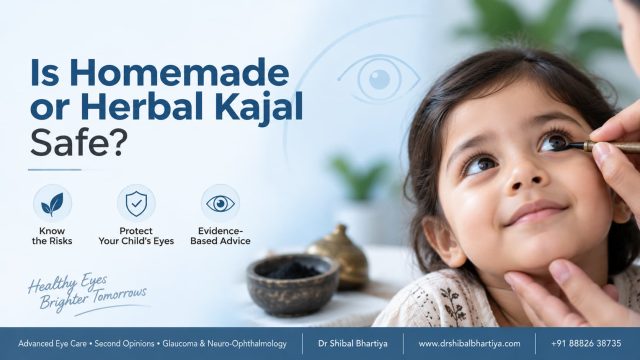
Homemade, herbal, or expensive kajal is not automatically safe for the eyes. Safety depends entirely on what the product actually contains and how it is used, not on price, branding, or whether it was made at home. Many homemade and “natural” preparations have tested positive for lead, and applying any kajal on the waterline carries risk regardless of its origin or cost.
Quick Answer: Homemade, herbal, and expensive kajal are not inherently safer than ordinary kajal. Safety comes from verified composition and lead-free certification, not from price, natural branding, or being made at home. Waterline application itself carries risk independent of the product used.
Key Health Risks
- Bacterial Contamination & Eye InfectionsMaking kajal at home lacks sterile manufacturing environments. Storing soot, oils, or ghee in domestic containers can foster bacterial growth, which can lead to conjunctivitis (pink eye), styes, or severe corneal ulcers.
- Heavy Metal Toxicity (Lead Risk)Many traditional or uncertified “herbal/ayurvedic” kajals (and surma/kohl) contain galena (lead sulfide) or heavy metals like antimony. Lead is absorbed through the thin mucous membranes of the eye and can cause irreversible neurological damage, especially in children.
- Clogged Eyelid Glands (Dry Eyes & Styes)Applying kajal along the waterline (inner rim of the eyelid) blocks the Meibomian glands. These tiny oil glands keep the tear film stable; blocking them leads to chronic dry eye disease, chalazions, and inflammation (blepharitis).
- Corneal Abrasions & IrritationCarbon particles from burnt almonds, camphor, or ghee soot are coarse under a microscope. Applying fine carbon soot directly near the eye can scratch the cornea or trigger chemical conjunctivitis.
Special Risk: Infants & Children
Applying homemade kajal to babies to ward off evil eyes (nazar) is a widespread cultural practice, but it carries high medical risk. Infants have delicate ocular tissues, underdeveloped immune systems, and higher rates of absorption. Health agencies (including the CDC and WHO) explicitly warn against applying traditional kajal or kohl to infants.
Safe Cultural Alternative: If you wish to maintain cultural traditions for a baby, apply a small dot behind the ear or on the sole of the foot—never in or around the eyes.
If You Choose to Wear Kajal
If you wear eye makeup, follow these guidelines to protect your vision:
- Choose Certified Products: Use commercial brands explicitly tested by ophthalmologists, labeled lead-free, and approved by safety standards.
- Avoid the Waterline: Apply cosmetics along the outer lash line rather than directly on the inner eyelid rim.
- Never Share Eye Makeup: Sharing applicators transfers bacteria between eyes.
- Remove Before Sleep: Sleeping with eye cosmetics blocks tear ducts and causes night-time infection risks.
- Discard Regularly: Replace any eye cosmetic every 3 to 6 months.
Why This Belief Persists
This belief rests on three separate assumptions that feel reasonable individually but do not hold up together. Homemade feels safe because it is made with known ingredients by someone trusted, away from mass manufacturing. Herbal feels safe because “natural” is widely equated with harmless. Expensive feels safe because higher price is assumed to mean better regulation and purer ingredients. None of these assumptions are reliably true for a cosmetic applied directly to the eye.
What The Science Actually Says
Composition, not origin, determines whether a kajal is safe. Homemade kajal is often prepared using traditional recipes involving soot, oils, and sometimes metallic compounds passed down through generations, without any testing for heavy metal content. Because it is not manufactured under any regulatory oversight, there is no way to verify what it actually contains, and testing of homemade preparations has repeatedly found significant lead levels.
“Herbal” or “natural” labelling refers to marketing, not to a lead-free guarantee. A product can be plant-based in some ingredients while still containing mineral additives like lead sulphide, which is traditionally used to achieve the deep black colour and smooth texture kajal is known for. Natural does not mean unregulated compounds are absent.
Price behaves similarly. An expensive kajal may follow better manufacturing and packaging standards, but price alone does not confirm lead-free certification or safe application. The only way to know is checking for genuine safety certification and ingredient testing, not the cost on the label.
Separately, the waterline itself is a risk factor regardless of what is applied there. It sits directly against the eye’s surface and the tear duct openings. Repeated application, of any product, can cause irritation, blocked ducts, or low-grade chronic inflammation, independent of the formulation’s purity.
What Actually Helps
- Check for genuine safety certification or lab-tested lead-free status before using any kajal, homemade or store-bought
- Avoid applying kajal directly on the waterline, even with a trusted or verified product
- Be especially cautious with homemade preparations, since they cannot be verified for heavy metal content
- Don’t equate “herbal,” “natural,” or “Ayurvedic” labelling with a lead-free guarantee
- If irritation, watering, or redness develops with regular use, stop and get the eyes examined
When To See a Doctor
- Persistent redness, watering, or irritation with regular kajal use
- A gritty or burning sensation after application
- Recurrent styes or eyelid swelling
- Any known exposure to unverified or homemade kohl preparations over months or years
- No eye check in the last 12 months
Frequently Asked Questions
Is herbal kajal actually lead-free?
Not necessarily. “Herbal” describes some plant-based ingredients but does not guarantee the absence of lead or other metallic compounds. Only lab testing or verified certification confirms lead-free status.
Does a higher price mean a kajal is safer?
Not reliably. Price reflects branding, packaging, and marketing more than verified safety testing. The determining factor is certified composition, not cost.
Is homemade kajal riskier than commercial kajal?
It can be, because it is untested and prepared without any regulatory oversight. Commercial products vary too, but at least some are subject to safety standards that homemade preparations are not.
Book a Consultation
If you’ve noticed irritation or discomfort with regular kajal use, or want a proper eye check, it’s worth getting assessed rather than assuming the product is safe.
Book an Appointment →
📍 Gurgaon 📞 +91 88826 38735 | 🌐 Contact Us | Second Opinion Form for teleconsults
This article is a part of the Myths about Eyes Hub. Read on more to understand more about your eye health. Also read Do Almonds Improve Vision, Do Spinach and Amla Improve Vision, and Nutrients for Eye Health, Glaucoma Myths Debunked, Myths About Cataract.
Please also read about Eye Makeup, Removing eye Makeup, Mascara and Eyelash Extensions .
About the Author
This article was written by Dr Shibal Bhartiya, fellowship-trained glaucoma specialist and Mayo Clinic Research Collaborator, Clinical Director at Marengo Asia Hospitals, Gurugram, known for ethical, patient-centred glaucoma care and independent glaucoma second opinions. She is also the Program Director for Community Outreach & Wellness; and for the Marengo Asia International Institute of Neuro and Spine.
She has published peer-reviewed research on glaucoma management, examining how treatment decisions should balance medical evidence, patient preferences, and long-term vision outcomes.
As Editor-in-Chief of Clinical and Experimental Vision and Eye Research and Executive Editor of the Journal of Current Glaucoma Practice (Pubmed Indexed, official journal of the International Society of Glaucoma Surgery), Dr Shibal Bhartiya brings editorial and research depth to every clinical decision. Her 200+ publications, including 90+ PubMed-indexed publications and 28 edited textbooks span glaucoma biology, surgical outcomes, health equity, and emerging diagnostics.
1600+ Five Star Patient Reviews Google Business Profile
If you are unable to come to Dr Bhartiya’s clinic: Read more about teleconsultation
Read her research on PubMed | Google Scholar | ResearchGate | ORCID | Github | Wikidata
📋Upload your reports for a structured review.| 🌐 Contact Us| 📞 +91 88826 38735
⭐ Helped by this article? Leave a Google review — it helps other patients find reliable eye care.