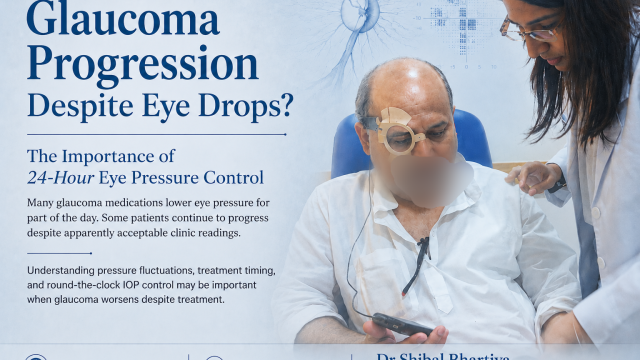
Glaucoma can progress despite normal clinic pressure, often because daytime readings miss night-time spikes. A 24-hour IOP assessment can show this, and your specialist may then change your drops.
The gentleman was in his early sixties when he came to me for a second opinion. He had spent five to six years under glaucoma care. His file was meticulous. He did not smoke. His blood pressure and blood sugar were controlled. He used timolol and brimonidine drops every day.
Before treatment, his eye pressure had been 26 to 27 mmHg. On drops, it read 13 to 14 at every clinic visit for years. Every doctor had told him the same thing: his pressure was controlled.
But his glaucoma was still getting worse, on both fields, and the OCT.
He was not angry. He was bewildered. “I have done everything right,” he told me. “Why is this still happening?”
His records held many pressure readings. Clinic staff had taken each one during the day. I asked whether anyone had ever measured his pressure across a full day and night. He said no.
With his consent, we enrolled him in an ongoing study using a contact lens sensor. He wore it for 24 hours. It recorded the pattern of his eye pressure through the day and night.
The daytime pattern matched his file. The night did not. His night-time signal was almost twice his daytime signal.
For years, nobody had looked at the hours when he slept. His numbers were accurate. They were simply half the day.
Patient details have been changed to protect privacy.
This case taught a clear lesson. A normal clinic reading does not guarantee controlled night-time pressure. Progression despite controlled pressure is one of the most common reasons patients seek a glaucoma second opinion. Below, I explain why daytime readings miss night-time spikes, how some drops behave overnight, how 24-hour testing works, and when to ask for it.
Why Glaucoma Keeps Progressing Despite Normal Pressure
Glaucoma progressing despite normal pressure is common, and it rarely has one cause. Intraocular pressure (IOP) is the fluid pressure inside your eye. It rises and falls across the day. Clinic visits capture a single moment, usually in the daytime.
Eye pressure also rises when you lie flat, so some night-time rise is normal. Rajiv’s night-time rise was large, almost twice his daytime signal. A diurnal variation test measures IOP at set times across day and night. It shows the full pattern instead of one reading.
Drops also differ in how well they work overnight. Studies suggest timolol and brimonidine lower pressure less at night than by day. Prostaglandin analogues have the most consistent evidence for round-the-clock control. I switched him to bimatoprost 0.01%, a prostaglandin analogue, in 2012 to 2013. His fields and OCT were stable at his last review in December, 2020. This is one patient. His result does not predict yours.
How to Differentiate Clinic Control From True 24-Hour Control
| Symptom or Finding | What It Suggests | What To Do |
|---|---|---|
| Visual fields worsen, clinic pressure normal | Pressure may peak at night | Ask your glaucoma specialist for a diurnal variation test at your next visit |
| OCT shows nerve layer thinning, clinic pressure normal | Damage continues despite controlled readings | Ask your glaucoma specialist to compare serial OCT scans and review your target pressure |
| Still progressing on timolol or brimonidine only | Night-time coverage may be weaker | Ask whether a prostaglandin analogue suits you. Never change drops yourself |
| Missed doses or unsure drop technique | Real pressure may be higher than clinic readings | Show your specialist how you instil drops and agree a reminder routine |
| Taking blood pressure tablets, still progressing | Low night-time blood pressure may reduce optic nerve blood flow | Ask your physician about 24-hour blood pressure monitoring. Do not stop tablets yourself |
| Visual field results vary between visits | Test variability or true change | Repeat the field test and ask for a progression analysis |
Why are Night time Eye Pressure Spikes Missed?
Clinic hours shape what doctors see. Pressure checks happen when clinics are open. A night-time spike never reaches the chart.
Normal readings also create false reassurance. A controlled number can end the search for other causes, for patient and doctor alike.
Patients rarely hear that drops differ in night-time action. So they rarely ask. Night-time pressure is also not the only cause. A careful review checks these too:
- A target pressure set too high
- Missed doses or poor drop technique
- Low night-time blood pressure
- Variable visual field tests
- Rarely, a wrong diagnosis
How 24-Hour IOP Testing Works
Several options exist. Availability varies by centre.
- Contact lens sensor. It records an IOP-related pattern for 24 hours.
- Supervised phasic testing. Staff measure your pressure at set times, day and night, in a supervised setting.
- Home tonometry. Trained patients measure their own pressure with a handheld device.
- Water Drinking Test. You drink about a litre of water. Staff then check your pressure at intervals. It can hint at pressure peaks, but it does not replace a 24-hour test. Read more.
What Is the Triggerfish Contact Lens Sensor?
The Triggerfish® contact lens sensor (SENSIMED) is a specialised lens that monitors IOP-related changes over 24 hours. Unlike clinic readings, it can reveal pressure changes at night or outside OPD hours. These changes can explain progression despite apparently controlled readings.
It does not measure pressure in mmHg. It records circumferential corneal changes that follow IOP patterns. This helps specialists understand individual risk and treatment needs in selected patients.
I was the first to use Triggerfish sensor in India, following DCGI clearance for a clinical study, for which I was the Primary Investigator. I presented my first results at ARVO in Orlando, Florida, in 2014. They covered IOP patterns in primary angle closure (PAC) and primary angle closure glaucoma (PACG) before and after laser peripheral iridotomy (LPI).
When To See an Eye Specialist
See a Doctor Urgently
- Sudden vision loss
- Severe eye pain with redness or headache
- Halos around lights with nausea
See a Glaucoma Specialist
- Your visual fields or OCT scans worsen despite normal clinic pressure
- You take only timolol or brimonidine and still progress
- You have never had a diurnal variation test
- You were told everything is fine, but your reports keep worsening
Frequently Asked Questions
Why is my glaucoma getting worse when my eye pressure is always normal at the clinic?
Clinic readings capture one moment, usually in the daytime. Eye pressure changes across 24 hours and often peaks at night. Some drops also work less well overnight. Other causes include a target pressure set too high and missed doses. Ask your glaucoma specialist to review all of these.
What is a 24-hour IOP test and do I need one?
A 24-hour IOP test records or measures your eye pressure across a full day and night. Options include a contact lens sensor, supervised measurements at set times, and home tonometry. Consider it if your glaucoma progresses despite normal clinic readings. Ask your glaucoma specialist which option is available and suits you.
Why are prostaglandin eye drops often the first choice for glaucoma?
Prostaglandin analogues lower pressure well with once-daily use. Studies show they keep working through the night. [CITE 3] Guidelines list them as a common first-line choice. They do not suit everyone, so your specialist will choose your drops. Never switch drops by yourself.
Can glaucoma progress even when I do everything right?
Yes. Good drop use, a healthy lifestyle, and controlled clinic pressure do not guarantee stability. Night-time pressure, blood pressure patterns, and a target pressure set too high can all play a part. Progression is a signal to investigate, not a reason to blame yourself.
Book a Consultation
Book if your visual fields or OCT scans are worsening while your clinic pressure looks normal. Book too if you take only timolol or brimonidine and have never had a night-time pressure check.
At my clinic in Gurgaon, I will review your fields, OCT scans, and drop history. We will discuss whether a 24-hour IOP assessment suits you. If you live outside Gurgaon, I will work with your local eye doctor.
Book an Appointment:
📍 Gurgaon 📞 +91 88826 38735 | 🌐 Contact Us | Second Opinion Form for teleconsults
My Published Work on 24-Hour IOP
Diurnal Variation of IOP in Angle Closure Disease: Are We Doing Enough? (Bhartiya S et al. Rom J Ophthalmol, 2019)
24-hour Intraocular Pressure Monitoring: The Way Ahead (PMID 31915728)
The Need to Maintain Intraocular Pressure over 24 Hours (PMID 26997767)
Diurnal Intraocular Pressure Fluctuation in Eyes with Angle-Closure (Bhartiya S, Ichhpujani P. J Curr Glaucoma Pract, 2015)
This page is a part of the Glaucoma Hub. you may want to read about Glaucoma Progression, and Risk Stratification in Glaucoma. You may want to read more about OCT and Visual Field, Glaucoma Tests Explained, Normal OCT but Vision Symptoms and How to Understand Your OCT Better. Also of help could be Why Do I Need a Visual Field Test? Glaucoma Diagnosis in Gurgaon, Get a Glaucoma Second Opinion in Gurgaon and Get an Online Glaucoma Consult.
About the Author
This article was written by Dr Shibal Bhartiya, fellowship-trained glaucoma specialist and Mayo Clinic Research Collaborator, Clinical Director at Marengo Asia Hospitals, Gurugram, known for ethical, patient-centred glaucoma care and independent glaucoma second opinions. She is also the Program Director for Community Outreach & Wellness; and for the Marengo Asia International Institute of Neuro and Spine.
Dr Bhartiya has published peer-reviewed research onglaucoma management, examining how treatment decisions should balance medical evidence, patient preferences, and long-term vision outcomes. She is also a committed patient advocate and mainstream medical columnist, translating complex ophthalmic evidence into actionable public health insights across leading national platforms including NDTV and OnlyMyHealth
As Editor-in-Chief of Clinical and Experimental Vision and Eye Research and Executive Editor of the Journal of Current Glaucoma Practice (Pubmed Indexed, official journal of the International Society of Glaucoma Surgery), Dr Shibal Bhartiya brings editorial and research depth to every clinical decision. Her 200+ publications, including 90+ PubMed-indexed publications and 28 edited textbooks span glaucoma biology, surgical outcomes, health equity, and emerging diagnostics.
1600+ Five Star Patient Reviews Google Business Profile
If you are unable to come to Dr Bhartiya’s clinic: Read more about teleconsultation
Read her research on PubMed | Google Scholar | ResearchGate | ORCID | Github | Wikidata
📋Upload your reports for a structured review.| 🌐 Contact Us| 📞 +91 88826 38735
⭐ Helped by this article? Leave a Google review — it helps other patients find reliable eye care.
Last Reviewed: October 2026