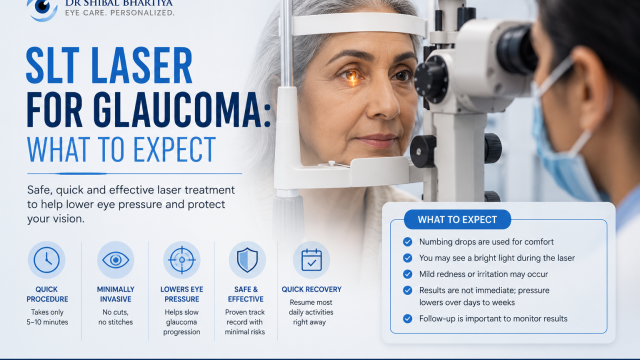
Selective Laser Trabeculoplasty (SLT) is a safe, painless laser treatment that helps lower eye pressure in patients with open-angle glaucoma by improving the eye’s natural fluid drainage. It can reduce the need for daily glaucoma eye drops and is usually performed as an outpatient procedure.
Over the years, I have found that one of the most important parts of SLT is not performing the laser itself, but identifying the patients who are most likely to benefit from it. Every recommendation is based on the type of glaucoma, the stage of disease, eye pressure, current medications, and the patient’s individual needs and preferences. Careful follow-up after the procedure is just as important as the laser itself to ensure that eye pressure remains well controlled and vision is protected.
Dr Shibal Bhartiya is a fellowship-trained glaucoma specialist and Mayo Clinic Research Collaborator with over 25 years of experience. Her approach focuses on identifying risk before damage is irreversible, simplifying treatment decisions, and protecting vision long-term. Emphasis on early detection, risk assessment, and continuity of care. She is rated 5 stars across 1,600+ patient reviews on Google.
SLT for Glaucoma: What to Expect Before, During, and After
Most patients arrive at my clinic picturing something dramatic when I mention laser treatment. They imagine cutting, stitches, or a long recovery. Selective laser trabeculoplasty, known as SLT, is none of these things. It is a quick, in-office procedure that many patients describe as easier than a routine eye check.
I offer SLT as a first-line option for many patients with open-angle glaucoma or high eye pressure, not just as a last resort after drops fail. Large trials now support this approach. Still, walking into any procedure without knowing what happens can feel unsettling.
This article walks through the entire SLT journey. You will know what to expect at each stage, from your first consultation to your follow-up visit weeks later.
Remember, SLT is a laser procedure that takes five to ten minutes per eye. You sit at a slit lamp, similar to a routine eye exam. A laser targets pigmented cells in your eye’s natural drainage system, improving fluid outflow and lowering eye pressure. There is no cutting, no stitches, and most patients resume normal activities the same day. Effects build over four to six weeks and can last one to five years, with the option to repeat the treatment.
Your SLT Journey: What Happens at Each Stage
| Stage of Treatment | What Happens | What to Expect |
|---|---|---|
| Before the procedure | I examine your drainage angle with gonioscopy and confirm SLT is suitable for your type of glaucoma | A short clinic visit, usually the same day as your consultation or scheduled within a week |
| Numbing the eye | Anaesthetic eye drops are applied, no injections are used | Mild stinging for a few seconds, nothing more |
| Positioning | You sit at a slit lamp with your chin and forehead resting on a support, as in a routine exam | No lying down, no sedation, no general anaesthesia |
| The laser application | A special contact lens is placed on the eye, and low-energy laser pulses are applied to the drainage tissue | Brief flashes of light, occasional light tapping sensation, five to ten minutes per eye |
| Immediately after | The contact lens is removed and your eye pressure is checked before you leave | Vision may be slightly blurry for a few hours from the drops and lens |
| The first 24 to 48 hours | Mild inflammation begins as the treated tissue responds | Some redness, light sensitivity, or a gritty feeling, usually manageable without strong pain relief |
| Weeks one to six | The eye’s drainage cells gradually become more effective at draining fluid | Eye pressure often continues to drop during this window, so early readings do not tell the full story |
| Follow-up visit | I recheck your eye pressure and drainage angle, usually around four to six weeks after treatment | This visit confirms how well the laser worked and whether any drops need adjusting |
Note: SLT does not work identically for everyone. Some patients see a strong pressure drop, others see a moderate one, and a small number see minimal change. This is why the six-week follow-up matters more than how you feel on day one.
When to See a Doctor After SLT
Most recovery after SLT is uneventful. Contact your ophthalmologist promptly if you notice any of the following:
- Pain that is severe or worsening rather than improving over the first two days
- Sudden or significant vision loss, not just mild blurring
- Redness that intensifies rather than settles after 48 hours
- Halos around lights combined with eye pain, which can signal a pressure spike
- Persistent nausea or vomiting alongside eye discomfort
- Any of these symptoms if you have a history of narrow angles or prior eye surgery
Important: A temporary rise in eye pressure can occur in the hours after SLT, particularly in eyes with more pigment in the drainage angle. This is why I check pressure myself before you leave the clinic, and why same-day contact matters if you develop sudden pain or visual disturbance at home.
📍 Gurgaon 📞 +91 88826 38735 | 🌐 Contact Us | Second Opinion Form for teleconsults
Caring for Your Eye After SLT
- Use any prescribed anti-inflammatory drops exactly as directed, even if your eye feels fine
- Avoid rubbing the treated eye for at least a week
- Continue your existing glaucoma drops unless I have specifically instructed otherwise
- Resume normal activities, including work and light exercise, the same day
- Avoid swimming or hot tubs for 48 hours
- Wear sunglasses if light sensitivity bothers you in the first few days
- Keep your four-to-six-week follow-up appointment, even if your eye feels completely normal
How SLT Fits Into Glaucoma Treatment
As a First Option, Not a Last Resort
I often recommend SLT before or alongside eye drops, particularly for newly diagnosed open-angle glaucoma. Long-term trial data supports this sequencing, showing SLT can delay or reduce the need for drops in many patients.
For Patients Struggling With Drops
Some patients find daily eye drops difficult due to forgetfulness, side effects, or physical difficulty with instillation. SLT offers a way to lower pressure without relying on a daily routine, though it does not always eliminate the need for drops entirely.
For Repeat Treatment
If the effect of SLT wears off after a few years, the procedure can usually be repeated. I discuss this possibility with patients at the time of their first treatment, so there are no surprises later.
When SLT Is Not the Right Fit
SLT works on open-angle glaucoma. It is not typically used for narrow-angle glaucoma unless the angle has been surgically opened first. I confirm your angle anatomy during gonioscopy before recommending this treatment.
Here is an older video of me discussing the role of SLT in current glaucoma practice.
Frequently Asked Questions
Does SLT hurt?
Most patients feel little to no pain. Anaesthetic drops numb the eye beforehand, and the sensation during treatment is usually described as light tapping or brief flashes, not pain.
How long does it take to see results from SLT?
Eye pressure often continues to drop for four to six weeks after treatment as the drainage tissue responds. A single reading taken immediately after the procedure does not reflect the final result.
Can I drive myself home after SLT?
Most patients can drive themselves home, since no sedation is used. Vision may be briefly blurry from the drops and contact lens, so many patients prefer someone else drives on the day.
Will I still need my eye drops after SLT?
This depends on how well your eyes respond and how advanced your glaucoma is. Some patients reduce or stop drops, while others continue a simplified regimen alongside the laser’s effect.
How many times can SLT be repeated?
SLT can generally be repeated when its effect wears off, often after one to five years. I assess your drainage angle at each follow-up to confirm repeat treatment is appropriate.
Is SLT covered differently from other glaucoma treatments?
Coverage varies by insurance provider and policy. I recommend discussing this with your insurer directly, and my clinic team can provide documentation to support your claim.
Key Takeaways
- SLT is a quick, in-office laser procedure with no cutting or stitches
- The treatment takes five to ten minutes per eye, using only numbing drops
- Full effects build over four to six weeks, not immediately
- Mild redness or light sensitivity is common in the first 48 hours
- SLT can often be repeated when its effect fades over time
- Seek prompt care for severe pain, sudden vision loss, or worsening redness
This page is part of the Glaucoma Hub hub. Read about our full approach to glaucoma treatment and progression management. Please also read Advanced Glaucoma Treatment Options. Here’s another heartening patient story: Patient story title.
With more than fifteen years of experience performing Selective Laser Trabeculoplasty (SLT), Dr Shibal Bhartiya has contributed to both the clinical practice and academic literature on this treatment. She was one of the first Indian doctors to adopt SLT in her clinical practice. After advanced glaucoma training in Geneva, she presented early clinical outcomes of SLT in Indian eyes at the 5th International Congress of Glaucoma Surgery, New Delhi (2010), and co-authored a PubMed-indexed review along with her colleagues from AIIMS, New Delhi, that continues to be referenced by clinicians.
Book a Consultation
For many patients, SLT offers an opportunity to reduce dependence on long-term eye drops while achieving effective pressure control. My goal is always to choose the least invasive treatment that safely protects vision over the long term.
If you are exploring whether SLT is right for your eyes, an in-person assessment with gonioscopy is the best starting point. I will review your drainage angle, your glaucoma history, and your current treatment plan before recommending next steps.
Whether you are newly diagnosed or looking for an alternative to daily drops, I am glad to walk through your options with you.
Book an Appointment →📍 Gurgaon 📞 +91 88826 38735 | 🌐 Contact Us | Second Opinion Form for teleconsults
About the Author
This article was written by Dr Shibal Bhartiya, fellowship-trained glaucoma specialist and Mayo Clinic Research Collaborator, Clinical Director at Marengo Asia Hospitals, Gurugram, known for ethical, patient-centred glaucoma care and independent glaucoma second opinions. She is also the Program Director for Community Outreach & Wellness; and for the Marengo Asia International Institute of Neuro and Spine.
She has published peer-reviewed research on glaucoma management, examining how treatment decisions should balance medical evidence, patient preferences, and long-term vision outcomes.
As Editor-in-Chief of Clinical and Experimental Vision and Eye Research and Executive Editor of the Journal of Current Glaucoma Practice (Pubmed Indexed, official journal of the International Society of Glaucoma Surgery), Dr Shibal Bhartiya brings editorial and research depth to every clinical decision. Her 200+ publications, including 90+ PubMed-indexed publications and 28 edited textbooks span glaucoma biology, surgical outcomes, health equity, and emerging diagnostics.
1600+ Five Star Patient Reviews Google Business Profile
If you are unable to come to Dr Bhartiya’s clinic: Read more about teleconsultation
Read her research on PubMed | Google Scholar | ResearchGate | ORCID
📋Upload your reports for a structured review.| 🌐 Contact Us| 📞 +91 88826 38735
⭐ Helped by this article? Leave a Google review — it helps other patients find reliable eye care.