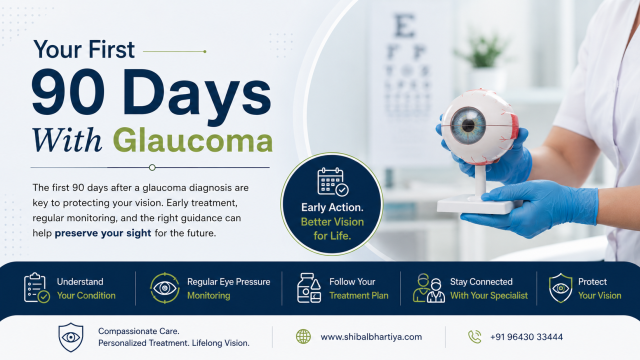
After a glaucoma diagnosis, start treatment, learn the right drop technique, and book a follow-up within four to six weeks. Check your general health, watch out for any side effects, and ask your doctor whether laser suits you. Then make your close relatives are screened for glaucoma.
A glaucoma diagnosis can feel overwhelming, but the first 90 days are crucial for understanding your condition, starting treatment, and establishing a plan to protect your vision long term. Early follow-up, regular eye pressure monitoring, and clear communication with your glaucoma specialist can make a significant difference in preserving sight.
Your First 90 Days With Glaucoma: A Step-by-Step Action Plan
Many patients ask me: I have been diagnosed with glaucoma. What do I do now. Here is what I tell them: A glaucoma diagnosis does not mean you are going blind. It means you now have information most people get too late. The next 90 days are the most important window — not because the disease moves fast, but because the habits you build now protect your vision for the next 30 years.
This guide, written by Dr Shibal Bhartiya, tells you exactly what to do, in order.
Dr Shibal Bhartiya is a fellowship-trained glaucoma specialist and Mayo Clinic Research Collaborator with over 25 years of experience. Her approach focuses on identifying risk before damage is irreversible, simplifying treatment decisions, and protecting vision long-term. Emphasis on early detection, risk assessment, and continuity of care. She is rated 5 stars across 1,500+ patient reviews on Google.
Day 1–7 of Glaucoma Diagnosis: Get the Basics Right
Ask three questions before you leave the clinic
- What type of glaucoma do I have?
- What is my target eye pressure?
- How much damage is already present?
Write the answers down. They guide every decision that follows.
Learn to put in your eye drops correctly
This is the single most important skill you will learn. Studies show that over 60% of patients use eye drops incorrectly — and incorrect technique means the drop misses the eye, or drains immediately into the tear duct and does nothing.
- Wash your hands.
- Tilt your head back. Pull your lower eyelid down to form a pocket.
- Hold the bottle above the eye. Do not touch your eye or lashes.
- Squeeze one drop into the pocket.
- Close your eye gently. Press the inner corner, near your nose, for one minute.
- Do not blink hard. Do not wipe the eye.
This pressure blocks the tear duct, so the medicine stays in the eye. Wait five minutes between different drops. Otherwise the second drop washes out the first.
Ask your doctor or technician to watch you once and correct your technique.
Here’s a video demonstration of how to put eye drops:
Set a daily alarm — and take them seriously
Glaucoma drops work only when taken on time, every day, for life. A single missed day matters less than a pattern of casual delays.
Most drops are once daily, ideally at night. Set a recurring alarm on your phone with a label — “Left eye drop, right eye drop, press corner.” Place the bottle next to your toothbrush. The habit links to the existing habit.
If you use drops twice daily, set both alarms. Never rely on memory alone.
NOTE: Some drops blur vision for a few minutes. Do not drive until your vision feels normal. After a dilated eye exam, this can take several hours.
Keep every report
You walked out of the clinic with reports. Photograph or scan every one of them today — the visual field test, the OCT nerve scan, the IOP readings, the prescription. Put them in a dedicated folder on your phone or email them to yourself with the subject line “Glaucoma Records — [your name].”
You will need these at your next visit, at any second opinion, and if you travel and need emergency eye care. Doctors cannot make good decisions without your baseline.
Week 2–4 of Glaucoma Diagnosis: Build the Follow-Up Structure
Book your first follow-up for four to six weeks
Most drops start lowering pressure within days to a few weeks. Your doctor rechecks at four to six weeks to confirm the drop works for you. Book this visit before you leave the clinic, or call and book it this week.
At this visit, your doctor checks three things:
- Whether you need a different dose or medicine
- Your eye pressure compared with your baseline
- Redness, allergy, or discomfort from the drop
Set a calendar reminder for this appointment the day you are diagnosed. If the appointment was not scheduled, call the clinic and schedule it yourself before the week is over.
Know the side effects of common drops
Most glaucoma drops are well-tolerated. But some cause changes you should know about.
A few effects deserve a call to your doctor.
- Prostaglandin analogues (latanoprost, travoprost, bimatoprost): These can darken the iris or eyelid skin, lengthen lashes, and cause mild redness. Most effects are cosmetic. Tell your doctor.
- Beta-blockers (timolol): Tell your doctor before starting if you have asthma, COPD, a slow pulse, or heart block. These drops can worsen those conditions. If you feel breathless or unusually tired, call the same day.
- Alpha agonists (brimonidine): These can cause an allergic reaction with red, itchy, watery eyes. It may appear after weeks or months. Call your doctor if this happens.
Redness is common. Do not stop your drops on your own. A preservative-free drop or a different class often solves the problem. Read more on managing drop side effects.
Month 1–2 of Glaucoma Diagnosis: Tell Your Family
Your siblings and children need an eye check — now
Why should my relatives get screened? Glaucoma runs in families. Population studies report a roughly four to nine times higher risk for first-degree relatives. Most have no symptoms until damage is advanced.
Tell your siblings and adult children this month. Ask each to see an ophthalmologist for an eye pressure check, optic nerve assessment, and visual field test. This may be the most useful thing your diagnosis does for your family.
Month 1–3: Address the Controllable Risk Factors
Stop smoking
Smoking harms blood vessels and your general health. Evidence linking it directly to glaucoma progression is mixed. Quitting still protects your heart and circulation, which also matters for your eyes.
If you smoke, speak to your doctor about cessation support.
Blood pressure, diabetes, and sleep
High blood pressure, diabetes, thyroid disease, and sleep apnoea all affect glaucoma progression through vascular and metabolic pathways. If these are uncontrolled, your optic nerve faces risk from two directions simultaneously.
Ask your physician to check your blood pressure, fasting glucose, and HbA1c. Uncontrolled diabetes and high blood pressure add stress to the optic nerve. Mention loud snoring or morning tiredness, because several studies link sleep apnoea with glaucoma.
Tell every doctor about your glaucoma before they change a blood pressure medicine. Very low night-time blood pressure can matter in glaucoma. Never change those medicines yourself. Read more on glaucoma and blood pressure.
Exercise — the right kind
Moderate aerobic exercise, such as brisk walking for 30 minutes most days, can lower eye pressure modestly. Avoid heavy lifting with breath-holding and head-down yoga poses. Both raise eye pressure briefly.
Month 2–3: Ask About Laser Treatment
SLT — Selective Laser Trabeculoplasty
If you have open-angle glaucoma, ask whether SLT suits you. It is a clinic laser that improves fluid drainage from the eye. It takes about ten minutes and does not burn tissue.
In the LiGHT trial, at the end of six years, about 70% patients remained at or less than the target IOP without the need for medical or surgical treatment. That said, the effect can fade over years, and SLT can often be repeated.
Ask your doctor at the 30-day or 90-day visit: “Am I a candidate for SLT?”
LPI — Laser Peripheral Iridotomy
If you have narrow angles or angle-closure glaucoma, ask whether you need LPI. The laser makes a tiny opening in the iris. It lowers the risk of a sudden pressure rise, called an acute angle-closure attack. Do not delay this conversation.
LPI is typically recommended before an attack happens — it takes three to four minutes per eye and prevents one of the most painful ophthalmic emergencies.
When Should I Get a Second Opinion?
Consider one if your reports and diagnosis do not match, if you feel unsure about your plan, or if your glaucoma progresses despite treatment. I review your records using my L.I.F.T.S.™ second opinion framework. The outcome is a clear plan: observe, refine, or escalate. You can upload your reports for a structured review.
When to See a Doctor
See a doctor urgently (same day)
- Severe eye pain, especially with a red eye
- Sudden blurred vision or halos around lights
- Eye pain with headache, nausea, or vomiting
- Sudden loss of vision in either eye
These can signal acute angle closure, which needs emergency treatment.
See your doctor soon
- Redness or irritation that does not settle
- Trouble putting in drops, or repeated missed doses
- Difficulty getting your medicine
- New gaps or dim patches in your side vision
- Low mood or constant worry about your diagnosis
Book an Appointment:
📍 Gurgaon 📞 +91 88826 38735 | 🌐 Contact Us | Second Opinion Form for teleconsults
Throughout: Keep Your Perspective
Do not search the internet at 2am
Try not to search online at 2am. The worst stories online often involve people who were never diagnosed or who stopped treatment. You have been diagnosed, and you now have a plan.
A new diagnosis can feel unsettling. That is normal. I have studied quality of life in advanced glaucoma in my own published research. If worry or low mood persists, read about glaucoma and depression and speak with your doctor.
Reach out if you need support
Several Indian and international glaucoma patient forums, and online communities run by ophthalmologists offer peer support from people at every stage of the same journey.
You do not have to figure this out alone.
Your 90-Day Checklist
- Drop technique checked by a doctor or technician
- Daily alarm set
- Type of glaucoma and target pressure written down
- Reports photographed and saved
- Four to six week follow-up booked
- Side-effect list saved on your phone
- Siblings and adult children told and booked for screening
- Blood pressure, glucose, and HbA1c checked
- SLT or LPI discussion held with your doctor
- One support resource bookmarked
Frequently Asked Questions
Do I have to use eye drops for life?
In most cases, yes. Drops control glaucoma but do not cure it. If you stop, pressure rises and damage can resume. Some patients reduce drops after laser treatment. Your doctor decides this using your pressure readings and tests.
Will I go blind from glaucoma?
Most people who are diagnosed and treated do not go blind. Risk is highest when glaucoma is undiagnosed, undertreated, or already advanced at diagnosis. Steady treatment and regular follow-up lower that risk.
My eye pressure was normal. Do I still have glaucoma?
Yes, this can happen. It is called normal-tension glaucoma. Doctors diagnose it from optic nerve changes and visual field loss, not pressure alone. Many Indian patients have pressure in the normal range. Treatment still aims to lower pressure from your own baseline.
Is glaucoma hereditary?
Yes, risk is higher if a parent, sibling, or child has it. Tell your close relatives. Ask them to get a pressure check, optic nerve assessment, and visual field test.
Can I exercise with glaucoma?
Yes. Brisk walking, cycling, and swimming are good choices. Avoid heavy lifting with breath-holding and head-down positions. Tell your doctor about your routine so they can interpret your pressure readings.
This page is a part of the Glaucoma Hub. you may want to read about Glaucoma Progression, and Risk Stratification in Glaucoma. You may want to read more about OCT and Visual Field, Glaucoma Tests Explained, Normal OCT but Vision Symptoms and How to Understand Your OCT Better. Also of help could be Why Do I Need a Visual Field Test? Glaucoma Diagnosis in Gurgaon, Get a Glaucoma Second Opinion in Gurgaon and Get an Online Glaucoma Consult.
Newly Diagnosed? Let’s Build Your Plan Together
A glaucoma diagnosis raises many questions. You do not have to answer them alone.
Bring your reports, and I will review your diagnosis, your target eye pressure, and your treatment plan with you. You leave with a clear next step: observe, refine, or escalate.
Living outside Gurgaon? I work with your local eye doctor to guide your care over time.
Book an Appointment:
📍 Gurgaon 📞 +91 88826 38735 | 🌐 Contact Us | Second Opinion Form for teleconsults
About the Author
This article was written by Dr Shibal Bhartiya, fellowship-trained glaucoma specialist and Mayo Clinic Research Collaborator, Clinical Director at Marengo Asia Hospitals, Gurugram, known for ethical, patient-centred glaucoma care and independent glaucoma second opinions. She is also the Program Director for Community Outreach & Wellness; and for the Marengo Asia International Institute of Neuro and Spine.
Dr Bhartiya has published peer-reviewed research onglaucoma management, examining how treatment decisions should balance medical evidence, patient preferences, and long-term vision outcomes. She is also a committed patient advocate and mainstream medical columnist, translating complex ophthalmic evidence into actionable public health insights across leading national platforms including NDTV and OnlyMyHealth
As Editor-in-Chief of Clinical and Experimental Vision and Eye Research and Executive Editor of the Journal of Current Glaucoma Practice (Pubmed Indexed, official journal of the International Society of Glaucoma Surgery), Dr Shibal Bhartiya brings editorial and research depth to every clinical decision. Her 200+ publications, including 90+ PubMed-indexed publications and 28 edited textbooks span glaucoma biology, surgical outcomes, health equity, and emerging diagnostics.
1600+ Five Star Patient Reviews Google Business Profile
If you are unable to come to Dr Bhartiya’s clinic: Read more about teleconsultation
Read her research on PubMed | Google Scholar | ResearchGate | ORCID | Github | Wikidata
📋Upload your reports for a structured review.| 🌐 Contact Us| 📞 +91 88826 38735
⭐ Helped by this article? Leave a Google review — it helps other patients find reliable eye care.
Last Reviewed: October 2026