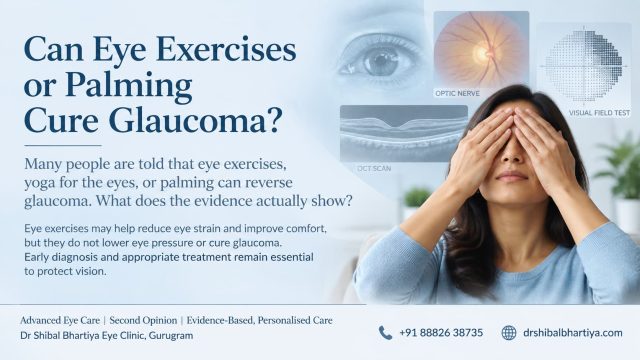
Eye exercises and palming cannot cure glaucoma. There is no natural technique that meaningfully lowers eye pressure or reverses optic nerve damage once it has occurred. Glaucoma is a progressive disease of the optic nerve. Delaying medical treatment in favour of exercises can result in permanent, irreversible vision loss.
Quick Answer: Eye exercises and palming have no proven effect on glaucoma. They do not lower eye pressure or protect the optic nerve. Glaucoma requires medical treatment, drops, laser, or surgery, to control eye pressure and prevent permanent vision loss. Delaying this for exercises carries real, irreversible risk.
Why This Belief Persists
Palming, closing your eyes and cupping warm palms over them, does produce a genuine sense of relaxation and relief. Most people often experience this as their eyes “resting” or feeling better. Because glaucoma itself often causes no symptoms in its early and moderate stages, someone practising palming may feel their eyes are fine and credit the technique. In reality, the disease was silent to begin with, symptoms or no symptoms, exercises or none. This mistaken sense of control, combined with the appeal of a gentle, non-invasive practice over medication or surgery, makes the claim attractive despite lacking a mechanism.
Science behind Eye Exercises and Palming
Glaucoma damages the optic nerve, most commonly due to elevated pressure inside the eye, gradually destroying the nerve fibres that carry visual information to the brain. This damage is permanent. Once nerve fibres are lost, they do not regenerate. This is why glaucoma treatment focuses entirely on stopping further damage rather than reversing existing loss.
Palming and eye exercises work through relaxation and reduced muscular tension around the eyes. This can feel soothing but has no established mechanism for lowering intraocular pressure or affecting the optic nerve. No controlled clinical trial has demonstrated that these techniques meaningfully or reliably reduce eye pressure in glaucoma patients. Eye pressure is the primary modifiable risk factor in glaucoma. It is a fluid dynamic process controlled by production and drainage inside the eye, not something influenced by external hand placement or gentle massage.
Effective glaucoma treatment lowers eye pressure through mechanisms that have been rigorously studied. Prescription eye drops that reduce fluid production or improve drainage. Laser procedures that improve outflow, and surgical options for more advanced or resistant cases. These treatments have measurable, reproducible effects on eye pressure and, correspondingly, on the rate of further optic nerve damage. Nothing about palming or eye exercises interacts with any of the actual physiological pathways involved.
Because glaucoma frequently has no early symptoms, someone can lose a significant portion of their vision before noticing anything wrong. Using exercises as a substitute for monitored medical treatment during this period allows the disease to progress without any real intervention. By the time vision changes become noticeable, unrelated to whether exercises were practiced, damage is often already substantial.
What Actually Helps Glaucoma
- Take glaucoma medication exactly as prescribed, including timing and consistency, since effectiveness depends on regular use
- Attend all scheduled eye pressure checks and visual field tests, since these are how progression is actually monitored
- Discuss laser or surgical options with your doctor if drops alone aren’t achieving target pressure
- Get a baseline glaucoma screening if you’re over 40 or have a family history. Early detection is what protects vision
- Use relaxation techniques like palming for comfort or stress relief if you find them pleasant. But never as a substitute for medical treatment
When To See a Doctor
- A family history of glaucoma, even without any symptoms yourself
- Gradual loss of peripheral or side vision, often unnoticed until advanced
- Eye pain, redness, or blurred vision with haloes around lights, which can indicate acute angle-closure glaucoma and needs urgent care
- No eye pressure check in the last 12 months if you’re over 40
- Currently using exercises or natural remedies instead of prescribed glaucoma treatment
Frequently Asked Questions
Can palming lower eye pressure even a small amount?
There is no reliable clinical evidence that palming affects intraocular pressure in any measurable, sustained way. Any sense of relief comes from general relaxation, not a change in eye pressure.
Is it safe to try palming alongside my prescribed glaucoma treatment?
Practising palming for relaxation alongside your prescribed treatment is not harmful. As long as it never replaces or delays your medications, checkups, or procedures.
Why didn’t I notice any vision loss until my glaucoma was already advanced?
Glaucoma typically damages peripheral vision first and progresses gradually, often without pain or obvious symptoms. Which is why regular monitoring, not waiting for symptoms, is essential for catching it early.
Book a Consultation
If you have glaucoma or a family history of it, please don’t substitute exercises for monitored treatment. Vision lost to glaucoma cannot be recovered, and early, consistent treatment is what protects what remains.
Book an Appointment →
📍 Gurgaon 📞 +91 88826 38735 | 🌐 Contact Us | Second Opinion Form for teleconsults
This page is a part of the Glaucoma Hub. you may want to read about Glaucoma Progression, and Risk Stratification in Glaucoma. You may want to read more about OCT and Visual Field, Glaucoma Tests Explained, Normal OCT but Vision Symptoms and How to Understand Your OCT Better. Also of help could be Why Do I Need a Visual Field Test? Glaucoma Diagnosis in Gurgaon, Get a Glaucoma Second Opinion in Gurgaon and Get an Online Glaucoma Consult.
This article is a part of the Myths about Eyes Hub. Please also read Glaucoma Myths Debunked, Complementary and Alternate Medication for Glaucoma, and Marijuana for Glaucoma.
About the Author
This article was written by Dr Shibal Bhartiya, fellowship-trained glaucoma specialist and Mayo Clinic Research Collaborator, Clinical Director at Marengo Asia Hospitals, Gurugram, known for ethical, patient-centred glaucoma care and independent glaucoma second opinions. She is also the Program Director for Community Outreach & Wellness; and for the Marengo Asia International Institute of Neuro and Spine.
She has published peer-reviewed research onglaucoma management, examining how treatment decisions should balance medical evidence, patient preferences, and long-term vision outcomes.
As Editor-in-Chief of Clinical and Experimental Vision and Eye Research and Executive Editor of the Journal of Current Glaucoma Practice (Pubmed Indexed, official journal of the International Society of Glaucoma Surgery), Dr Shibal Bhartiya brings editorial and research depth to every clinical decision. Her 200+ publications, including 90+ PubMed-indexed publications and 28 edited textbooks span glaucoma biology, surgical outcomes, health equity, and emerging diagnostics.
1600+ Five Star Patient Reviews Google Business Profile
If you are unable to come to Dr Bhartiya’s clinic: Read more about teleconsultation
Read her research on PubMed | Google Scholar | ResearchGate | ORCID | Github
📋Upload your reports for a structured review.| 🌐 Contact Us| 📞 +91 88826 38735
⭐ Helped by this article? Leave a Google review — it helps other patients find reliable eye care.