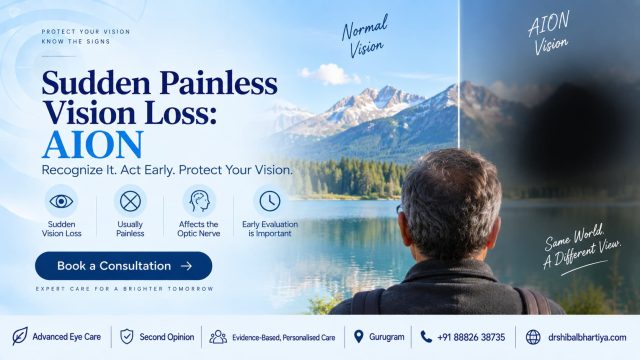
Sudden, painless vision loss in one eye in someone over 50 is most often AION, caused by reduced blood flow to the optic nerve. The urgent first step is ruling out giant cell arteritis, a treatable emergency form that can blind the second eye within days if missed.
Sudden Painless Vision Loss in One Eye: Could it be AION?
Patients describe it almost the same way every time. They woke up, or noticed within minutes, that part of their vision in one eye had simply gone dark, with no pain at all. That absence of pain is often what delays them from seeking help, because pain is what most people associate with a medical emergency.
Anterior ischemic optic neuropathy, or AION, is the most common cause of sudden, painless vision loss in people over 50. It happens when blood flow to the front of the optic nerve is interrupted, and depending on the cause, it can also threaten your other eye if not identified quickly.
This article explains the two types of AION, why the distinction matters urgently, and what management actually looks like.
Arteritic vs. Non-Arteritic AION: Why the Distinction Is Urgent
| Feature | Arteritic AION (AAION) | Non-Arteritic AION (NAION) |
|---|---|---|
| Underlying cause | Giant cell arteritis, an inflammatory disease of blood vessels | Reduced blood flow from vascular risk factors, not inflammation |
| Typical age | Usually over 70 | Usually 50 to 70 |
| Associated symptoms | Scalp tenderness, jaw pain while chewing, unexplained weight loss, fatigue | Often none beyond the vision loss itself |
| Urgency | True emergency; needs same-day steroid treatment to protect the other eye | Urgent evaluation needed, but no proven emergency treatment reverses vision loss |
| Risk to the other eye | High and rapid if untreated, within days | Present but lower and typically not as immediate |
| Blood test findings | Markedly elevated ESR and CRP | Usually normal |
When To See a Doctor
See a Doctor Urgently (same-day)
- Sudden, painless vision loss or dimming in one eye, at any age
- Vision loss accompanied by scalp tenderness, jaw pain on chewing, or unexplained fatigue
- Any vision loss in a person over 60, given the risk of giant cell arteritis
- New vision loss in the second eye after a previous AION diagnosis
- Sudden decrease in vision if you are on GLP-1 agonists
See a Doctor (routine booking)
- Ongoing management of cardiovascular risk factors after a confirmed NAION diagnosis
- Questions about long-term monitoring following an AION episode
- General risk assessment if you have diabetes, hypertension, or high cholesterol and want to understand your optic nerve risk
Why Ruling Out Giant Cell Arteritis Comes First
Giant cell arteritis causes arteritic AION and is one of the few true ophthalmic emergencies where treatment can prevent blindness in the second eye. Blood tests for ESR and CRP, sometimes followed by a temporal artery biopsy, confirm the diagnosis. If arteritic AION is suspected, high-dose steroid treatment begins immediately, often before biopsy results are even back, because the risk of losing vision in the fellow eye is too high to wait.
Managing Non-Arteritic AION
This is the harder conversation to have with patients. There is currently no proven treatment that reverses vision loss once non-arteritic AION has occurred. Management instead focuses on:
- Identifying and controlling vascular risk factors, including diabetes, high blood pressure, high cholesterol, and sleep apnea
- Reviewing medications that may increase risk, including certain erectile dysfunction drugs and, in recent research, GLP-1 receptor agonists
- Monitoring the fellow eye closely, since a meaningful minority of patients go on to develop AION in the other eye over time
- Referral for a sleep study if obstructive sleep apnea is suspected, as it’s an under-recognized risk factor
Recent research has raised a specific question about GLP-1 receptor agonists such as semaglutide (Ozempic, Wegovy) and tirzepatide (Mounjaro), with some studies reporting an association with NAION, particularly in diabetic and obese patients. The absolute risk remains low, and this is an active area of research rather than settled fact, but any new visual symptoms while on these medications warrant prompt ophthalmic evaluation. I’ve published a PubMed-indexed systematic review and an editorial specifically on GLP-1 agonists and eye health, and I offer a dedicated pre- and on-treatment eye evaluation for patients starting or continuing these medications. Read more in GLP-1 Agonists and Eye Health.
Frequently Asked Questions
Can vision loss from AION improve on its own?
Some patients regain partial vision, particularly in non-arteritic AION, but significant recovery is uncommon. This is why prevention through risk factor control and prompt evaluation of the fellow eye matters more than waiting for spontaneous improvement.
How is giant cell arteritis diagnosed?
Blood tests measuring ESR and CRP are the first step, often followed by a temporal artery biopsy to confirm the diagnosis. Treatment with steroids typically begins immediately if arteritis is strongly suspected, without waiting for biopsy confirmation.
Is AION the same as a stroke of the eye?
They’re related but distinct. AION specifically involves the optic nerve’s blood supply, while the term “eye stroke” is sometimes used more broadly to include retinal artery occlusions as well, which affect a different part of the eye.
What is my risk of AION happening in my other eye?
For non-arteritic AION, published rates suggest a meaningful minority of patients develop it in the fellow eye over several years. For untreated arteritic AION, the risk to the second eye is much higher and more immediate, which is why urgent treatment matters so much.
Can GLP-1 medications like Ozempic cause vision loss?
Some recent studies have found an association between GLP-1 receptor agonists and NAION, though the absolute risk appears low and research is ongoing. If you’re on these medications and notice any new visual symptoms, seek prompt ophthalmic evaluation.
What can I do to reduce my risk of AION?
Controlling diabetes, blood pressure, and cholesterol, treating sleep apnea if present, and avoiding smoking all reduce vascular risk factors linked to AION. Regular eye examinations also help catch early warning signs like crowded optic discs.
Key Takeaways
- Sudden, painless vision loss in one eye is the hallmark symptom of AION
- Ruling out giant cell arteritis is the urgent first step, especially over age 60
- Arteritic AION is a true emergency treatable with immediate steroids
- Non-arteritic AION has no proven treatment to reverse vision loss; management focuses on risk factor control
- GLP-1 receptor agonists have shown a possible, low-absolute-risk association with NAION in recent research
- The fellow eye needs close, ongoing monitoring after any AION diagnosis
Book a Consultation
If you or a family member has experienced sudden vision loss in one eye, don’t wait to see if it improves. Same-day evaluation is essential to rule out a treatable emergency and protect your remaining vision.
I offer detailed neuro-ophthalmology evaluations for patients in Gurgaon and beyond.
Book an Urgent Consultation →
📍 Gurgaon 📞 +91 88826 38735 | 🌐 Contact Us | Second Opinion Form for teleconsults
This page is part of the Neuro-Ophthalmology Hub. Please also read GLP-1 Agonists and Eye Health. This page is part of the Vision Symptoms hub. Read more about our full approach to neurological vision conditions, and Glaucoma & Neuro-Ophthalmology Second Opinion Guidelines. Request an urgent appointment if you’ve experienced unexplained vision loss.
About the Author
This article was written by Dr Shibal Bhartiya, fellowship-trained glaucoma specialist and Mayo Clinic Research Collaborator, Clinical Director at Marengo Asia Hospitals, Gurugram, known for ethical, patient-centred glaucoma care and independent glaucoma second opinions. She is also the Program Director for Community Outreach & Wellness; and for the Marengo Asia International Institute of Neuro and Spine.
She has published peer-reviewed research onglaucoma management, examining how treatment decisions should balance medical evidence, patient preferences, and long-term vision outcomes.
As Editor-in-Chief of Clinical and Experimental Vision and Eye Research and Executive Editor of the Journal of Current Glaucoma Practice (Pubmed Indexed, official journal of the International Society of Glaucoma Surgery), Dr Shibal Bhartiya brings editorial and research depth to every clinical decision. Her 200+ publications, including 90+ PubMed-indexed publications and 28 edited textbooks span glaucoma biology, surgical outcomes, health equity, and emerging diagnostics.
1600+ Five Star Patient Reviews Google Business Profile
If you are unable to come to Dr Bhartiya’s clinic: Read more about teleconsultation
Read her research on PubMed | Google Scholar | ResearchGate | ORCID | Github | Wikidata
📋Upload your reports for a structured review.| 🌐 Contact Us| 📞 +91 88826 38735
⭐ Helped by this article? Leave a Google review — it helps other patients find reliable eye care.