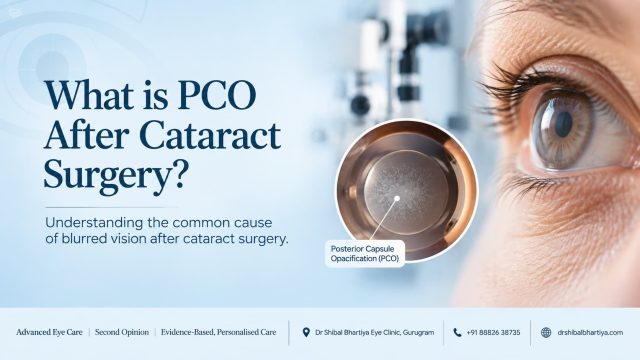
Blurry vision months or years after cataract surgery is usually posterior capsule opacification (PCO) or “secondary cataract”, a clouding of the membrane left behind during surgery, not a new cataract. It’s treated with a quick, painless outpatient laser procedure called YAG capsulotomy, which restores clear vision almost immediately.
I see this often, and it always alarms patients the same way: vision was clear after cataract surgery, sometimes for years, and now it’s cloudy again. The first fear is almost always the same. “Did the cataract come back?”
It hasn’t. What you’re likely experiencing is posterior capsule opacification, often called a “secondary cataract,” even though no new cataract has formed. It happens when the thin membrane left behind during surgery clouds over with time.
This article explains why it happens, how it’s treated, and what the YAG laser procedure actually involves.
Signs of PCO vs. Other Causes of Blurring
| Symptom | What It Means | What To Do About It |
|---|---|---|
| Gradual haziness developing months to years after surgery | Classic pattern of posterior capsule opacification developing slowly over time | Book a routine evaluation; YAG capsulotomy resolves this in one visit |
| Glare or halos around lights at night | PCO commonly scatters light before it significantly affects daytime clarity | Mention this specifically to your doctor, as it often confirms PCO on examination |
| Vision fluctuates rather than staying consistently blurry | Less typical of PCO, which usually causes steady, progressive haziness | This pattern needs examination to rule out other causes like dry eye or a refractive shift |
| Blurring appeared suddenly within days | PCO develops gradually; sudden change points to a different, more urgent cause | Book an urgent evaluation rather than assuming it’s PCO |
| Blurring with new floaters or flashes | Suggests a retinal issue rather than capsule clouding | Needs prompt evaluation, not routine booking |
| Reduced contrast, especially in dim light or reading | A common early sign of PCO before overall vision feels noticeably worse | Flag this pattern at your next eye check even if vision still feels “mostly fine” |
When To See a Doctor for Blurring After Cataract Surgery
See a Doctor Urgently (same-day)
- Sudden vision loss or blurring that develops within hours to days
- New flashes of light or a sudden shower of floaters
- Blurring accompanied by eye pain or redness
- Any curtain-like or shadow effect across part of your vision
See a Doctor (routine booking)
- Gradual haziness developing months to years after cataract surgery
- New glare or halos around lights at night
- Reduced contrast or dimmer colors than you remember post-surgery
- Any general concern about your vision quality after cataract surgery
What YAG Laser Capsulotomy Actually Involves
YAG capsulotomy is one of the most straightforward procedures in ophthalmology. It takes about 5 minutes, is done in the outpatient clinic, and needs no incision at all.
- No cutting, no stitches. The laser creates a small opening in the clouded capsule to let light pass through clearly again.
- Painless for almost all patients. Only numbing eye drops are used; no injections are needed.
- Vision improvement is often immediate. Most patients notice clearer vision within hours, occasionally by the next day.
- A one-time treatment for most people. PCO does not recur once the capsule has been opened with the laser.
Risks of Yag Capsulotomy and What to Expect Afterward
YAG capsulotomy is very safe, but like any procedure, it isn’t entirely risk-free. A small number of patients notice floaters afterward, caused by capsule fragments released into the eye, which usually settle over a few weeks. A temporary rise in eye pressure can occur in some patients, checked and managed at your follow-up visit. Retinal detachment is a rare but recognized risk, which is why I always recommend a dilated eye check some weeks after the procedure.
Frequently Asked Questions
Does PCO mean my cataract has come back?
No. A cataract cannot return once the natural lens has been removed during surgery. PCO is clouding of the capsule membrane left behind to support your new artificial lens, which is a separate process entirely.
How soon after cataract surgery can PCO develop?
PCO can develop anywhere from a few months to several years after surgery. It becomes more common the longer it has been since your original cataract procedure.
Is YAG laser capsulotomy painful?
No, it’s a painless outpatient procedure using only numbing eye drops. Most patients describe feeling nothing more than a few clicking sounds during the brief laser application.
How long does it take to see clearly after YAG laser treatment?
Many patients notice clearer vision within a few hours of the procedure. Full stabilization typically happens within a day or two.
Can PCO come back after YAG laser treatment?
No, once the capsule has been opened with the laser, PCO does not recur in that eye. The procedure is a one-time treatment for the vast majority of patients.
Are there any risks with YAG laser capsulotomy?
Risks are low but include temporary floaters, a brief rise in eye pressure, and a small increased risk of retinal detachment. A dilated eye check after the procedure helps catch any issues early.
Key Takeaways about PCO
- Blurry vision after cataract surgery is often PCO, not a new cataract
- YAG laser capsulotomy is a quick, painless, one-time outpatient fix
- Vision improvement is often noticeable within hours of treatment
- Sudden blurring, flashes, or new floaters need urgent evaluation, not routine booking
- Glare and halos at night are a common early PCO sign worth mentioning to your doctor
- A follow-up dilated exam after YAG treatment checks for rare risks like retinal detachment
Book a Consultation
If your vision has started clouding again after cataract surgery, a quick evaluation confirms whether it’s PCO and whether YAG laser treatment is right for you.
I offer detailed post-cataract evaluations for patients in Gurgaon and beyond.
Book an Appointment →
📍 Gurgaon 📞 +91 88826 38735 | 🌐 Contact Us | Second Opinion Form for teleconsults
This article is part of the Cataract Hub. Read more Cause of cataract, Cataract Surgery, Cataract Surgery Does Not Protect You From Glaucoma, Femtosecond Laser Cataract Surgery: Contraindications, Femtosecond Laser-Assisted Cataract Surgery, Cataract Surgery , Cataract in Glaucoma Patients, Is Cataract Surgery Painful?, Vision Not Clear After Cataract Surgery? What It Really Means, Second opinion Before Cataract Surgery, Which Lens is Best for Cataract Surgery, and Premium Lenses for Cataract Surgery in Gurgaon.
You can also watch these videos to understand more, here and here
About the Author
This article was written by Dr Shibal Bhartiya, fellowship-trained glaucoma specialist and Mayo Clinic Research Collaborator, Clinical Director at Marengo Asia Hospitals, Gurugram, known for ethical, patient-centred glaucoma care and independent glaucoma second opinions. She is also the Program Director for Community Outreach & Wellness; and for the Marengo Asia International Institute of Neuro and Spine.
She has published peer-reviewed research onglaucoma management, examining how treatment decisions should balance medical evidence, patient preferences, and long-term vision outcomes.
As Editor-in-Chief of Clinical and Experimental Vision and Eye Research and Executive Editor of the Journal of Current Glaucoma Practice (Pubmed Indexed, official journal of the International Society of Glaucoma Surgery), Dr Shibal Bhartiya brings editorial and research depth to every clinical decision. Her 200+ publications, including 90+ PubMed-indexed publications and 28 edited textbooks span glaucoma biology, surgical outcomes, health equity, and emerging diagnostics.
1600+ Five Star Patient Reviews Google Business Profile
If you are unable to come to Dr Bhartiya’s clinic: Read more about teleconsultation
Read her research on PubMed | Google Scholar | ResearchGate | ORCID | Github | Wikidata
📋Upload your reports for a structured review.| 🌐 Contact Us| 📞 +91 88826 38735
⭐ Helped by this article? Leave a Google review — it helps other patients find reliable eye care.