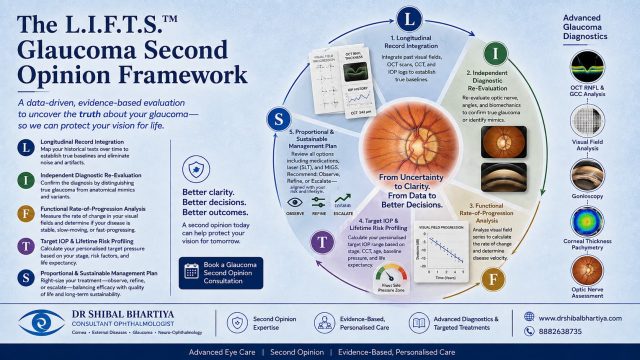
A glaucoma second opinion can confirm the diagnosis, identify the true rate of progression, and determine whether current treatment is appropriate. The L.I.F.T.S.™ Framework, devised by Dr Shibal Bhartiya, provides a comprehensive, evidence-based evaluation to guide personalised glaucoma care and lifelong vision preservation. The framework follows five structured steps: Longitudinal Record Integration, Independent Diagnostic Re-Evaluation, Functional Rate-of-Progression Analysis, Target IOP & Lifetime Risk Profiling, and Proportional & Sustainable Management Planning.
Please also read Are Your Eye Tests Being Interpreted Together.
The L.I.F.T.S. Glaucoma Second Opinion Framework
A Precision Clinical Methodology for Lifetime Vision Preservation
Receiving a glaucoma diagnosis or being told your condition is worsening can be overwhelming. Too often, patients are left with conflicting advice, escalating drop regimens, or recommendation for surgery without a clear explanation of why.
A true second opinion shouldn’t mean starting from scratch or blindly repeating tests. It requires synthesizing your complete eye history with expert human judgment.
Developed over 25 years of specialized clinical practice and research, The L.I.F.T.S. Framework is our structured, 5-step methodology designed to cut through diagnostic noise, verify your true progression rate, and provide a clear, proportional roadmap for your vision.
The 5 Steps of The L.I.F.T.S. Methodology
1.L – Longitudinal Record Integration:Establishing True Baselines.
Direct Clinical Purpose: Synthesizing past reports to eliminate test noise.
We map your historical visual field tests, OCT structural scans, corneal thickness measurements, and pressure logs chronologically. By evaluating your data over time rather than looking at an isolated scan, we filter out testing artifacts and baseline variations to reveal what is actually happening to your optic nerve.
2.I – Independent Diagnostic Re-Evaluation:Confirming the Primary Diagnosis.
Direct Clinical Purpose: Distinguishing true glaucoma from anatomical mimics.
We independently re-evaluate your optic nerve head morphology, gonioscopic drainage angle structure, and corneal biomechanics. This step answers a crucial question: Is this true progressive glaucoma, or an anatomical variant mimic such as high myopia, optic nerve drusen, or physiological cupping?
3.F – Functional Rate-of-Progression Analysis:Determining Disease Velocity.
Direct Clinical Purpose: Measuring how fast change is actually occurring.
Not all optic nerve changes move at the same speed. By calculating the slope of progression across your visual field series, we determine whether your disease is fast-progressing, slow-moving, or functionally stable. This prevents unnecessary surgical escalation for stable conditions.
4.T – Target IOP & Lifetime Risk Profiling:Calculating Your Safe Pressure Zone.
Direct Clinical Purpose: Customizing pressure goals to your specific eyes.
There is no single “normal” eye pressure. We calculate your personalized Target Intraocular Pressure (IOP) range based on your current stage of loss, baseline pressure, central corneal thickness, age, and life expectancy—ensuring your treatment goal actively protects your sight for life.
5.S – Proportional & Sustainable Management Plan:Right-Sizing Your Care.
Direct Clinical Purpose: Balancing treatment efficacy with quality of life.
We evaluate whether your current treatment is proportional to your actual risk. We review medication side effects, ocular surface health, suitability for Selective Laser Trabeculoplasty (SLT), and minimally invasive glaucoma surgery (MIGS)—delivering a clear recommendation: Observe, Refine, or Escalate.
What You Receive: The Second Opinion Matrix
When your L.I.F.T.S. evaluation is complete, you receive a structured summary breaking down your care plan:
| Framework Pillar | Clinical Question Solved | Your Clear Output |
|---|---|---|
| 1. Longitudinal Review | Are my historical test reports consistent? | Chronological trend map of structural & functional data |
| 2. Independent Verification | Is my diagnosis definitive or a mimic? | Confirmed diagnostic classification |
| 3. Progression Velocity | Is my vision loss actively progressing? | Progression rate classification (Stable vs. Active) |
| 4. Target IOP Profiling | What exact pressure range do MY eyes need? | Personalized, calculated Target IOP range |
| 5. Proportional Plan | Am I under-treated, over-treated, or on track? | Actionable roadmap (Observe vs. Refine vs. Escalate) |
Please also read Avoid Glaucoma Surgery
How to Submit Your Reports for a L.I.F.T.S. Review
We offer both in-person consultations in Gurugram/Delhi NCR and remote digital report evaluations for international and out-of-station patients.
Step-by-Step Report Submission Guide
┌────────────────────────────────────────────────────────────────────────┐
│                        REPORT SUBMISSION STEPS                         │
├───────────────────┬───────────────────────────────┬────────────────────┤
│ 1. Gather         │ 2. Upload                     │ 3. Review          │
│ Scans, Scans, &   │ Secure Portal Submission      │ Video Consultation │
│ Drop Names        │ (PDF / High-Res Images)       │ & L.I.F.T.S. Report│
└───────────────────┴───────────────────────────────┴────────────────────┘
- Gather Your Records: Collect past visual field tests (Humphrey/Perimetry), OCT optic disc scans, pachymetry (corneal thickness) reports, and a list of your current eye drop brands/frequencies.
- Submit via Secure Portal: Fill out our brief clinical intake form below and upload high-resolution photos or PDFs of your reports.
- Receive Your Evaluation: Our clinical team will review the completeness of your records. You will then be scheduled for an in-person consultation or a structured tele-consultation to walk through your personalized L.I.F.T.S. evaluation.
Book a Consultation
Concerned about your glaucoma diagnosis or treatment plan? A comprehensive second opinion can help confirm the diagnosis, assess your true risk of progression, and ensure your treatment is appropriate for your eyes—not just your eye pressure.
Book a consultation for an evidence-based assessment and a personalised management plan tailored to your glaucoma.Ready for Clarity on Your Glaucoma Care?
Obtain an independent, evidence-based evaluation of your optic nerve health before changing your medications or undergoing surgery.
📍 Gurgaon 📞 +91 88826 38735 | 🌐 Contact Us | Second Opinion Form for teleconsults
PATIENT PREPARATION CHECKLIST
What to Prepare Before Your Glaucoma Second Opinion
Welcome to Your Consultation
A true glaucoma second opinion relies on seeing how your eye health has evolved over time. Bringing complete, organized historical records allows Dr. Shibal Bhartiya to perform a precise longitudinal trend analysis, confirm your diagnosis, and determine your personalized target eye pressure.
SECTION 1: Essential Medical Records & Diagnostic Tests
Please gather printouts, original print sheets, or high-resolution digital files (PDF/JPEG) for the following:
- [ ] Visual Field Tests (Perimetry):
- Collect all past visual field printouts (especially your earliest baseline test and your 2–3 most recent tests).
- Tip: Look for full single-page printouts showing black/grey dotted maps (Humphrey/Octopus).
- [ ] Optical Coherence Tomography (OCT) Scans:
- Optic Nerve Head (ONH) structural scans and RNFL thickness maps.
- Macular ganglion cell complex (GCC) scans (if available).
- [ ] Corneal Thickness (Pachymetry):
- Central Corneal Thickness (CCT) measurements.
- [ ] Optic Disc Photographs:
- High-resolution color or stereo photos of your optic nerve (if previously taken).
- [ ] Eye Pressure (IOP) Log:
- Any recorded eye pressure readings, including highest known pressure (peak IOP) and baseline readings before starting drops.
SECTION 2: Current Eye Drops & Treatment History
Exact details matter for evaluating ocular surface health and drug efficacy.
- [ ] Current Eye Drop List:
- Brand names, bottle colors, exact dosing schedule (e.g., Xalatan 1 drop in both eyes at 9 PM).
- [ ] Drop Intolerance / Allergies:
- List any eye drops you stopped using due to redness, stinging, or side effects.
- [ ] Previous Procedures & Surgeries:
- Dates and details of laser therapy (e.g., SLT, YAG Iridotomy) or previous eye surgeries (Cataract, MIGS, Trabeculectomy).
- [ ] General Medical History:
- List of oral medications (especially blood pressure, asthma, or steroid medications).
SECTION 3: Key Questions to Consider Before Your Visit
Write down your primary goals so we can address them during your consultation:
- Has my vision loss been proven to be actively progressing, or is it stable?
- Is my current eye pressure within my safe, personalized Target IOP range?
- Are there alternative treatments (like SLT laser) to reduce my daily drop burden?
- Is surgery necessary right now, or is it safe to continue monitoring?
SUBMISSION & CONTACT INSTRUCTIONS
┌────────────────────────────────────────────────────────────────────────┐
│                        HOW TO SUBMIT YOUR DOCUMENTS                    │
├───────────────────┬───────────────────────────────┬────────────────────┤
│ Digital / Remote  │ In-Person Visit               │ Portal Upload      │
│ Upload PDFs to    │ Bring all physical test       │ Use secure upload  │
│ second-opinion    │ folders and current drop      │ link sent via      │
│ portal link       │ bottles to the clinic         │ SMS / WhatsApp     │
└───────────────────┴───────────────────────────────┴────────────────────┘
- Online Portal: Upload scanned PDFs or clear phone photos to: Second Opinion Form
- Need Assistance? Contact our clinical desk for guidance on report formatting or appointment scheduling.
This page is a part of the Glaucoma Hub. you may want to read about Glaucoma Progression, and Risk Stratification in Glaucoma. Other articles of interest could be Advanced Glaucoma Care in Gurgaon, What Good Glaucoma Care Actually Optimises For, What Happens If Glaucoma Is Left Untreated?, More Glaucoma Eye Drops is Not Better Glaucoma Care, 5 Mistakes Patients Make in Glaucoma Care and Do You Really Need Treatment for Glaucoma?
This article is also a part of the Second Opinion Hub. Please also read Second Opinion in Glaucoma, Second Opinion Before Cataract Surgery, Second Opinions in Eye Care, Second Opinion Guidelines,Second Opinion Framework for Glaucoma, Neuro-ophthalmology Second Opinion, and Second Opinion Framework for Dry Eye.
About the Author
This article was written by Dr Shibal Bhartiya, fellowship-trained glaucoma specialist and Mayo Clinic Research Collaborator, Clinical Director at Marengo Asia Hospitals, Gurugram, known for ethical, patient-centred glaucoma care and independent glaucoma second opinions. She is also the Program Director for Community Outreach & Wellness; and for the Marengo Asia International Institute of Neuro and Spine.
She has published peer-reviewed research on glaucoma management, examining how treatment decisions should balance medical evidence, patient preferences, and long-term vision outcomes.
As Editor-in-Chief of Clinical and Experimental Vision and Eye Research and Executive Editor of the Journal of Current Glaucoma Practice (Pubmed Indexed, official journal of the International Society of Glaucoma Surgery), Dr Shibal Bhartiya brings editorial and research depth to every clinical decision. Her 200+ publications, including 90+ PubMed-indexed publications and 28 edited textbooks span glaucoma biology, surgical outcomes, health equity, and emerging diagnostics.
1600+ Five Star Patient Reviews Google Business Profile
If you are unable to come to Dr Bhartiya’s clinic: Read more about teleconsultation
Read her research on PubMed | Google Scholar | ResearchGate | ORCID | Github
📋Upload your reports for a structured review.| 🌐 Contact Us| 📞 +91 88826 38735
⭐ Helped by this article? Leave a Google review — it helps other patients find reliable eye care.
Last Reviewed: October 2026