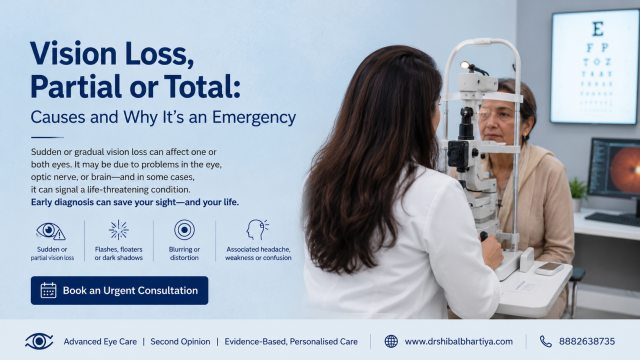
Any sudden loss of vision, partial or total, in one or both eyes, is a medical emergency. Go to emergency eye care or a hospital emergency department immediately rather than waiting for a scheduled appointment.
Losing vision, whether it’s a portion of your visual field or your entire sight in one or both eyes, is the single symptom on this hub that most consistently demands emergency care. Sudden vision loss almost always has a time-sensitive cause behind it, and the speed of treatment often determines how much vision can be saved.
Vision Loss, Partial or Total: What It Means and Why It’s a Medical Emergency
| Possible Cause | How It Typically Feels | Related Page |
|---|---|---|
| Retinal artery occlusion | Sudden, painless, often total loss in one eye, over seconds to minutes | [Neuro-Ophthalmology hub] |
| Retinal vein occlusion | Sudden, painless, partial or significant blur in one eye | [Retina hub] |
| Retinal detachment | Partial, spreading over hours to days, often preceded by flashes and floaters | [Retinal Detachment] |
| Stroke affecting the visual pathway | Sudden, may affect the same side of vision in both eyes, with other neurological signs | [Neuro-Ophthalmology hub] |
| Acute angle-closure glaucoma | Sudden, with severe pain, redness, nausea | [Glaucoma] |
| Optic neuritis | Partial, over hours to days, one eye, pain on eye movement | [Neuro-Ophthalmology hub] |
| Giant cell arteritis (temporal arteritis) | Sudden, often in older adults, may come with scalp tenderness or jaw pain when chewing | [Second Opinion hub] |
When This Needs Urgent Attention
- Any sudden vision loss, partial or total, in one or both eyes: this is always an emergency
- Vision loss with headache, scalp tenderness, or jaw pain, particularly in adults over 60, which can indicate giant cell arteritis, a genuine sight and life-threatening emergency
- Vision loss with weakness, numbness, confusion, or difficulty speaking
- Vision loss with severe eye pain, redness, or nausea
When to See a Doctor, Not Urgently
- Gradual vision loss over months to years, still deserving prompt evaluation but not an emergency-room-level urgency
- Vision loss already diagnosed and under active management, with a new but expected pattern of change
What to Expect at the Eye Check
In a sudden vision loss emergency, the priority is identifying whether the cause is retinal, related to blood flow, or neurological, since each has a different, time-critical treatment window. Expect immediate examination, possible same-day imaging, and, depending on findings, referral to a stroke unit or immediate treatment for a retinal cause.
Frequently Asked Questions
Is all sudden vision loss an emergency, even if it’s partial?
Yes. Partial sudden vision loss carries the same urgency as total loss, since many of the causes, like retinal artery occlusion or stroke, are time-critical regardless of how much vision is affected.
How fast do I need to seek care?
Immediately. For several causes on this list, including retinal artery occlusion and giant cell arteritis, the window to preserve vision or prevent it from affecting the other eye is measured in hours, not days.
Can lost vision come back?
It depends entirely on the cause and how quickly treatment began. Some causes, like retinal detachment caught early, have a good chance of vision recovery. Others, like a completed retinal artery occlusion, often do not reverse, which is why speed matters more than any other single factor.
This page is part of the Vision Symptoms hub. Read more about Neuro-Ophthalmology and about our full approach to neurological vision conditions. Request an urgent appointment if you’ve experienced unexplained vision loss.
Book a Consultation
Sudden vision loss is not something to schedule around. Seek emergency eye care immediately.
Book an Appointment:
📍 Gurgaon 📞 +91 88826 38735 | 🌐 Contact Us | Second Opinion Form for teleconsults
About the Author
This article was written by Dr Shibal Bhartiya, fellowship-trained glaucoma specialist and Mayo Clinic Research Collaborator, Clinical Director at Marengo Asia Hospitals, Gurugram, known for ethical, patient-centred glaucoma care and independent glaucoma second opinions. She is also the Program Director for Community Outreach & Wellness; and for the Marengo Asia International Institute of Neuro and Spine.
Dr Bhartiya has published peer-reviewed research onglaucoma management, examining how treatment decisions should balance medical evidence, patient preferences, and long-term vision outcomes. She is also a committed patient advocate and mainstream medical columnist, translating complex ophthalmic evidence into actionable public health insights across leading national platforms including NDTV and OnlyMyHealth
Dr Bhartiya is the Editor-in-Chief of Clinical and Experimental Vision and Eye Research and Executive Editor of the Journal of Current Glaucoma Practice (Pubmed Indexed, official journal of the International Society of Glaucoma Surgery). Her 200+ publications, including 90+ PubMed-indexed publications and 28 edited textbooks span glaucoma biology, surgical outcomes, health equity, and emerging diagnostics.
1700+ Five Star Patient Reviews Google Business Profile
If you are unable to come to Dr Bhartiya’s clinic: Read more about teleconsultation
Read her research on PubMed | Google Scholar | ResearchGate | ORCID | Github | Wikidata
📋Upload your reports for a structured review.| 🌐 Contact Us| 📞 +91 88826 38735
⭐ Helped by this article? Leave a Google review — it helps other patients find reliable eye care.
Last Reviewed: November 2026