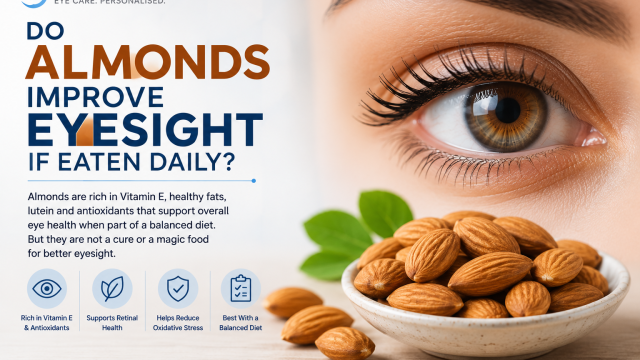
Eating almonds daily does not improve eyesight or reduce glasses power. Almonds contain vitamin E and healthy fats that support general eye health as part of a balanced diet, but no amount of daily almond consumption can correct a refractive error or reverse an existing glasses prescription.
One of the commonest questions parents ask in my clinic is, “How can my child need glasses? We give them five almonds every morning.” I understand why they ask. Almonds are a nutritious food and contribute to overall eye health through vitamin E, healthy fats, and antioxidants, but they do not improve visual acuity, reduce glasses power, or prevent refractive errors such as myopia. Glasses power reflects the eye’s physical shape, which diet cannot change once established. Almonds are a healthy addition to diet, not a vision treatment.
Why This Belief Persists
Almonds have long held a reputation in Indian households as a brain and memory food, often given to children before exams with the belief that they sharpen mental faculties. This general association with cognitive and sensory sharpness appears to have extended naturally to vision as well, since eyesight is often grouped mentally with other “sharpness” functions like memory and focus. Add to this almonds’ real, genuine nutritional value, and the leap from “healthy for the body” to “fixes eyesight specifically” feels like a small, reasonable step, even though it isn’t supported by how the eye actually works.
What The Science Actually Says
Almonds are a good source of vitamin E, an antioxidant, along with healthy monounsaturated fats, magnesium, and other nutrients that support overall cellular health, including in eye tissue. Vitamin E has some studied role in protecting retinal cells from oxidative stress over the long term, and adequate intake is one of several nutritional factors researchers have examined in relation to age-related eye conditions like macular degeneration, generally as part of a broader dietary pattern rather than almonds specifically or in isolation.
None of this relates to how glasses power develops or changes. Refractive error, whether myopia, hypermetropia, or astigmatism, results from the physical length and curvature of the eyeball relative to its focusing system, a structural feature established through genetics and childhood visual development, not through nutrient levels. A person with completely optimal vitamin E status, eating almonds daily for years, will still have exactly the same glasses power their eye’s structure requires, because there is no structural mechanism by which any nutrient reshapes the eyeball once it has developed.
The confusion often stems from conflating two very different categories of eye health: nutritional support for the retina’s long-term cellular function, where some dietary components do have a modest, evidence-based role, and correction of refractive error, which is a structural, optical issue entirely unrelated to diet. Almonds sit in the first category, glasses power sits in the second, and no amount of almonds moves a person from one category’s problem into the other’s solution.
What Actually Helps
- Include almonds and other vitamin E-rich foods as part of a generally balanced diet, understood as supporting overall eye health, not fixing glasses power
- Get an annual eye check to accurately track any actual changes in glasses power over time
- Wear the correct prescribed glasses consistently rather than adjusting diet in place of correction
- Encourage adequate outdoor time, particularly in children, which has real evidence for slowing myopia progression
- Ask your doctor about medically proven options if you’re specifically concerned about long-term eye health beyond refractive error, such as macular degeneration risk
When To See a Doctor
- Glasses power changing at each yearly check despite a healthy diet
- Difficulty seeing clearly at distance or near, regardless of diet
- A family history of high myopia or age-related eye disease
- Interest in diet’s actual role in conditions like macular degeneration, which is worth discussing directly with your doctor
- No eye check in the last 12 months
Every consultation is an opportunity to discuss not only the treatment of eye disease but also the role of nutrition and healthy lifestyle choices in protecting vision. If you have questions about foods, supplements, or common eye health myths, I would be delighted to help at my clinic in Gurgaon.
Book a Consultation
A healthy diet is important for your eyes, but no single food—including almonds—can improve eyesight or replace a comprehensive eye examination. My goal is to help patients separate evidence-based advice from common myths, while identifying any underlying eye condition that may need treatment.
If you are experiencing blurred vision, difficulty reading, eye strain, or any change in your eyesight, a comprehensive eye examination is the best place to start. I will assess your vision, examine your eyes, and recommend appropriate treatment or lifestyle measures based on your individual needs.
Whether you have questions about nutrition, eye health, or changes in your vision, I would be happy to guide you with evidence-based, personalised advice.
Book an Appointment → 📍 Gurgaon 📞 +91 88826 38735 | 🌐 Contact Us | Second Opinion Form for teleconsults
Frequently Asked Questions
Is there any real evidence almonds help with any eye condition?
Vitamin E, found in almonds, has been studied as one of several nutrients relevant to long-term retinal health, particularly in the context of age-related macular degeneration, generally as part of a broader dietary pattern, not almonds in isolation or as a treatment for refractive error.
Can eating almonds prevent me from needing glasses in the future?
No. Whether someone needs glasses is determined by the eye’s physical shape and structure, which develops independently of diet. Almonds cannot prevent or delay the structural development of a refractive error.
Should I stop eating almonds if they don’t fix eyesight?
Not at all. Almonds remain a nutritious food with real health benefits as part of a balanced diet. The point is simply that they should not be relied on as a substitute for glasses or an eye check.
This article is a part of the Myths about Eyes Hub. Read on more to understand more about your eye health. Also read Do Almonds Improve Vision, and Nutrients for Eye Health, Does Triphala Eyewash Improve Vision?, and Does Honey or Turmeric Treat Eye Infections.
About the Author
This article was written by Dr Shibal Bhartiya, fellowship-trained glaucoma specialist and Mayo Clinic Research Collaborator, Clinical Director at Marengo Asia Hospitals, Gurugram, known for ethical, patient-centred glaucoma care and independent glaucoma second opinions. She is also the Program Director for Community Outreach & Wellness; and for the Marengo Asia International Institute of Neuro and Spine.
She has published peer-reviewed research on glaucoma management, examining how treatment decisions should balance medical evidence, patient preferences, and long-term vision outcomes.
As Editor-in-Chief of Clinical and Experimental Vision and Eye Research and Executive Editor of the Journal of Current Glaucoma Practice (Pubmed Indexed, official journal of the International Society of Glaucoma Surgery), Dr Shibal Bhartiya brings editorial and research depth to every clinical decision. Her 200+ publications, including 90+ PubMed-indexed publications and 28 edited textbooks span glaucoma biology, surgical outcomes, health equity, and emerging diagnostics.
1600+ Five Star Patient Reviews Google Business Profile
If you are unable to come to Dr Bhartiya’s clinic: Read more about teleconsultation
Read her research on PubMed | Google Scholar | ResearchGate | ORCID
📋Upload your reports for a structured review.| 🌐 Contact Us| 📞 +91 88826 38735
⭐ Helped by this article? Leave a Google review — it helps other patients find reliable eye care.