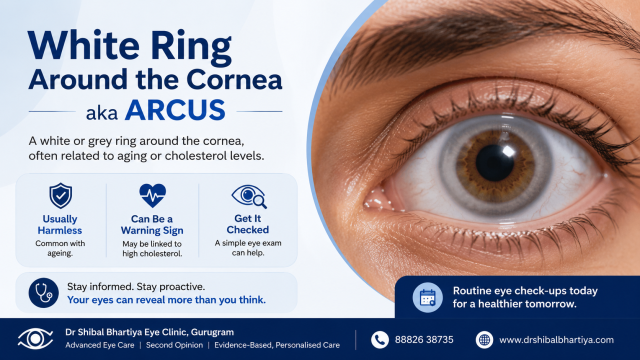
A white or gray ring around the iris is corneal arcus, a fat deposit at the edge of the cornea. After 60, it’s usually a normal ageing change. Before 40, it can signal high cholesterol and is worth a blood test.
A grayish-white ring circling the edge of the colored part of the eye, right where it meets the white, is called corneal arcus, or arcus senilis when it appears with age. It comes from tiny fat deposits at the rim of the cornea and does not affect vision. In older adults it’s usually harmless. In anyone under 40, it’s worth checking cholesterol.
White Ring Around the Colored Part of the Eye: What It Means
| Possible Cause | How It Typically Feels |
| Arcus senilis (age-related) | Gradual, both eyes, common after 60, no other symptoms |
| High cholesterol or lipid disorder (younger patients) | Same ring appearance, but present before age 40 |
| Familial hypercholesterolaemia | Ring present in a younger patient with a family history of early heart disease |
| One-sided arcus (rare) | Ring in only one eye, can indicate reduced blood flow on that side |
When This Needs Urgent Attention
- This finding itself is not an eye emergency
- A ring in only one eye, at any age, should prompt a check for reduced blood flow to that eye
When to See a Doctor, Not Urgently
- Any corneal arcus noticed before age 40, since it’s worth a cholesterol and lipid panel
- New arcus with a family history of early heart attacks or stroke
What to Expect at the Eye Check
The eye exam confirms the ring is arcus and not another cause of discoloration. If you’re under 40 or the ring is one-sided, expect a referral for blood work, since the ring itself is just a visible marker of what’s happening in the bloodstream.
Frequently Asked Questions
Does corneal arcus affect vision?
No. It sits at the very edge of the cornea, outside the central area used for sight, so it does not blur or affect vision.
Is it the same as a cataract?
No. A cataract clouds the lens inside the eye and affects vision. Corneal arcus is a ring on the surface layer at the edge and doesn’t cloud sight.
Can this go away?
Once formed, corneal arcus doesn’t reverse or fade, even if cholesterol improves afterward. The ring becoming visible is what prompts the check, not something to treat directly.
This page is part of the Vision Symptoms hub. Read more aboutNeuro-Ophthalmology and about our full approach to neurological vision conditions. If you’ve noticed this in someone under 40, request a second opinion to arrange the right referral for a cholesterol check. Request an urgent appointment if you’ve experienced unexplained vision loss.
Book a Consultation
If you’ve spotted this ring and you’re under 40, or it’s only in one eye, get it checked rather than assuming it’s just age.
[Book an Appointment → contact us | 8882638735]
About the Author
This article was written by Dr Shibal Bhartiya, fellowship-trained glaucoma specialist and Mayo Clinic Research Collaborator, Clinical Director at Marengo Asia Hospitals, Gurugram, known for ethical, patient-centred glaucoma care and independent glaucoma second opinions. She is also the Program Director for Community Outreach & Wellness; and for the Marengo Asia International Institute of Neuro and Spine.
She has published peer-reviewed research on glaucoma management, examining how treatment decisions should balance medical evidence, patient preferences, and long-term vision outcomes.
As Editor-in-Chief of Clinical and Experimental Vision and Eye Research and Executive Editor of the Journal of Current Glaucoma Practice (Pubmed Indexed, official journal of the International Society of Glaucoma Surgery), Dr Shibal Bhartiya brings editorial and research depth to every clinical decision. Her 200+ publications, including 90+ PubMed-indexed publications and 28 edited textbooks span glaucoma biology, surgical outcomes, health equity, and emerging diagnostics.
1600+ Five Star Patient Reviews Google Business Profile
If you are unable to come to Dr Bhartiya’s clinic: Read more about teleconsultation
Read her research on PubMed | Google Scholar | ResearchGate | ORCID
Upload your reports for a structured review.| www.drshibalbhartiya.com | +91 88826 38735
Leave a review on Google