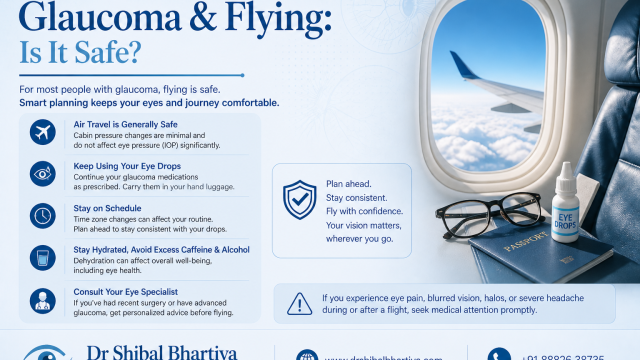
Flying with glaucoma is safe for the vast majority of patients, but there are specific situations where air travel carries real risk, and your eye doctor needs to know about your travel plans before you board, explains Dr Shibal Bhartiya.
Can You Fly With Glaucoma? What Does Every Glaucoma Patient Needs to Know Before Travelling? The key is knowing which category you fall into.
Why Glaucoma Patients Ask About Flying
The question comes up in almost every glaucoma clinic. Patients worry that cabin pressure will affect their eye pressure, that altitude will worsen their condition, or that long-haul flights will somehow accelerate damage. Most of these fears are unfounded, but not all of them.
The truth is layered. For most people with well-controlled glaucoma, flying presents no meaningful risk. For a small but important subset, those who have had recent eye surgery, those with advanced disease and very high pressures, or those with certain angle configurations; the picture is more complex and deserves a specific conversation with your specialist before travel.
What Happens to Eye Pressure at Altitude
Commercial aircraft cabins are pressurised, but not to sea-level pressure. The standard cabin pressure is equivalent to an altitude of approximately 6,000 to 8,000 feet. This mild reduction in ambient pressure has been studied in glaucoma patients, and the findings are reassuring for most.
Research has not shown a consistent or clinically significant rise in intraocular pressure (IOP) in glaucoma patients during commercial air travel when their disease is well controlled and they are on treatment. The pressure changes that occur in a pressurised cabin are modest, and the eye largely compensates.
Where altitude does matter is in unpressurised aircraft: small planes, high-altitude trekking, or glider flights, where ambient pressure drops more substantially. At true high altitude (above 3,500–4,000 metres), some studies suggest IOP can rise, though the evidence is not uniform.
When Flying With Glaucoma Needs Extra Care
After eye surgery — this is the most important restriction
If you have had glaucoma surgery: trabeculectomy, tube shunt implantation, or any procedure involving a gas bubble in the eye such as retinal surgery, flying is potentially dangerous until your surgeon clears you.
Gas bubbles used in certain retinal procedures expand at altitude. Even the modest pressure change in a commercial cabin can cause a gas bubble to expand significantly, raising intraocular pressure to dangerous levels and risking vision loss. Your surgeon will give you a specific no-fly period, typically few weeks, and this instruction must be followed precisely.
Carry a card or letter from your surgeon if you are within the post-operative window, even if you believe you are cleared, in case of questions at the airport.
After LASIK or corneal procedures
The evidence on flying after LASIK is generally permissive after the first 24 hours, but corneal healing and dry eye are relevant. Cabin air is very dry, humidity in aircraft cabins can fall to 10–20 percent, far below the 40–60 percent that eyes are comfortable in. For glaucoma patients who also have dry eye, a common combination, partly due to long-term use of preserved eye drops, this can cause significant discomfort and blur during flight.
Narrow-angle glaucoma or untreated angle closure
If you have been told you have a narrow drainage angle, or if you have a history of angle-closure episodes that have not been treated with a laser iridotomy, discuss flying with your specialist before travel. Changes in lighting conditions, particularly the dimmer cabin environment during night flights, cause the pupil to dilate, which can precipitate angle closure in susceptible eyes.
A prophylactic laser iridotomy, where appropriate, resolves this risk entirely. If you have already had bilateral iridotomies, this concern no longer applies.
Very advanced glaucoma with poorly controlled pressure
For patients with severe optic nerve damage and pressures that remain elevated despite maximum treatment, any additional stress on the optic nerve deserves consideration. This is not a blanket contraindication to flying, but it is a reason to have a specific conversation with your glaucoma specialist before a long journey, and to ensure your pressure is as well controlled as possible before departure.
Practical Advice for Flying With Glaucoma
Do not skip your eye drops. This is the most important practical point. Crossing time zones disrupts medication schedules. Plan your drop timing before you travel — work out when to take each drop relative to both departure and destination time zones, and set reminders. Missing doses, particularly on long-haul flights, can cause IOP to rise.
Carry all medications in hand luggage. Never put eye drops in checked baggage. Cabins are pressurised; hold luggage is not in some aircraft configurations, and temperature extremes in the hold can affect medication. More practically — bags get lost. Your drops do not.
Use preservative-free lubricating drops liberally. Cabin air is extremely dry. Even if dry eye is not a significant problem on the ground, the low humidity in an aircraft cabin will increase evaporation from the tear film. Use preservative-free artificial tears every hour or so during the flight. If you use preserved glaucoma drops, space these out as you normally would and use lubricants in between.
Stay hydrated, avoid alcohol. Alcohol causes systemic dehydration, which worsens dry eye. It also affects sleep quality on overnight flights, which matters for IOP — pressure tends to be higher after poor sleep.
Inform your travel insurer. Glaucoma is a pre-existing condition and must be declared. Failure to declare it can invalidate a claim.
Carry your prescription and a doctor’s letter for long trips. If you need to replace eye drops abroad, a clear prescription — ideally with the generic drug name, not just the brand — allows a pharmacist in any country to help you. A brief letter confirming your diagnosis and medication is useful for travel to countries with strict pharmaceutical import rules.
What Doctors Often Miss Telling You
- The dry eye-glaucoma medication link matters most on flights. Preservative-containing glaucoma drops — almost all the commonly used ones — damage the ocular surface over time. The desiccating effect of cabin air compounds this significantly. Switching to preservative-free formulations before long travel seasons is worth discussing with your specialist.
- Night flights with dim cabin lighting are higher risk for narrow-angle patients than daytime flights, most patients are never told this distinction.
- The no-fly rule after gas bubble surgery is absolute, not advisory. Patients who fly within this window have lost vision. The restriction is not about comfort, it is about preventing a pressure spike that can permanently damage the optic nerve within hours.
- Jet lag affects IOP. Circadian rhythm disruption alters the normal diurnal pattern of intraocular pressure. If you notice your vision is slightly different or your eyes feel more pressured after crossing multiple time zones, this is physiologically real, not imagined.
When to Worry
Seek urgent eye care — at your destination if necessary — if you experience any of the following during or after a flight:
- Severe eye pain during or after the flight
- Sudden blurring of vision or coloured haloes around lights
- A new shadow or loss of part of your visual field
- Nausea or vomiting alongside eye pain
- Any of the above in the days following eye surgery
These symptoms may indicate a dangerous rise in intraocular pressure and require same-day assessment.
Frequently Asked Questions
Is it safe to fly with glaucoma?
For most patients with well-controlled glaucoma on stable treatment, flying is safe. The pressure changes in a commercial aircraft cabin are modest and do not cause clinically significant IOP rises in the majority of patients. The main exceptions are recent eye surgery involving a gas bubble, untreated narrow angles, and very advanced uncontrolled disease.
How soon after glaucoma surgery can I fly?
This depends entirely on the type of surgery and whether a gas bubble was used. Your surgeon will give you a specific clearance date. For procedures involving gas, such as certain retinal or combined procedures, the no-fly period can be four to six weeks or longer. For trabeculectomy without gas, the window is shorter but still defined by your surgeon. Never fly within this window without explicit clearance.
Do I need to tell the airline I have glaucoma?
For routine travel with well-controlled glaucoma on drops alone, there is no requirement to notify the airline. If you are travelling shortly after surgery, carry a doctor’s letter. Declare your condition to your travel insurer regardless.
What if I miss my eye drops on a long flight?
Try not to. Plan your dosing schedule before departure and set phone alarms. If you miss one dose of a once-daily drop, take it as soon as you remember and resume your normal schedule. Do not double-dose. If you are on twice-daily drops and miss a dose mid-flight, take the next dose at the scheduled time. For any uncertainty about your specific medication, call the clinic before you travel.
Can altitude trekking worsen glaucoma?
At high altitude, above 3,500 metres, there is some evidence of IOP fluctuation. The evidence is not definitive, but for patients with advanced glaucoma or poorly controlled pressure, high-altitude trekking deserves a specific discussion with your specialist before departure. Acclimatisation, hydration, and adherence to medication are particularly important at altitude.
Does cabin pressure affect the optic nerve directly?
No direct effect of commercial cabin pressure on the optic nerve has been demonstrated in research. The concern in glaucoma is about IOP — and for most patients on treatment, this is well managed even during flight.
Plan Your Travel — and Your Eye Care
If you are planning a long trip, an international journey, or travel shortly after an eye procedure, bring it up at your next appointment. A five-minute conversation before you travel is far better than a five-hour emergency at your destination.
Book a pre-travel consultation: +91 88826 38735 | www.drshibalbhartiya.com
Upload your latest reports and medication list through the website before your appointment.
Note:
This article draws on clinical experience and published research in glaucoma and environmental physiology. Work co-authored by Dr Shibal Bhartiya, and her colleagues in Mexico, has specifically examined how altitude and atmospheric pressure influence intraocular pressure (IOP) measurements, highlighting that readings, and their interpretation, can vary across environments and measurement techniques.
This reinforces an important principle: glaucoma is not just about a single pressure reading, but about context, consistency, and longitudinal interpretation.
Additional research contributions emphasise that glaucoma progression is influenced by multiple ocular and systemic factors beyond IOP alone, requiring a more holistic, patient-centred approach to care.
About the Author
This article was written by Dr Shibal Bhartiya, fellowship-trained glaucoma specialist and Mayo Clinic Research Collaborator, Clinical Director at Marengo Asia Hospitals, Gurugram, known for ethical, patient-centred glaucoma care and independent glaucoma second opinions. She is also the Program Director for Community Outreach & Wellness; and for the Marengo Asia International Institute of Neuro and Spine.
She has published peer-reviewed research on glaucoma management, examining how treatment decisions should balance medical evidence, patient preferences, and long-term vision outcomes.
As Editor-in-Chief of Clinical and Experimental Vision and Eye Research and Executive Editor of the Journal of Current Glaucoma Practice (Pubmed Indexed, official journal of the International Society of Glaucoma Surgery), Dr Shibal Bhartiya brings editorial and research depth to every clinical decision. Her 200+ publications, including 90+ PubMed-indexed publications and 28 edited textbooks span glaucoma biology, surgical outcomes, health equity, and emerging diagnostics.
Access her work on Pubmed, Google Scholar, ResearchGate and ORCID.
Dr Shibal Bhartiya
Glaucoma • Second Opinion • Advanced Care
PubMed Profile | Google Scholar | ResearchGate | ORCID
⭐ Helped by this article? Leave a Google review — it helps other patients find reliable eye care.
📋 Upload your reports for review before your appointment at www.drshibalbhartiya.com
📞 +91 88826 38735