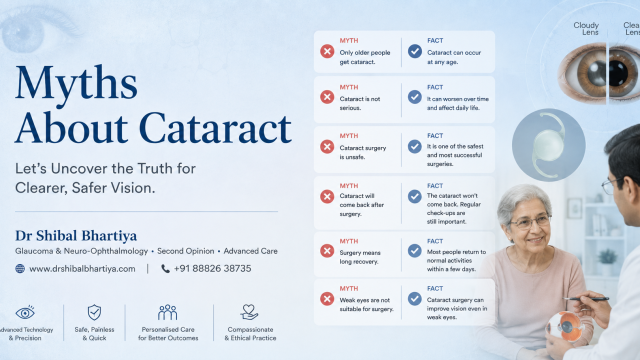
| Cataracts do not need to be ripe, eye drops cannot reverse them, and they do not grow back after surgery, explains Dr Shibal Bhartiya. Modern cataract surgery is usually safe, precise, and planned based on how vision problems affect daily life rather than age alone. |
Cataracts are the leading cause of reversible blindness in India, yet most patients arrive in clinic carrying misinformation that has delayed their treatment by months or years. Here is what the evidence actually shows about when surgery is needed, whether cataracts grow back, and who is at risk.
Cataracts are one of the most treatable conditions in ophthalmology. The surgery is safe, effective, and takes under 30 minutes. And yet patients delay, avoid, and misunderstand this condition more than almost any other. These are the myths that cause real harm.
Dr Shibal Bhartiya is a fellowship-trained glaucoma specialist and Mayo Clinic Research Collaborator with over 25 years of experience. Her approach focuses on identifying risk before damage is irreversible, simplifying treatment decisions, and protecting vision long-term. Emphasis on early detection, risk assessment, and continuity of care. She is rated 5 stars across 1,500+ patient reviews on Google.
The Most Harmful Cataract Myths
| Myth | What Is Actually True |
| Cataracts only affect old people. | Age is the most common risk factor, but cataracts can develop at any age. Congenital cataracts are present at birth. Trauma, steroid use, diabetes, and radiation can cause cataracts in patients in their 30s and 40s. |
| You must wait until the cataract is ripe before surgery. | This advice is decades out of date. Modern phacoemulsification surgery works best on softer, earlier cataracts. Waiting until a cataract is dense makes surgery harder, recovery longer, and outcomes less predictable. |
| Cataract surgery uses a laser that burns the cataract away. | Standard cataract surgery uses ultrasound energy (phacoemulsification) to break up and remove the cloudy lens. Laser-assisted options exist but are not required for excellent results. |
| Cataracts grow back after surgery. | The natural lens is permanently removed and replaced with an artificial intraocular lens (IOL). It cannot reform. Some patients develop posterior capsule opacification months or years later — this is not a new cataract. It is treated with a brief, painless laser procedure. |
| Eye drops can dissolve or reverse a cataract. | No eye drop, supplement, or medication has been proven to reverse cataract formation. Surgery is the only effective treatment. |
| Reading in dim light causes cataracts. | Poor lighting strains the eyes but does not cause cataracts. Cataracts result from protein changes within the lens, not from how the eyes are used. |
| After surgery I will never need glasses again. | Most patients need reading glasses after standard cataract surgery. Premium multifocal or extended depth-of-focus IOLs can reduce spectacle dependence significantly, but this depends on your individual eye and expectations. |
When Is the Right Time for Cataract Surgery?
The right time is when your cataract is affecting your daily life. This includes difficulty driving, reading, recognising faces, or managing glare. There is no universal density threshold. The decision is made jointly by you and your surgeon based on your visual needs, your other eye, and your overall health.
Does Diabetes Make Cataract Surgery Riskier?
Diabetes accelerates cataract formation and increases the risk of complications during and after surgery. This does not mean surgery should be avoided — it means blood sugar control before surgery is essential, and your surgeon should be aware of any diabetic retinal disease. With proper preparation, outcomes in diabetic patients are excellent.
Can I Have Cataract Surgery If I Have Glaucoma?
Yes. In fact, cataract surgery often lowers intraocular pressure modestly in patients with glaucoma, which can be an additional benefit. In some cases, combined cataract and glaucoma procedures are performed in a single sitting. Your glaucoma specialist and cataract surgeon need to coordinate your care.
Is Cataract Surgery Covered Under Health Insurance in India?
Most health insurance policies in India cover cataract surgery, but the extent of coverage varies. Standard monofocal IOLs are typically covered. Premium lenses — toric, multifocal, or extended depth-of-focus — are usually not. Confirm with your insurer before surgery.
This article is part of the Cataract Hub. Read more Cause of cataract, Cataract Surgery, Cataract Surgery Does Not Protect You From Glaucoma, Femtosecond Laser Cataract Surgery: Contraindications, Femtosecond Laser-Assisted Cataract Surgery, Is Cataract Surgery Painful?, Cataract in Glaucoma Patients and Vision Not Clear After Cataract Surgery? What It Really Means. This article is also a part of the Myths about Eyes Hub.
You can also watch these videos to understand more, here and here
About the Author
This article was written by Dr Shibal Bhartiya, fellowship-trained glaucoma specialist and Mayo Clinic Research Collaborator, Clinical Director at Marengo Asia Hospitals, Gurugram, known for ethical, patient-centred glaucoma care and independent glaucoma second opinions. She is also the Program Director for Community Outreach & Wellness; and for the Marengo Asia International Institute of Neuro and Spine.
She has published peer-reviewed research on glaucoma management, examining how treatment decisions should balance medical evidence, patient preferences, and long-term vision outcomes.
As Editor-in-Chief of Clinical and Experimental Vision and Eye Research and Executive Editor of the Journal of Current Glaucoma Practice (Pubmed Indexed, official journal of the International Society of Glaucoma Surgery), Dr Shibal Bhartiya brings editorial and research depth to every clinical decision. Her 200+ publications, including 90+ PubMed-indexed publications and 28 edited textbooks span glaucoma biology, surgical outcomes, health equity, and emerging diagnostics.
1500+ Five Star Patient Reviews Google Business Profile
If you are unable to come to Dr Bhartiya’s clinic: Read more about teleconsultation for glaucoma
Read her research on PubMed | Google Scholar | ResearchGate | ORCID
Upload your reports for a structured review.| www.drshibalbhartiya.com | +91 88826 38735
Leave a review on Google