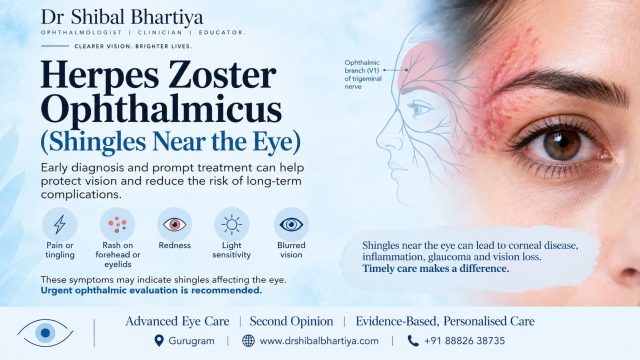
Shingles near the eye, or Herpes Zoster Ophthalmicus (HZO), is a sight-threatening condition that can permanently damage the cornea and optic nerve if left untreated. Prompt oral antiviral therapy within 72 hours of the rash appearing and an immediate ophthalmologic evaluation are critical to protect your vision.
Most people think of shingles as a painful skin rash and nothing more. However, when that rash appears on the forehead, eyelid, or around the eye, it stops being just a dermatological issue. It becomes a sight-threatening medical condition that can compromise the cornea, the optic nerve, and your long-term vision if not managed within a critical therapeutic window.
In my clinical practice in Gurugram, I frequently see patients who underestimate the initial signs. Because the eye itself often looks completely normal while the rash is still forming on the skin, the danger is easily missed in the first few days. By the time deep eye pain, redness, or blurred vision begin, valuable treatment time may already be slipping away.
This guide breaks down what herpes zoster ophthalmicus (HZO) is, how to identify the critical warning signs, and why a shingles rash near the eye demands immediate specialist evaluation rather than a wait-and-watch approach.
Can Shingles Near Your Eye Cause Permanent Vision Loss?
Shingles is caused by the reactivation of the varicella-zoster virus (the chickenpox virus), which lies dormant in sensory nerve ganglia for decades. When the virus reactivates along the ophthalmic division of the trigeminal nerve—the nerve branch supplying the forehead, upper eyelid, and eye structures—it is known as Herpes Zoster Ophthalmicus.
Approximately 50% of individuals with facial shingles develop ocular (eye) involvement. Crucially, the eye can be severely affected even when the skin rash itself appears mild.
One hallmark sign I routinely look for during examinations is Hutchinson’s sign: skin lesions appearing on the tip, side, or bridge of the nose. Because the same nerve branch (the nasociliary nerve) supplies both the tip of the nose and critical interior structures of the eye, a rash here signals a significantly higher probability of dangerous intraocular inflammation.
Clinical Guide: Common Presentations by Tissue Affected
| Symptom / Presentation | What It Means Clinically | Recommended Action |
| Blisters on forehead, scalp, or upper eyelid (one side only) | Classic HZO along the first branch of the trigeminal nerve | Start oral antivirals immediately; contact an ophthalmologist the same day |
| Rash reaching the tip or side of the nose (Hutchinson’s sign) | High-risk nasociliary nerve involvement | Book an urgent eye exam immediately, even if your vision feels fine |
| Red, painful, watering eye during or after the rash | Potential conjunctivitis, episcleritis, or early keratitis | Same-week specialist review; do not self-treat with random or leftover eye drops |
| Blurred vision or a cloudy haze over your sight | Corneal involvement or active intraocular inflammation | Urgent same-day assessment; delays risk permanent corneal scarring |
| Deep, aching eye pain with extreme light sensitivity (photophobia) | Iritis (inflammation inside the eye) | Requires prescription corticosteroid drops under strict specialist supervision |
| Eye pain persisting weeks after the rash has healed | Post-herpetic neuralgia or chronic low-grade inflammation | Ongoing specialist follow-up; both nerve pain and internal inflammation require management |
| Sudden pressure-like pain or halos around lights | Secondary glaucoma driven by intraocular inflammation | Urgent intraocular pressure check; untreated pressure spikes can permanently damage the optic nerve |
| Drooping eyelid or double vision | Nerve palsy affecting muscles that control eye movement | Neuro-ophthalmology assessment to monitor recovery and rule out complications |
Triage: When To See a Specialist
🚨 See an Ophthalmologist Urgently (Same-Day Assessment)
- Sudden blurring, dimming, or loss of vision in the affected eye
- A shingles rash spreading to the tip or side of the nose
- Severe, deep eye pain, especially when combined with light sensitivity
- Redness accompanied by pressure-like pain, headache, or visual halos
- Accompanying fever or systemic illness alongside the facial rash
- Any shingles rash near the eye in individuals who are over 60, pregnant, or immunocompromised
📅 Book an Appointment This Week
- Mild eye irritation, dryness, or watering starting after a facial shingles episode
- Persistent eyelid swelling after the acute blistering phase has resolved
- Lingering, dull aches around the orbit weeks after the rash has cleared
- A history of prior HZO accompanied by a new, mild flare of redness or discomfort
📍 Gurgaon 📞 +91 88826 38735 | 🌐 Contact Us | Second Opinion Form for teleconsults
Evidence-Based Treatment: What Protects Your Vision
Oral antiviral medications (such as acyclovir, valacyclovir, or famciclovir) are most effective when initiated within 72 hours of the skin rash first appearing. However, starting treatment past this window remains valuable, particularly if new blisters are actively forming or internal eye inflammation is already present.
Modern Insights from Clinical Trials
For patients who develop keratitis (corneal inflammation) or iritis from HZO, treatment paradigms have evolved. Landmark findings from major multicenter evaluations, including the Zoster Eye Disease Study (ZEDS), demonstrate that a prolonged course of low-dose suppressive valacyclovir significantly reduces the recurrence of new or worsening eye flares and decreases reliance on nerve pain medications—with the most pronounced protective benefits seen within the first six months. In my practice, I discuss suppressive antiviral therapy proactively with patients who have experienced even a single confirmed ocular flare to prevent long-term damage.
Tailored Care Protocols:
- For Eyelid and Surface Protection: Oral antivirals combined with preservative-free artificial tears and lubricants to safeguard the corneal epithelium while skin lesions heal. Cool compresses can offer comfort; never apply over-the-counter steroid creams to the eyelids without a direct prescription.
- For Corneal and Intraocular Inflammation: Precisely dosed topical corticosteroid drops managed and tapered under close ophthalmologic supervision, paired with cycloplegic (pupil-relaxing) drops to alleviate internal muscle spasms and prevent scarring. If intraocular pressure rises—as HZO is a known trigger for secondary glaucoma—specialized pressure-lowering medications are introduced immediately.
- For Post-Herpetic Neuralgia: Targeted neuropathic pain management protocols, alongside long-term monitoring for patients prone to recurrent ocular inflammation.
Take Control of Your Eye Health
If you or a loved one develops a painful, one-sided rash on the forehead, eyelid, or nose, do not treat it as a routine skin condition. The therapeutic window for protecting your vision is narrow, and intraocular complications can evolve silently before obvious visual symptoms set in.
An immediate, expert evaluation can make the definitive difference between a routine recovery and long-term visual impairment. I usually work with dermatologists and neurologists in managing patients of HZO.
Book an Appointment
📍 Gurgaon 📞 +91 88826 38735 | 🌐 Contact Us | Second Opinion Form for teleconsults
Frequently Asked Questions
Can shingles near the eye cause blindness?
Yes. Untreated herpes zoster ophthalmicus can lead to severe corneal scarring, chronic uveitis, or secondary glaucoma—any of which can cause permanent vision loss. Prompt antiviral intervention and specialized follow-up protect visual function in the vast majority of patients.
How do I know if my shingles rash will affect my eye?
The primary clinical indicator is Hutchinson’s sign (a rash extending to the tip or side of the nose), which confirms involvement of the nasociliary nerve branch supplying the eye. However, ocular involvement can occur even without this sign, meaning any shingles rash in the upper face requires professional evaluation.
How soon do I need to start treatment for shingles near the eye?
Oral antiviral therapy yields the best clinical outcomes when initiated within 72 hours of rash onset. Starting treatment later is still beneficial, especially if active blistering continues or if the eye is already showing signs of inflammation.
Can shingles come back and affect the eye again?
Yes. HZO can recur, and successive flares carry cumulative risks of corneal damage and internal eye pressure spikes. Patients with a documented history of ocular HZO are often candidates for extended, low-dose suppressive antiviral therapy to keep recurrences at bay.
Is the shingles vaccine effective at preventing eye involvement?
The shingles vaccine significantly reduces your overall risk of contracting shingles and minimizes disease severity if a breakthrough case occurs, directly lowering your risk of dangerous eye complications. It is widely recommended for adults aged 50 and older.
Why does my eye still hurt weeks after the shingles skin rash healed?
Persistent pain after skin healing can point toward post-herpetic neuralgia, lingering low-grade intraocular inflammation, or secondary pressure issues. These symptoms require professional evaluation rather than casual dismissal, as unmanaged internal inflammation can quietly threaten your vision.
Key Takeaways
- Treat it as an emergency: A one-sided facial rash near the eye is an ophthalmologic concern, not just a skin condition.
- Watch the nose: A rash extending to the tip of the nose (Hutchinson’s sign) indicates a high risk of internal eye involvement.
- Time matters most: Antiviral treatment is most powerful when started within 72 hours of the initial rash.
- Looks can deceive: The eye can suffer severe internal inflammation even when the skin rash appears mild or is already healing.
- Modern evidence supports suppression: Contemporary clinical trials support long-term, low-dose suppressive antivirals following a confirmed ocular flare to prevent long-term damage.
Related reading: Explore our guides on Vision Symptoms Explained, Uveitis and Eye Inflammation, and our approach to Glaucoma second opinions.
About the Author
This article was written by Dr Shibal Bhartiya, fellowship-trained glaucoma specialist and Mayo Clinic Research Collaborator, Clinical Director at Marengo Asia Hospitals, Gurugram, known for ethical, patient-centred glaucoma care and independent glaucoma second opinions. She is also the Program Director for Community Outreach & Wellness; and for the Marengo Asia International Institute of Neuro and Spine.
She has published peer-reviewed research onglaucoma management, examining how treatment decisions should balance medical evidence, patient preferences, and long-term vision outcomes.
As Editor-in-Chief of Clinical and Experimental Vision and Eye Research and Executive Editor of the Journal of Current Glaucoma Practice (Pubmed Indexed, official journal of the International Society of Glaucoma Surgery), Dr Shibal Bhartiya brings editorial and research depth to every clinical decision. Her 200+ publications, including 90+ PubMed-indexed publications and 28 edited textbooks span glaucoma biology, surgical outcomes, health equity, and emerging diagnostics.
1600+ Five Star Patient Reviews Google Business Profile
If you are unable to come to Dr Bhartiya’s clinic: Read more about teleconsultation
Read her research on PubMed | Google Scholar | ResearchGate | ORCID | Github | Wikidata
📋Upload your reports for a structured review.| 🌐 Contact Us| 📞 +91 88826 38735
⭐ Helped by this article? Leave a Google review — it helps other patients find reliable eye care.