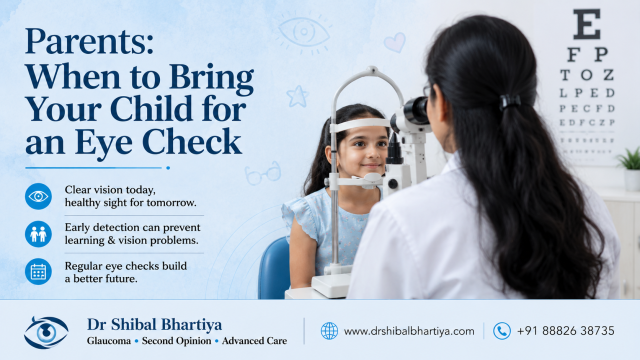
Children should have their first eye check before the age of three, and again before starting school. If your child squints, sits too close to screens, rubs their eyes often, or complains of headaches, bring them in, do not wait for the school test, explains Dr Shibal Bhartiya.
Her research in paediatric eye disease began at MAMC, where, as Shibal Fatima, she co-authored peer-reviewed publications in the Journal of Pediatric Ophthalmology and Strabismus and the Indian Journal of Ophthalmology; presenting it at the XXIX International Congress of Ophthalmology, Sydney 2002. Her postgraduate thesis examined levodopa as an adjuvant to occlusion therapy in amblyopia.
That academic work has since met field-scale reality. Through Vision Unlimited, the not-for-profit she founded, Dr Bhartiya has screened over 15,000 children across urban slum communities in Gurugram, many presenting with correctable refractive error, squint, and amblyopia they would otherwise never have had diagnosed.
Dr Shibal Bhartiya is a fellowship-trained glaucoma specialist and Mayo Clinic Research Collaborator, and her approach focuses on identifying risk before damage is irreversible, simplifying treatment decisions, and protecting vision long-term. Emphasis on early detection, risk assessment, and continuity of care. She is rated 5 stars across 1,500+ patient reviews on Google.
Why children’s eyes need early attention
A child’s visual system is not fully developed at birth. The brain and the eyes work together to build sharp, coordinated vision during the first eight to ten years of life. If something interferes during this window, an uncorrected refractive error, a squint, or a lazy eye, the brain may stop developing that pathway entirely. Once the window closes, reversing the damage becomes significantly harder.
This is why early detection is not optional. It is the difference between a child who reads comfortably at nine and one who struggles at nineteen.
When to bring your child — a clear guide
| Age | Why | What the doctor checks |
|---|---|---|
| Before 3 years | Early detection of amblyopia, squint, congenital problems | Eye alignment, red reflex, response to light |
| Before starting school (4–5 years) | Vision affects learning readiness | Distance vision, near vision, colour vision |
| Every 2 years if no problems | Refractive error can change | Full eye test |
| Immediately, any age | Red flags (see below) | Urgent clinical assessment |
Signs that should not wait
Bring your child in without delay if you notice any of the following:
- One eye turns in or out, even occasionally
- Your child closes one eye in bright light or to look at something
- They tilt or turn their head to see clearly
- They complain of double vision or blurred vision
- Headaches after reading or screen time
- One pupil looks different from the other, or appears white in photos
- Your child is not making eye contact as a baby should
- A family history of childhood squint, amblyopia, or early-onset glaucoma
None of these are reasons to panic. They are reasons to act quickly.
What about school vision screenings?
School screenings are useful but imperfect. They typically test distance vision in one eye at a time using a basic chart. They miss near vision problems, colour vision deficiency, binocular vision issues, early glaucoma risk, and many forms of refractive error in young children who cannot yet report what they are seeing. A screening pass does not mean your child’s eyes are healthy. It means your child passed a screening.
The myopia question every parent is asking
Myopia, short-sightedness, is increasing rapidly in children, particularly in urban India. A child who sits close to the TV, holds books very near their face, or struggles to read the class whiteboard may already be myopic. Early correction matters. Left uncorrected, high myopia is associated with long-term risks to the retina and, in some cases, to the optic nerve.
If both parents are myopic, the risk to the child is significantly elevated. Bring them in before symptoms appear. And don’t forget to discuss myopia prevention with your eye doctor.
What your child’s eye check will involve
A full paediatric eye assessment does not require your child to read a chart perfectly or answer complex questions. Modern tests are designed for children who cannot yet read, or who are too young to cooperate verbally. The examination covers visual acuity, eye alignment, colour vision, and where indicated, a dilated examination of the refractive error, retina and optic nerve.
It is not frightening. It takes about thirty to forty minutes. And it gives you answers.
Symptom | Cause | When to Act
| What you see | Possible cause | When to act |
|---|---|---|
| One eye turns inward or outward | Squint (strabismus) | Within one week |
| Squinting to see the board at school | Myopia | Within two weeks |
| White reflection in pupil in photos | Possible retinal issue | Same day |
| Frequent eye rubbing | Dry eye, allergy, or refractive error | Within two weeks |
| Tilting head to see | Squint or astigmatism | Within one week |
| Headaches after reading | Convergence insufficiency or uncorrected refractive error | Within two weeks |
| One droopy eyelid | Ptosis — may cover visual axis | Within one week |
FAQ
At what age should a child first see an eye doctor?
Before age three for a baseline check, and before starting school. Earlier if there is a family history of squint, amblyopia, or childhood eye conditions.
Can an eye doctor examine a child who cannot read yet?
Yes. Picture charts, light response tests, and other objective tools allow a full assessment even in very young children and infants.
My child passed the school eye test. Does she still need to see a doctor?
School tests check distance vision only. They do not detect near vision problems, binocular vision issues, early glaucoma risk, or colour vision deficiency. A clinical examination is more thorough.
Is myopia in children serious?
Myopia is common and manageable, but high myopia carries long-term risks. Early detection and correction reduce those risks. Children with myopic parents should be checked before symptoms appear.
What if my child is scared?
Most children find the examination straightforward. Bringing a familiar toy, explaining what will happen beforehand, and choosing a calm environment helps. The tests are designed not to require cooperation that a child cannot give.
Does glaucoma affect children?
Childhood glaucoma is rare but sight-threatening. In infants, the signs are a cloudy or enlarged cornea, extreme sensitivity to light, and excessive tearing. In older children, the condition is more subtle: gradual loss of peripheral vision, frequent changes in glasses prescription, or a cup-to-disc ratio that increases on routine examination. A child who squints in bright light, rubs their eyes persistently, or has one eye that appears larger than the other should be seen promptly. Childhood glaucoma requires specialist evaluation
Remember
If you are reading this because something caught your attention- a squint, a complaint of blurred vision, or just a feeling that something is not right, trust that instinct. Early assessment costs very little. Delayed diagnosis can cost significantly more.
Dr Shibal Bhartiya sees patients at Marengo Asia Hospitals, Sector 56, Gurugram.
📞 +91 88826 38735 | 🌐 www.drshibalbhartiya.com | Upload your reports or request a teleconsultation via the website.
This article is a part of the Paediatric Ophthalmology Hub. Please also read Children’s Eye Care, Nutrition, Are Children’s Eyes More Vulnerable, Lazy Eye, and Myopia Prevention in Children. Eye Care Tips for Screen Use, and 7 Ways to Take Care of Your Child’s Eye Health also may be of interest.
You may want to see some eye care tips for children here, here, and here.
About the Author
This article was written by Dr Shibal Bhartiya, fellowship-trained glaucoma specialist and Mayo Clinic Research Collaborator, Clinical Director at Marengo Asia Hospitals, Gurugram, known for ethical, patient-centred glaucoma care and independent glaucoma second opinions. She is also the Program Director for Community Outreach & Wellness; and for the Marengo Asia International Institute of Neuro and Spine. This article was updated in May 2026.
She has published peer-reviewed research on glaucoma management, examining how treatment decisions should balance medical evidence, patient preferences, and long-term vision outcomes.
As Editor-in-Chief of Clinical and Experimental Vision and Eye Research and Executive Editor of the Journal of Current Glaucoma Practice (Pubmed Indexed, official journal of the International Society of Glaucoma Surgery), Dr Shibal Bhartiya brings editorial and research depth to every clinical decision. Her 200+ publications, including 90+ PubMed-indexed publications and 28 edited textbooks span glaucoma biology, surgical outcomes, health equity, and emerging diagnostics.
Access her work on Pubmed, Google Scholar, ResearchGate and ORCID.
Dr Shibal Bhartiya
Glaucoma • Second Opinion • Advanced Care
www.drshibalbhartiya.com
+91 88826 38735
1500+ Five Star Patient Reviews Google Business Profile
Upload your reports for a structured review.
If you are unable to come to Dr Bhartiya’s clinic: Read more about teleconsultation
PubMed | Google Scholar | ResearchGate | ORCID | Leave a Google Review | Upload your reports at www.drshibalbhartiya.com | +91 88826 38735