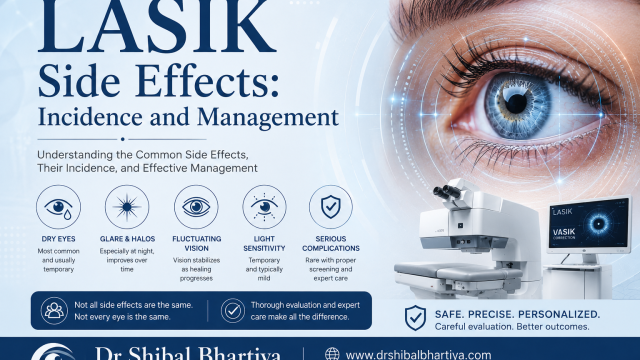
Most LASIK side effects—such as dry eyes, glare, halos, and fluctuating vision—are temporary and improve as the eyes heal. Serious complications are uncommon, especially when patients undergo thorough pre-operative evaluation and appropriate follow-up care.
Before we discuss the Lasik side effects, it’s important to know one thing: Complications and side effects are not the same. Complications, by definition, are unexpected, unintended results. In the context of eye surgery, complications can cause permanent damage to vision. Complications of Lasik are serious, and very rare. Side effects, on the other hand, is a word that encompasses all that can happen from a medical treatment that wasn’t originally intended. These may be serious and long lasting, but usually, aren’t. Most of the common side effects of Lasik are actually self-limiting, and do not require an intervention.
So when you Google side effects of Lasik, be wary of these two terms being used interchangeably, because they aren’t. Moreover, make sure you discuss any concerns that you have about Lasik side effects or complications with your eye surgeon. She is the best person to answer your questions, especially in the context of your eye health and vision needs.
That said, this article will talk of the common side effects of Lasik, so you can take an informed decision about the surgery. In fact, since forewarned is forearmed, you will also face few surprises after your surgery.
What are the common LASIK side effects?
Remember, modern LASIK is one of the safest eye surgeries today. You will, however, experience certain side effects. These side effects are a part of the normal healing process. This means that during the recovery period you may experience side effects like glare, halos, and ghost images. You will, almost invariably, experience some degree of dry eye also.
While these generally go away over time without treatment, sometimes, your doctor may advise eye drops to keep you comfortable.
How safe is Lasik?
Lasik, and especially its modern day variants of premium laser eye surgery, is extremely safe and effective for spectacle removal. As on date, over 40 million Lasik procedures have been performed worldwide, since 1991. While all of this data is not on file, here is what we know from this vast experience/
Dry Eye
As many as 30% of patients experience dry eye symptoms in the first three months after surgery. This may be due to several reasons. Firstly, laser eye surgery side results in a temporary decrease in tear production. Additionally, during healing of the corneal flap, the tear films tend to “break-up” faster resulting in discomfort.
Your doctor will, therefore, usually prescribe lubricating eye drops for this duration.
Other visual disturbances
You may experience glare, halos, or ghost images for up to the first one year after surgery. Your doctor will suggest eye drops, especially tear supplements. This is because dry eye aggravates these symptoms.
Light sensitivity
Your eyes may be sensitive to light in the immediate post-operative period. This aversion to light may last for a few days. For this reason, your doctor will advise dark glasses for a few days, especially when you step out in the sun.
Fluctuations in vision and haze
Your vision will stabilize in about a month after Lasik. During this time, you may experience changes in your vision. While this may be distressing, it is important to remember that this side effect is also self-limiting.
Residual Refractive Error
You may require glasses, contact lenses or additional LASIK treatment to attain perfect vision. While only 5 out of 100 patients require this, it’s good to be aware of this phenomenon.
Conditions that can increase risk of Lasik side effects
Your doctor will ask you questions about your general health and perform a comprehensive eye evaluation before discussing the risks and benefits of Lasik. Here is a list of conditions which may compromise your eventual Lasik experience. Please make sure to discuss them with your doctor.
- Autoimmune disorders, such as rheumatoid arthritis, SLE, Sjogren’s syndrome
- Eye inflammations like recurrent uveitis, chronic allergic conjunctivitis, herpetic eye infections
- Dry eye
- Any immunosuppression due to medications or HIV, especially if you have had an organ transplant
- If you are pregnant, or plan to be, or if you are breast feeding
This article is a part of the LASIK Hub. Please also read LASIK Recovery Timeline, Are You Fit For LASIK?, Is LASIK Safe?, Bladeless LASIK, Lasik Side Effects: Incidence and Management,
Femtosecond Lasik: Bladeless Surgery, LASIK Eye Surgery: Are You a Candidate? What to Expect, and What to Ask, and PROWL: Listening to Lasik patients. Also useful is Second Opinion Before Eye Surgery
You may want to watch these videos to understand things better here, here, and here.
FAQs
1. What are the most common side effects of LASIK?
The most common side effects include dry eyes, glare, halos around lights, starbursts, fluctuating vision, and temporary light sensitivity. Most improve during the healing process.
2. How common is dry eye after LASIK?
Dry eye symptoms are among the most frequently reported side effects after LASIK. They are usually temporary but may persist longer in patients who already have dry eye disease before surgery.
3. Do glare and halos after LASIK go away?
In most patients, glare and halos improve over several weeks to months as the eyes heal and the brain adapts to the new visual system.
4. Can LASIK cause permanent side effects?
Permanent side effects are uncommon. Careful patient selection and modern diagnostic testing help reduce the risk of long-term complications.
5. What is the incidence of serious LASIK complications?
Serious complications such as infection, significant corneal problems, or vision-threatening issues are rare, especially when surgery is performed after thorough pre-operative screening.
6. How is dry eye managed after LASIK?
Treatment may include lubricating eye drops, prescription medications, punctal plugs, eyelid hygiene measures, and management of underlying ocular surface disease.
7. Why does vision fluctuate after LASIK?
Vision can fluctuate during the healing period because of changes in the tear film and corneal healing. This usually stabilizes over time.
8. Can LASIK lead to regression of vision correction?
Some patients experience a small degree of regression, particularly with higher prescriptions. In selected cases, enhancement procedures may be considered.
9. What factors increase the risk of LASIK side effects?
Pre-existing dry eye, thin corneas, irregular corneal shape, large pupils, unstable prescriptions, and certain medical conditions can increase the risk of side effects.
10. How can LASIK side effects be minimized?
The best strategy is comprehensive pre-operative evaluation, careful patient selection, individualized treatment planning, and close follow-up after surgery.
11. When should I contact my eye doctor after LASIK?
Seek prompt medical attention if you experience severe pain, sudden vision loss, increasing redness, significant discharge, or worsening vision after surgery.
12. Are LASIK side effects usually manageable?
Yes. Most LASIK side effects are mild, temporary, and respond well to appropriate treatment and follow-up care. Early recognition and management are important for optimal outcomes.
About the Author
This article was written by Dr Shibal Bhartiya, fellowship-trained glaucoma specialist and Mayo Clinic Research Collaborator, Clinical Director at Marengo Asia Hospitals, Gurugram, known for ethical, patient-centred glaucoma care and independent glaucoma second opinions. She is also the Program Director for Community Outreach & Wellness; and for the Marengo Asia International Institute of Neuro and Spine.
She has published peer-reviewed research on glaucoma management, examining how treatment decisions should balance medical evidence, patient preferences, and long-term vision outcomes.
As Editor-in-Chief of Clinical and Experimental Vision and Eye Research and Executive Editor of the Journal of Current Glaucoma Practice (Pubmed Indexed, official journal of the International Society of Glaucoma Surgery), Dr Shibal Bhartiya brings editorial and research depth to every clinical decision. Her 200+ publications, including 90+ PubMed-indexed publications and 28 edited textbooks span glaucoma biology, surgical outcomes, health equity, and emerging diagnostics.
1500+ Five Star Patient Reviews Google Business Profile
If you are unable to come to Dr Bhartiya’s clinic: Read more about teleconsultation
Read her research on PubMed | Google Scholar | ResearchGate | ORCID
Upload your reports for a structured review.| www.drshibalbhartiya.com | +91 88826 38735
Leave a review on Google