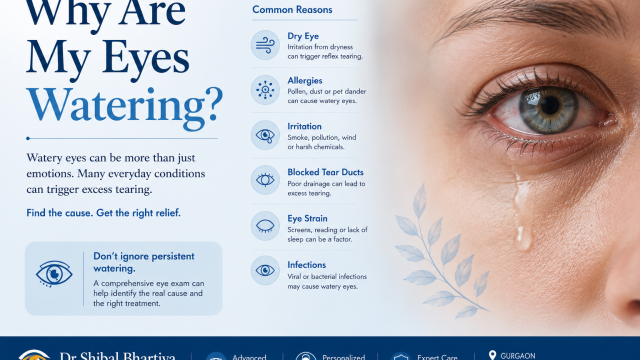
Why Are My Eyes Watering? Causes, Diagnosis, and When It Needs Treatment
The short answer: Watery eyes — the medical term is epiphora — are one of the most common eye complaints in India. The cause is almost never “too many tears.” In most cases, either the drainage system is blocked, or the eye surface is so irritated that it triggers reflex tearing as a protective response. Identifying which mechanism is at work determines the treatment entirely.
Dr Shibal Bhartiya is a fellowship-trained glaucoma specialist and Mayo Clinic Research Collaborator with over 25 years of experience. Her approach focuses on identifying risk before damage is irreversible, simplifying treatment decisions, and protecting vision long-term. Emphasis on early detection, risk assessment, and continuity of care. She is rated 5 stars across 1,500+ patient reviews on Google.
Two completely different mechanisms — same symptom
Overproduction of tears (reflex tearing): The eye produces excess tears in response to irritation — dry eye, allergy, infection, foreign body, corneal injury, or eyelid problems. The drainage system is working but overwhelmed.
Drainage failure (nasolacrimal obstruction): Tears are produced normally but cannot drain. The nasolacrimal duct — the channel running from the inner corner of the eye down to the nose — is narrowed or blocked. Tears overflow onto the cheek. This is the more common cause in adults over 50 and in newborns.
Treating overproduction with drainage surgery — or treating drainage failure with lubricant drops — produces no result. The distinction matters.
Common causes of watery eyes
1. Dry eye disease — the paradox cause The most counterintuitive cause. Inadequate basal tear production triggers a reflex from the lacrimal gland — flooding the eye with watery tears that lack the oily and mucin components of a stable tear film. These reflex tears overflow, producing watery eyes and paradoxically worsening dryness. Patients present with watery eyes and are surprised to be told they have dry eye. This is the most commonly missed cause in working-age adults.
2. Blocked nasolacrimal duct (NLD obstruction) The drainage channel becomes narrowed through age, inflammation, chronic infection, or structural changes. Tears pool at the inner corner of the eye and overflow. The eye itself is white and comfortable — the only symptom is constant or intermittent watering, often worse in cold or windy weather. Common in adults over 50. In severe cases, the blocked duct becomes infected (dacryocystitis) — producing pain, swelling, and discharge at the inner corner of the eye. Requires surgical correction (dacryocystorhinostomy, DCR).
3. Allergic conjunctivitis Seasonal or perennial allergy causes intense itching, redness, and watering. Bilateral, associated with nasal symptoms, worse in spring and during high-pollution periods in Gurgaon. The itching distinguishes allergy from most other causes — itching is the hallmark of allergic eye disease.
4. Infective conjunctivitis Bacterial or viral infection causes watering, discharge, redness, and crusting. Viral conjunctivitis (adenovirus) is highly contagious — watery discharge, follicular reaction, often starting in one eye and spreading to the other. Bacterial conjunctivitis produces mucopurulent discharge. Both are self-limiting but require hygiene measures and sometimes treatment.
5. Blepharitis and eyelid margin disease Chronic inflammation of the eyelid margins — from seborrhoeic dermatitis, staphylococcal infection, or meibomian gland dysfunction — causes persistent irritation and reflex tearing. The eyelid margins appear red, scaled, or thickened. Lashes may be crusted in the morning. Responds to lid hygiene, warm compresses, and targeted treatment.
6. Entropion and ectropion Entropion (eyelid turning inward) causes lashes to rub against the cornea — producing constant irritation, reflex tearing, and corneal damage. Ectropion (eyelid turning outward) disrupts the tear meniscus and drainage — producing overflow tearing and exposure of the eye surface. Both are structural problems requiring surgical correction.
7. Corneal conditions Any corneal pathology — abrasion, ulcer, foreign body, keratitis — produces intense reflex tearing as a protective response. The eye is acutely painful, red, and photosensitive. This is not a cause to manage with drops — it is a cause to assess urgently.
8. Trichiasis — ingrowing eyelashes Misdirected eyelashes rubbing against the cornea or conjunctiva cause persistent irritation and watering. Common, easily missed, and easily treated with epilation or electrolysis.
9. Punctal stenosis The puncta — the small drainage openings at the inner corner of each eyelid — can narrow with age, chronic inflammation, or medication side effects (particularly topical glaucoma drops containing preservatives). Reduced drainage capacity causes epiphora despite a patent NLD.
10. Congenital NLD obstruction — in infants The nasolacrimal duct frequently fails to open fully at birth. Presents as a persistently watery, sticky eye in a newborn — typically one-sided. Resolves spontaneously in 90% of cases by 12 months with massage. Probing is recommended if it persists beyond 12–18 months.
Three-column diagnostic guide
| Pattern | Most Likely Cause | Urgency |
| Watery + burning + fluctuating vision | Dry eye (reflex tearing) | Routine |
| Watery overflow, comfortable white eye, age 50+ | NLD obstruction | Routine — ENT/ophthalmology |
| Watery + itching + seasonal | Allergic conjunctivitis | Routine |
| Watery + discharge + red eye | Infective conjunctivitis | Routine — hygiene + drops |
| Watery + crusted lids + morning stickiness | Blepharitis | Routine |
| Watery + pain + photosensitivity + red eye | Corneal pathology | Urgent — same day |
| Watery + swelling + pain at inner corner | Dacryocystitis | Urgent — same day |
| Watery + lashes touching eye | Trichiasis / entropion | Soon — within days |
| Watery eye in newborn, one-sided, sticky | Congenital NLD obstruction | Paediatric ophthalmology |
What doctors often miss
Dry eye as the cause of watery eyes is the most consistently missed diagnosis. Patients are told “your eyes are producing too many tears” and given no treatment — when the actual problem is tear film instability driving reflex lacrimation. A Schirmer’s test, tear film assessment, and meibomian gland evaluation resolve the diagnosis.
Punctal stenosis from preserved glaucoma drops is missed because no one connects the watering to the medication. Patients on long-term BAK-preserved drops who develop epiphora should have punctal diameter assessed.
Dacryocystitis is occasionally managed with antibiotics alone and recurs repeatedly — because the underlying NLD obstruction is never corrected. Antibiotic treatment clears the infection; DCR surgery corrects the cause.
Frequently asked questions
Why do my eyes water constantly? Constant watering suggests either a drainage problem (NLD obstruction, punctal stenosis) or a persistent surface irritant (dry eye, blepharitis, trichiasis). Both are diagnosable and treatable. A syringing and probing test assesses drainage patency in minutes.
Why do my eyes water in cold or windy weather? Cold and wind accelerate tear evaporation, triggering reflex tearing. In patients with NLD obstruction, reduced lacrimal pump efficiency in cold temperatures also worsens overflow. Wraparound glasses outdoors significantly reduce symptoms.
Can dry eyes cause watery eyes? Yes — this is the most common misunderstood cause. Unstable basal tear film triggers reflex tearing from the lacrimal gland. The resulting reflex tears are watery and unstable, worsening the underlying dry eye cycle.
Why does only one eye water? Unilateral watering strongly suggests a structural cause on that side — NLD obstruction, punctal stenosis, entropion, trichiasis, or a corneal foreign body. Bilateral causes (allergy, dry eye, infection) tend to affect both eyes, though often asymmetrically.
Can watery eyes be treated without surgery? Depends entirely on the cause. Dry eye, allergy, and blepharitis all respond to non-surgical treatment. NLD obstruction severe enough to cause constant overflow or recurrent dacryocystitis typically requires DCR surgery. Punctal plugs and punctal dilation are minimally invasive options for milder drainage issues.
Are watery eyes in babies serious? Usually not — congenital NLD obstruction is common and resolves in most infants by 12 months with massage. However, an acutely red, swollen, painful eye in a newborn is a different matter and requires urgent assessment.
[CTA] Watery eyes have a specific, identifiable cause — and an effective treatment. Dr Shibal Bhartiya offers a full assessment of the tear film, drainage system, eyelid margins, and ocular surface at her clinic in Gurgaon.
📞 +91 88826 38735 | www.drshibalbhartiya.com Upload previous eye reports for a pre-consultation review.
About the Author
This article was written by Dr Shibal Bhartiya, fellowship-trained glaucoma specialist and Mayo Clinic Research Collaborator, Clinical Director at Marengo Asia Hospitals, Gurugram, known for ethical, patient-centred glaucoma care and independent glaucoma second opinions. She is also the Program Director for Community Outreach & Wellness; and for the Marengo Asia International Institute of Neuro and Spine. This article was updated in May 2026.
She has published peer-reviewed research on glaucoma management, examining how treatment decisions should balance medical evidence, patient preferences, and long-term vision outcomes.
As Editor-in-Chief of Clinical and Experimental Vision and Eye Research and Executive Editor of the Journal of Current Glaucoma Practice (Pubmed Indexed, official journal of the International Society of Glaucoma Surgery), Dr Shibal Bhartiya brings editorial and research depth to every clinical decision. Her 200+ publications, including 90+ PubMed-indexed publications and 28 edited textbooks span glaucoma biology, surgical outcomes, health equity, and emerging diagnostics.
1500+ Five Star Patient Reviews Google Business Profile
If you are unable to come to Dr Bhartiya’s clinic: Read more about teleconsultation for glaucoma
Read her research on PubMed | Google Scholar | ResearchGate | ORCID
Upload your reports for a structured review.| www.drshibalbhartiya.com | +91 88826 38735
Leave a review on Google